

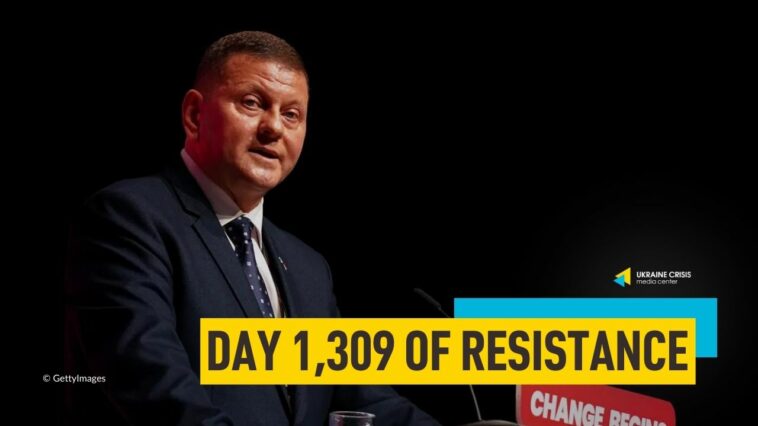
Russia is breaking the stalemate in Ukraine, Zaluzhnyi warns. Ukraine strikes Russia’s oil pumping stations and a drone plant. Russia carries out a combined drone and missile strike on a training ground, causing casualties.
Russia breaking stalemate in Ukraine, Zaluzhnyi says
Russia is breaking the stalemate in the war against Ukraine, Ukraine’s former army chief and current ambassador to the UK, Valeriy Zaluzhnyi said in an article titled “Innovation as core of strategic resilience: denying Russia the power to dictate terms through war” published by the Ukrainian news outlet Dzerkalo Tyzhnya (Mirror of the Week) on Wednesday.
Ukraine needs to seize and keep the technological initiative, he argues.
In an essay entitled “Modern Positional Warfare and How to Win It” published by The Economist in November 2023, Zaluzhnyi assessed that the war in Ukraine has taken on a positional nature and offered a series of recommendations for the country to restore maneuver to the battlespace. President Zelenskyi removed him from his post as Ukraine’s top military commander in February 2024.
In his current article Zaluzhnyi quotes the essay that appeared in The Economist, reassessing some of the statements. The paragraphs below are quoted from the article.
By spring 2024 the Russians, a year behind us, noted the rapid spread of small FPV quadcopters, flown in first-person view. (…) Russia saw in them one way out of the stalemate: the covert massing and subsequent use of FPV drones and loitering munitions to smash defensive lines, fortifications, armour and troops in depth.
Soldiers found themselves trapped under the “lower sky” of constant drone surveillance and attacks. The battlefield became completely transparent, manoeuvre all but impossible. Here the link with mobilization is obvious: manpower is still needed to hold the line.
The battlefield’s transparency—created by thousands of drones and sensors—has produced a kill-zone more than 20 kilometres deep, with a high probability of engagement: every heat signature, radio pulse or unnecessary movement can trigger an almost instant, lethal response. In practice, death, wounding or psychological collapse are the predictable consequences of prolonged exposure to today’s frontline. This is the reality known both to those who stubbornly evade mobilisation and to those who, having once hunted Shahed drones, now await their fate after going AWOL or in a reserve battalion.
Naturally, not only are lines of communication wrecked; the very idea of a secure rear is fading, since its customary location behind the forward echelons—anywhere within 40 kilometres—is no longer tenable under persistent enemy fire control.
As a result, defence is shifting away from active defense of positions in concert with second echelons, reserves and supporting firepower, toward the bare survival of small units constantly pressed by both remote reconnaissance-strike systems and the enemy’s tactic of swarming attacks by small infantry groups.
So Russians came up with another way to break the deadlock through so-called infiltration—the penetration of individual soldiers and small infantry groups through gaps in our defenses. We saw this vividly in Dobropillia, Pokrovsk and now in Kupiansk.
Sooner or later, with logistics increasingly cut off by drones, this pressure forces our units to give up their positions. This inevitably alters the configuration of the front line and creates a threat to neighbouring sectors. In this way, through the tactic of “burying” our defences under a constant stream of assaults by small groups, the front creeps, relentlessly, towards us.
By the way, lost ground is often recovered in exactly the same way, by assault units, and in exactly the same manner, resulting in the natural erosion of those formations, with the expected outcome already described and with no prospect of a deep breakthrough.
Worse still, the situation looks set to deteriorate. Advances in artificial intelligence will give rise first to semi-autonomous and then to fully autonomous strike systems, creating a qualitatively new level of threat to humans on the battlefield.
As of today, strike UAVs account for almost 80 percent of personnel and equipment losses.
So, while Russia leans on technology and keeps throwing ever more people at our positions—imposing that attritional tactic on us—we need a different path: a reliable means of deterring the lethal power of these new weapons.
A conceivable response would be to remove personnel from the forward edge and substitute them with robotic systems. That would, of course, reduce casualties from strike drones and reconnaissance-strike complexes. But technology is not yet at that point: current unmanned and autonomous systems remain short of abilities required to replace humans at scale.
The only viable escape today is to invent, as fast as possible, systems and measures that will improve troop survivability. That imperative is inseparable from questions of mobilization and training. It is a challenging task, requiring not only the development and scaling of appropriate technological solutions but also a fundamental reconsideration of methods of employment and, consequently, of the armed forces’ structure with respect to anti-drone defence. Historically, force protection focused on threats from artillery, air power small arms and even weapons of mass destruction—risks of physical destruction or injury that were constant. Today, however, we must build a system to counter a new threat in a new kind of warfare: drones.
Obviously, the “digital operation” I wrote about in 2023 remains a useful frame: the modern battlefield should be seen as a single, integrated network of cyber-physical systems. In practice this means unmanned and robotic platforms are linked by sensors and supporting command-and-control and communications infrastructure to software.
It is obvious that Ukraine’s victory today means denying Russia the ability to dictate its terms through war. That is the bare minimum for survival.
Only by embracing military innovation can Ukraine offset its chronic resource shortfall and inflict disproportionate losses on Russia. Moscow knows this too, and is already taking countermeasures that we feel on the battlefield. Ukraine’s advantage lies in its people, who not only stopped the invader but have already made the country a hub of battlefield innovation.
Ukraine strikes Russia’s oil pumping stations, drone plant
Ukrainian troops hit the Kuzmichi-1 oil pumping station in Russia’s Volgograd region, the General Staff of the Armed Forces of Ukraine said on Wednesday. The facility is part of the crude oil route to southern Russia, it added. Ukraine also struck the Zenzevatka oil pumping station that moves oil through the Kuybyshev-Tikhoretsk major pipeline.
Ukraine hit a drone plant in the village of Valuyki in Russia’s Belgorod region overnight into Wednesday, the General Staff added. The attack triggered a fire. The results are being determined, it said.
Ukraine also struck a primary processing unit at the Gazprom Neftekhim Salavat oil processing plant in the Russian republic of Bashkortostan overnight into Wednesday, sparking a fire.
Ukraine’s General Staff also confirmed a successful strike on Russia’s Astrakhan gas processing plant on Monday that halted part of its production. The facility is Russia’s main manufacturer of sulfur as an explosives component, accounting for 66 per cent of the country’s output. The plant has a processing capacity of 3.2 million tons per year.
Russia carries out drone, missile strike on training ground, causing casualties
Russian forces carried out a combined drone and missile attack on a training ground on Wednesday, causing casualties, Ukraine’s Ground Forces said in a statement. They used two Iskander ballistic missiles in the strike.
“Unfortunately, resulting from a precision strike on a bomb shelter and despite the safety measures taken, [the military] did not completely avoid losses. Emergency responders have been deployed to the site. The wounded are getting all necessary treatment,” the Ground Forces said.
Works are constantly underway to equip training centers and others military sites with shelters. Commanders exercise safety measures to protect the personnel during Russian airstrikes, the statement reads.
It did not say where the incident happened. At the same time, on Wednesday afternoon, Ukraine’s Air Force warned of drones and fast aerial targets moving toward Honcharivske, in Chernihiv region.