

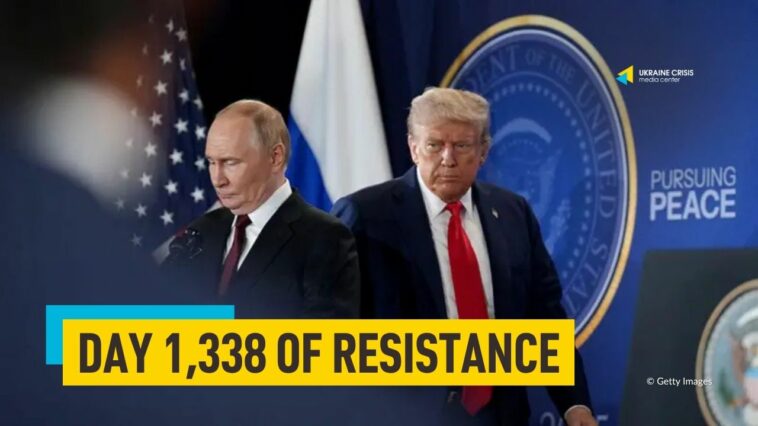
The U.S. imposes sanctions on Russia for the first time during Trump’s second term as president. A Russian drone strike on Kramatorsk kills two journalists. Power has been restored to the Zaporizhzhia nuclear power plant after the 10th, longest blackout.
U.S. imposes sanctions on Russia for first time during Trump’s second term
U.S. President Donald Trump on Wednesday imposed fresh sanctions on Russia for the first time in his second term, targeting oil companies Rosneft and Lukoil. “Today, the U.S. Department of the Treasury’s Office of Foreign Assets Control (OFAC) is imposing further sanctions as a result of Russia’s lack of serious commitment to a peace process to end the war in Ukraine,” it said in a statement.
“Now is the time to stop the killing and for an immediate ceasefire,” U.S. Secretary of the Treasury Scott Bessent said, as cited in a statement announcing the sanctions.
Trump said Wednesday he hopes the sanctions will help make Russian leader Vladimir Putin “reasonable” about ending the war.
U.S. sanctions against Russian oil are affecting China’s oil industry, Bloomberg News said on Thursday. The paragraphs below are quoted from the article.
US sanctions on Russia’s energy giants are sending shockwaves deep into the heart of China’s oil industry, where both state and private refiners face heightened pressure to keep up supplies while steering clear of penalties.
As much as 20% of China’s crude imports — about 2 million barrels a day in the first nine months of this year — come from Russia, making it one of the country’s leading sources of oil for processing into products such as diesel, gasoline and plastics.
The Trump administration’s blacklisting of Rosneft PJSC and Lukoil PJSC is the latest in a series of measures rolled out by the US, the European Union and the UK targeting buyers of Russian crude, and the contribution they make to Moscow’s coffers and its war efforts in Ukraine. Transactions involving the two firms need to be wound down by Nov. 21, according to the US government.
The risk for China as well as India, Russia’s biggest customers, lies in their dealings with sanctioned entities, which can leave companies exposed to crippling secondary penalties. These include being cut off from western banking systems and access to dollars, or frozen out by the western producers, traders, shippers and insurers that form the backbone of global commodities markets.
Of particular concern is the role western firms play as investors and operators across major oil-producing regions such as the Middle East and Africa, traders say. Chinese and Indian companies that opt to continue working with sanctioned firms risk being sidelined or cut off from large numbers of projects.
If they choose to comply with the sanctions, they’ll lose access to deeply discounted supplies of oil that have helped keep energy costs low for industry and consumers.
On Thursday, China pushed back against the US move, as oil futures spiked. “China consistently opposes unilateral sanctions that lack a basis in international law and have not been authorized by the United Nations Security Council,” Foreign Ministry spokesperson Guo Jiakun said in response to queries about US moves at the ministry’s daily press briefing.
Last week, moves by the UK to blacklist Rosneft and Lukoil, as well as China’s Shandong Yulong Petrochemical Co. for its Russian imports, had already put traders on edge. Western companies have since become wary of supplying the privately-owned refiner. Other recent US sanctions have targeted major Chinese ports including Rizhao and Dongjiakou, key conduits for both Russian and Iranian oil.
Central to the mammoth trade between Russia and China is the long-term contract between Rosneft and state-owned China National Petroleum Corp., which involves purchases of ESPO crude via pipelines to landlocked refineries in the northern Daqing region. The plants there rely predominantly on Russian feedstock, according to traders, making them particularly vulnerable to any disruptions.
It’s unclear, however, if these pipeline flows — about 800,000 barrels a day — will be affected by the sanctions due to the government-to-government nature of the project.
Together, the two firms [Rosneft and Lukoil — edit.] supplied about one quarter of Russia’s oil exports to China last year, according to data analytics firm Kpler.
Russian drone strike on Kramatorsk kills two journalists
A Russian attack on the city of Kramatorsk, in Donetsk region, on Thursday killed journalist Olena Hubanova and cameraman Yevhen Karmazin from Ukraine’s Freedom television channel.
“From the first days of Russia’s full-scale invasion, they covered the situation in the region, truthfully reported about the enemy’s crimes, civilian evacuations and conveyed the stories of our defenders. They worked in the hottest spots of Donetsk region and were always the first everywhere,” head of the Donetsk regional military administration, Vadym Filashkin said in a post to social media.
He did not give further details of what happened. He posted a photo of a destroyed car and an image of two flak jackets marked “press” in the trunk.
The Freedom television channel confirmed the deaths of its journalists. War correspondent Olena Hramova (Hubanova) was 43 years old and cameraman Yevhen Karmazin was 33. Both were natives of Donetsk region.
Freedom’s special correspondent Oleksandr Kolychev, aged 47, was also injured in the attack and taken to hospital.
The journalists were in a car at a petrol station at the time of the strike.
Regional police said the journalists were recording the aftermath of the latest attack on the city when the strike happened.
“Journalists are civilians and are protected under international humanitarian law,” Ukrainian Parliament Commissioner for Human Rights, Dmytro Lubinets said, reacting to the journalists’ deaths. “They were exercising their professional responsibility to document the consequences of the Russian aggression in Ukraine. They were bringing the truth to the world regardless of constant dangers. I extend my sincere condolences to the families, friends, and colleagues of the victims. This tragedy is yet another example of Russia’s systematic war crimes against civilians. Those responsible must be inevitably held liable in line with international law,” he added.
Power restored to Zaporizhzhia nuclear power plant after 10th, longest blackout
Energy workers have restored power to the Russian-held Zaporizhzhia nuclear power plant that was without external power supply for one month, Ukraine’s Energy Minister Svitlana Hrynchuk said Thursday. The station was hit by the tenth and longest blackout following Russian attacks.
“After the completion of the repair of the 750 kV ‘Dniprovska’ line, the repair of the 330 kV ‘Ferrosplavna’ line is underway,” Hrynchuk said.
Throughout the month, the safety of Europe’s largest nuclear power plant depended solely on emergency diesel generators, “posing an unprecedented threat to nuclear and radiation safety not only of Ukraine, but of the entire European continent,” she added.
The power outage resulted from Russia’s constant attacks that damaged transmission lines connecting the plant to Ukraine’s energy grid.
Hrynchuk said that the only way to ensure long-term nuclear safety is full de-occupation and demilitarization of the Zaporizhzhia nuclear power plant, and its return under full legal control of Ukraine’s Energoatom operator.
Since the beginning of the full-scale invasion, Ukrainian energy workers have restored the plant’s power supply lines 42 times.