

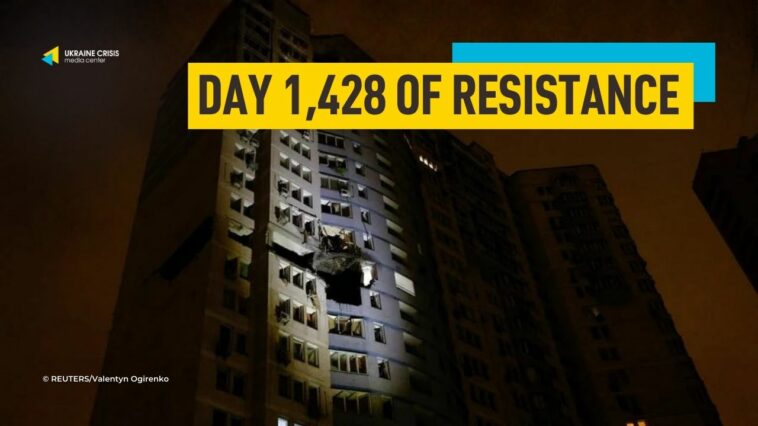
About 4,000 buildings in Kyiv remained without heating Wednesday, and nearly 60 per cent of the Ukrainian capital was without power. Ukraine seeks to create AI-powered air defense to protect its cities from Russian attacks, according to a WSJ column. Witkoff says he will meet with Putin in Moscow on Thursday.
About 4,000 buildings in Kyiv remain without heat, 60 per cent of the city is without power
About 4,000 buildings in Kyiv remained without heating Wednesday, and nearly 60 per cent of the Ukrainian capital was without power, Ukraine’s President Volodymyr Zelenskyi said on social media.
According to the president, the city authorities said they deployed enough resources [to restore heating, power and water supply], but more time was needed. “I do not agree with this assessment — additional measures and additional resources are needed,” Zelenskyi said on X.
He also said he had a meeting with regional authorities and executive officials to discuss the energy situation. The most difficult situation was in Kyiv and the surrounding region as well as in the regions of Kharkiv, Sumy, Chernihiv and Dnipro, he added.
Repair brigades, energy and utility workers, and emergency service staff are working at their full capacity, Zelenskyi said.
The Ministry of Internal Affairs reported on setting up warming centers and provision of hot meals for people in the cold. Mobile communications and base stations have stable operations. Zelenskyi also said he had discussed with the government and Ukrenergo national energy operator ways to speed up the repairs of the networks and substations.
This month 600,000 people have already fled the capital, home to more than 3 million, Kyiv mayor Vitaliy Klychko told The Times, according to an article published on Tuesday.
Klychko’s press service told Ukrainska Pravda that the 600,000 number was calculated from mobile phone billing data.
“That’s where the number voiced by the mayor comes from. The same method was used to calculate the city’s population at the start of the full-scale invasion — it was 800,000. Some people followed the advice [to leave] and those who could went to the countryside or went to stay with their friends,” the press service said.
Between December 20, 2025 and January 18, 2026, some 1,103 people sought emergency medical attention for frostbite and hypothermia, of whom 1,016 were hospitalized, Ukraine’s Health Ministry said Wednesday. January 18 marked the highest daily number of people — 85, admitted to hospital with hypothermia, it added.
Ukraine seeks to create AI-powered air defense to protect its cities from Russian attacks, according to WSJ column
Ukraine will soon deploy a new generation of domestically produced air-defense interceptors, powered by artificial intelligence, that could counter Moscow’s greatest advantage, David Ignatius said in a column for The Wall Street Journal published on Tuesday. The paragraphs below are quoted from the article.
Because the heat is out in some homes in the wake of savage Russian bombing of power facilities this month, they [pedestrians walking in bitter cold] may have to visit one of the hundreds of warming centers in the city to get through the night.
This grim winter scene is a snapshot of Russian President Vladimir Putin’s brutal strategy for victory. By pounding Ukraine’s sources of power and heat, he hopes to freeze the country into submission. President Donald Trump sometimes talks as if he agrees with Putin that Russian victory in this bloodbath is inevitable — and that Kyiv must give up territory in a peace deal.
But conversations here Sunday with Ukraine’s new Defense Minister Mykhailo Fedorov and other senior officials convinced me that this bleak picture is misleading. Ukraine will soon deploy a new generation of domestically produced air-defense interceptors, powered by artificial intelligence, that could allow the country to fight on indefinitely.
“We have a clear plan about how to stop Russia in our skies,” Fedorov said in a meeting Sunday in the defense ministry’s headquarters on a quiet Kyiv side street. A few minutes later, he signed an agreement with the U.S. defense software company Palantir to build an advanced AI “Dataroom.” It will use the millions of bits of sensor data and imagery that Ukraine has gathered over four years of war to train AI systems that can predict Russian attacks — and then guide cheap, autonomous interceptors to defeat them.
“It’s not about us winning, but about us becoming unconquerable,” said Andrii Hrytseniuk, chief executive of Brave1, a technology incubator that has coordinated Ukraine’s astonishing battlefield innovation with drones and AI. “The war stops when the enemy realizes that its political goals cannot be achieved,” he argued.
If the new Dataroom effort works as planned, six months from now, Ukraine will have the framework for a nationwide system of autonomous air-defense missiles that could finally make Ukraine’s cities safe from Russian attack.
The Dataroom project illustrates a crucial variable in this war. In its desperate attempt to fend off Russia, Ukraine has developed what may be the world’s most innovative defense-technology sector. Fedorov embodies this drive. He’s just 34, dressed like a tech bro in a simple sweatshirt. But back in 2022, he convinced President Volodymyr Zelensky to seek help from Palantir and Starlink, and launched a project known as the Army of Drones.
Another champion of using technology aggressively has been 40-year-old Lt. Gen. Kyrylo Budanov, the former chief of military intelligence, who Zelensky just elevated to head his presidential administration. This tech savvy is a big reason Ukraine has survived the onslaught from the much larger and more powerful Russia.
Brave1 coordinated this technology push. When the war began, Ukraine had just seven companies making small drones; a year later, it had 70, and today there are 500 — producing millions of aerial drones annually, according to Hrytseniuk. Another 280 companies are developing autonomous ground vehicles — unmanned tanks, in effect. In 2022, nearly all of Ukraine’s attack strikes were from artillery; today, nearly 90 percent are by drones.
The war has produced an extraordinary arms-industry boom: Brave1 told me Ukraine’s defense manufacturing capacity has surged 35-fold — growing from $1 billion in 2022 to an estimated $35 billion in 2025.
Though Ukraine has fought Russia to a stalemate on the ground, its biggest weakness has been air defense. Relentless Russian attacks have destroyed power and heating plants and other critical infrastructure. Ukraine wages a brave nightly battle against as many as 1,000 missiles and drones, but the attacks have made life miserable for civilians. The Dataroom interceptor project is an attempt to create an air-defense shield to end this nightly onslaught.
“We will be trading pawns for rooks,” says Hrytseniuk. The “Octopus,” for example, costs just a few thousand dollars, but Ukrainian officials say it can reliably hit Shahed attack drones costing much more. The Octopus has a radius of nearly 200 kilometers and can carry electro-optical, infrared or thermal targeting sensors — which will be trained on AI to recognize attackers.
Putin doesn’t want to make concessions because he still thinks he can win. But Ukraine’s new network of AI-driven air defenses will make that less likely. If Ukraine can protect the civilians on Kyiv’s frozen streets — and reassure them that they won’t face another winter in the deep freeze, even if the war continues — perhaps Putin will reconsider his bet.
Witkoff says he will meet with Putin in Moscow Thursday
US envoy Steve Witkoff said he and Jared Kushner will travel to Russia on Thursday for talks with President Vladimir Putin on the latest proposals for a peace plan to end the war in Ukraine.
“The Russians have invited us to come and that’s a significant statement from them,” Witkoff said in an interview with Bloomberg Television’s Annmarie Hordern at the World Economic Forum in Davos on Wednesday. The paragraphs below are quoted from the article.
US President Donald Trump remains “focused on that peace deal, it’s a very, very important part of his agenda,” Witkoff said.
Witkoff said he’ll meet with Ukrainian officials including lead negotiator Rustem Umerov before traveling to Moscow and will then go to the United Arab Emirates for “working groups.”
“The Ukrainians have said that we’re 90% done and I agree with them. In fact, I think that we’ve made even more significant improvement,” Witkoff said. “I think everybody is embedded in the process and wants to see a peace deal happen.”
In other news, Kirill Dmitriev, the CEO of the Russian Direct Investment Fund met with Witkoff and Kushner on the sidelines of the World Economic Forum on Tuesday. Envoys for Putin and Trump said the talks were “very positive” and “constructive.”
The Kremlin said Wednesday it will not publicly comment on talks in Davos between the envoys.