

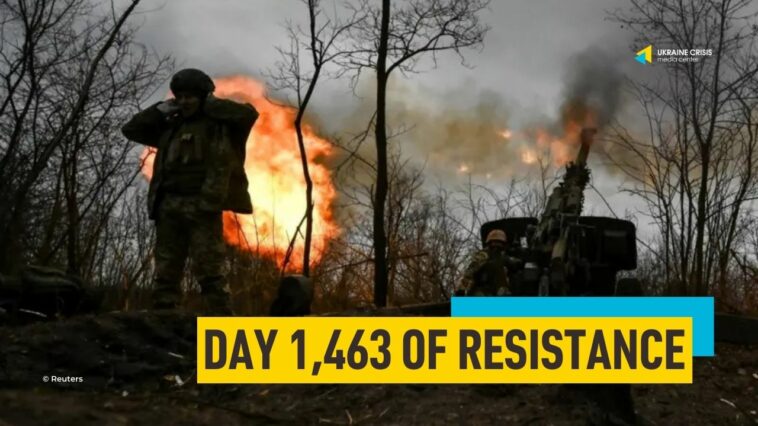
Countries of the Coalition of the Willing say they will only send troops to Ukraine if there’s Russian consent, The Telegraph says. Sixty-eight per cent of Russian war prisoners say Russia’s war in Ukraine is justified, a poll finds.
Ukraine’s defense intelligence conducts offensive operation on southern frontlines
The Artan unit of Ukraine’s defense intelligence is conducting a comprehensive offensive operation near Stepnohirsk to remove a threat of a Russian breakthrough into the outskirts of Zaporizhzhia, the Main Intelligence Department of Ukraine’s Defense Ministry said in a post to social media on Wednesday.
The Artan unit together with other intelligence units and branches of the military have regained control of “important positions” and improved their tactical positions in the area. The operation was set against a backdrop of difficult logistics and Russia’s so-called meat assaults, the message reads.
Ukrainian forces took out Russian forward assault groups, struck troop concentrations and weapons sites and took out dozens of Russian soldiers as part of the operation, the defense intelligence said.
Ukrainian troops also cut off the Russian supply lines that now fall within their range. The strikes on Russia’s supply and communication nodes make their assault operations in the area impossible.
The operation helped “create a solid foothold to further mop up the town [of Stepnohirsk] and push the enemy out of the area,” Commander of the Artan unit of Ukraine’s defense intelligence, Colonel Viktor Torkotyuk who goes by the call sign Titan was quoted as saying. The operation in the Zaporizhzhia direction goes on, he added.
Ukraine’s Southern Defense Forces said in late December 2025 that Hulyaipole and Stepnohirsk in Zaporizhzhia region were partially controlled by Russian troops. The situation was difficult, with battles for the cities still raging.
Spokesperson for Ukraine’s Southern Defense Forces, Colonel Vladyslav Voloshyn, said on February 21 that Ukrainian troops were conducting counterattacks and assaults and holding back Russian advances in the Hulyaipole direction.
Ukraine has regained control of more than 300 sq km of land, particularly along the Dnipro-Zaporizhzhia region administrative border, since late January 2026 when the operation started, he told Interfax Ukraine.
Ukraine has liberated 300 sq km in counterattacks along the southern front line, President Volodymyr Zelenskyi told AFP in an interview released on February 20.
Countries of Coalition of the Willing say they will only send troops if there’s Russian consent, The Telegraph says
Plans to deploy peacekeeping troops on the ground in Ukraine will require Vladimir Putin’s approval, allies have conceded. A growing number of members of the so-called coalition of the willing had privately admitted that their contributions to the mission depended on permission from the Russian president, multiple sources told The Telegraph. The paragraphs below are quoted from the article.
The diplomatic and defence insiders warned that this meant the Anglo-French plan to uphold any ceasefire could be thrown into disarray at the Kremlin’s whim.
But one senior diplomatic source said they had heard from representatives from countries that they would “only send our troops if there’s Russian consent”.
The fear is that without Putin’s backing, any European force could be considered a legitimate military target.
“If Russia says we don’t agree to it and consider those troops a target, then you need to send a different kind of force,” the source said. “So, whether Russia does or does not agree to this has a tremendous effect on it.”
A second diplomatic source suggested European governments had essentially handed Putin a veto over the coalition’s plans by demanding a spot at the negotiating table.
Volodymyr Zelensky, Ukraine’s president, welcomed a dozen European leaders to Kyiv on Tuesday to mark four years since the war broke out. He also joined a virtual meeting of the coalition of the willing, chaired by Sir Keir Starmer and Emmanuel Macron, to discuss the ongoing peace negotiations.
Officials from 35 countries, including the U.S. gathered in Paris for a meeting of the Coalition of the Willing on January 6, 2026. The UK and France have agreed to deploy forces in Ukraine if it strikes a peace deal with Russia. French President Emmanuel Macron then said that Paris could deploy “several thousand” French troops to Ukraine after the war. British Defence Secretary John Healey said he is not going into details about nature of the activities in the deployment nor the number of troops that will be deployed nor the commitment of other nations.
Speaking to journalists on the sidelines of the Munich Security Conference on February 14, Zelenskyi said Russia is against the deployment of foreign peacekeepers to Ukraine. “Of course we support the idea, and of course Russia will be against it. The U.S. says Russia is against it, but it will not attack you. My question is, if [Russia] does not want to continue the war or invade a foreign territory, why would [the allies] be afraid of the Russians?” Zelenskyi said, as cited by Ukrainian media.
Sixty-eight per cent of Russian war prisoners say Russia’s war in Ukraine is justified, poll finds
Nearly seven in ten Russian war prisoners (68 per cent) say Russia’s war against Ukraine is justified and necessary, a poll conducted by Ukrainian NGO LingvaLexa found, as cited by Ukrainian media. More than 40 per cent say they do not consider Ukrainians to be fully-fledged people.
“The average perception that Russia’s ‘special military operation’ (or ‘SVO’ — a Kremlin term for its 2022 invasion of Ukraine) is legitimate is 35.81 per cent, a moderate figure. A total of 68.29 per cent said the ‘SVO’ is legitimate, necessary and justified to some extent,” the pollster said.
Among the Russian war prisoners who share Russian propaganda narratives, around 88 per cent say the war is justified and necessary to some extent. Their answers rank higher than 0 points. Among those who do not fall for propaganda, 51 per cent say Russia’s war is justified.
“What’s striking is that around 13 per cent of those who accept the propaganda say that the ‘SVO’ was absolutely justified and necessary and assigned the highest number of points to the statement. Only two per cent are skeptical of it,” the pollster explained. Among those who consider the war to be fully legitimate, the group of soldiers who accept the propaganda is six times larger than those who don’t, it added.
An average 47.61 per cent fall for the Kremlin’s propaganda. Some 76.95 per cent believe at least one of its narratives.
Four in ten Russian war prisoners (42.94 per cent) say an average Ukrainian is not a fully-fledged person. They say Ukrainians are only 88 per cent developed compared to other people.
The more Russian war prisoners align with propaganda, the more they deny that Ukrainians are fully-fledged people, the pollster said.
Some 32.17 per cent say they would re-enlist in the Russian army after they’re free. Some 28.92 per cent claim ready to re-enter the fighting in non-combat roles and 22.29 per cent say they are somewhat ready to fight once again.
The share of those who claimed ready to come back to the battlefield was two times larger among those who strongly align with propaganda (33 per cent) compared to those whose beliefs are reportedly weak (17 per cent).
Similarly, the share of those who surrendered voluntarily among those who strongly align with propaganda stands at 9 per cent compared to 15 per cent among the non-believers.
The survey was conducted with the support of the Office of the Prosecutor General of Ukraine and in partnership with the European Association of Military Social Psychology, Kyiv School of Economics and Mitrax law firm.
Handout questionnaires were distributed to 1,060 Russian war prisoners. Their average age is 39, the pollster said.
LingvaLexa’s web site says that the organization was founded in 2023 to address “propaganda-related offences that escalate into serious international offences during armed conflicts.”