

Ukraine’s air defense efficiency increased to 89.9 per cent in March, the country’s defense ministry says. Russia’s demands that Ukraine withdraw from Donbas within two months are part of its cognitive warfare effort as Russian advances slow, ISW says. Ukrainian troops thwart this year’s largest Russian motorcycle assault in the Slovyansk direction.
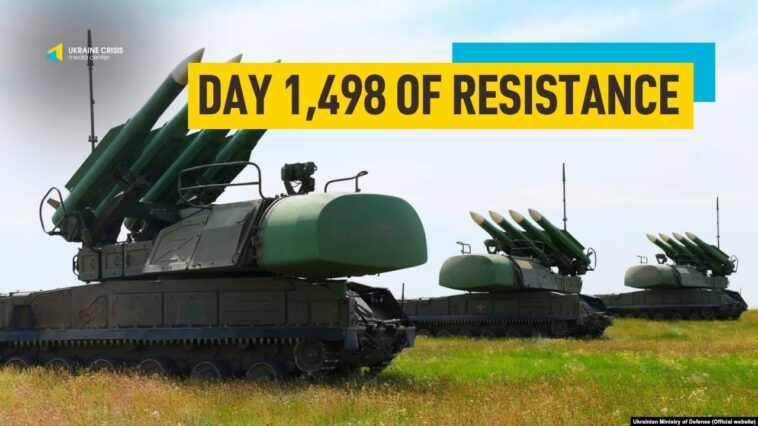
Ukraine’s air defense efficiency increased to 89.9 per cent in March, defense ministry says
In March 2026, Ukraine’s air defenses performed more effectively than in the previous month, the country’s Defense Ministry said on Wednesday.
The air defenses were 89.9 per cent effective in March in destroying or suppressing Russian missiles and drones. A total of 5,935 Russian projectiles did not reach their target last month, the ministry said.
The air-defense interception rate climbed to 89.9 per cent in March from 85.6 per cent in February, 82.5 per cent in January and 80.2 per cent in December.
“The numbers result from the implementation of new means to protect the skies and development of the ones that proved their efficiency,” the ministry said, adding that “We’re nearing the goal cemented by Ukraine’s war plan to intercept at least 95 per cent of missiles and drones.” Ukrainian Defense Minister Mykhailo Fedorov presented the country’s war plan in late February. The document has three goals: to strengthen air defenses, stop Russia’s advances and deprive it from revenue to continue fighting.
Ukraine has also allowed critical infrastructure companies to develop their own air-defense capabilities to protect their facilities, while being part of the broader command-and-control system. One company already shot down several Shahed and Zala drones in Kharkiv region, with another 13 firms authorized to set up air-defense groups, the Ministry of Defense said on Monday.
Russia’s demands that Ukraine withdraw from Donbas within two months are part of its cognitive warfare effort as Russian advances slow, ISW says
Russian advances have slowed as Ukrainian forces continue to contest the initiative in different frontline sectors for a protracted period, the Institute for the Study of War (ISW) said in an update on March 31. The paragraphs below are quoted from the report.
Russia’s position on the battlefield has changed over the past six months (October 2025 through March 2026) as Ukrainian counterattacks and mid-range strikes, the block on Russia’s use of Starlink terminals in Ukraine, and Kremlin efforts to throttle Telegram have exacerbated existing issues within the Russian military.
ISW has observed evidence to assess that Russian forces seized 1,929.69 square kilometers between October 1, 2025, and March 31, 2026, advancing at an average of 10.66 square kilometers per day. Russian forces comparatively seized 2,716.57 square kilometers of territory between October 1, 2024, and March 31, 2025, advancing at an average rate of 14.9 square kilometers per day.
Russian forces advanced at an average of 5.5 square kilometers per day in the first three months of 2026, compared to an average rate of 11.06 square kilometers per day in the first three months of 2025.
Ukrainian counterattacks and mid-range strikes are likely impeding Russian efforts to advance.
Ukrainian forces in Winter and Spring 2026 have made their most significant gains on the battlefield since Ukraine’s incursion into Kursk Oblast in August 2024 and have liberated the most territory in Ukraine itself since the 2023 counteroffensive.
The Kremlin is trying to create a false sense of urgency by reportedly trying to force Ukraine to cede the unoccupied part of Donetsk Oblast, which Russian forces have proven unable to take on the battlefield.
Ukrainian President Volodymyr Zelensky stated on March 31 that Russia is demanding that Ukrainian forces withdraw from the remainder of Donetsk Oblast within two months (likely referring to late May 2026), including from Ukraine’s heavily fortified Fortress Belt.
Zelensky implied that the Kremlin is trying to create a perception that Russia will imminently take Donbas and will impose new, harsher demands if Ukraine does not withdraw from Donetsk Oblast.
Kremlin Spokesperson Dmitry Peskov similarly claimed on March 31 that Ukraine needs “any kind” of truce as the dynamics on the front are not in Ukraine’s favor and Russian forces are advancing along the entire frontline.
These Russian claims are false, as Russian forces tried and failed to seize the Fortress Belt in 2014 and 2022, and Russian advances have slowed since the start of 2026. Russian forces have also shown no ability to rapidly envelop, penetrate, or otherwise seize cities the size of those in the Fortress Belt.
The Kremlin’s optimistic portrayal of Russian battlefield prospects is in stark contrast with recent criticism from prominent Russian milbloggers and other ultranationalist information space voices, which have complained about Russia’s unfavorable battlefield situation.
The Kremlin’s demands are thus part of its cognitive warfare effort to aggrandize Russian advances and falsely portray Ukrainian defenses as on the verge of collapse to drive the United States into forcing Ukraine to unnecessarily cede territory that Russian forces are far from seizing militarily, if at all.
Ukrainian troops thwart this year’s largest Russian motorcycle assault in Slovyansk direction
Ukraine’s 81st Slobozhanska Airmobile Brigade of the Air Assault Forces and neighboring branches of the military stopped the largest Russian motorcycle assault in the Slovyansk direction this year, the brigade said on social media on Wednesday.
Russian forces fielded 16 motorcycles and attacked in groups ranging from three to four motorcycles, hoping to break through the Ukrainian positions.
“Ukrainian troops stopped the Russian assault operation thanks to the timely detection of [enemy forces] and well-coordinated actions and took out dismounted Russian infantry,” the message reads.
The situation in the Slovyansk direction remains difficult as Russia is constantly deploying troops and materiel there, attempting to take up more advantageous positions in the area to advance further, the brigade said.
“In order to interfere with the work of Ukrainian troops, the enemy is trying to control the main logistical lines by using remote mining systems and drones. Despite the pressure, service members of the 81st Brigade of the 7th Corps of the Air Assault Forces continue to detect and destroy the occupying force,” the message said.
The brigade also released a video of the 81st Airmobile Brigade and the 54th Mechanized Brigade repelling the motorcycle assault.