

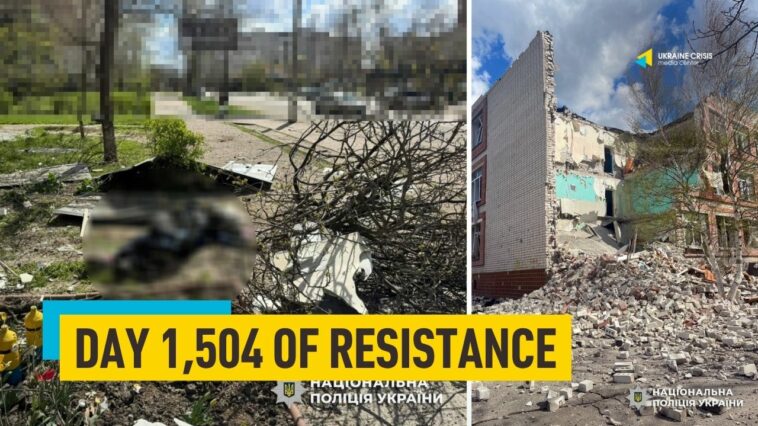
Russia steps up aerial attacks against civilians, strikes the regions of Dnipro, Chernihiv and Kherson. Ukraine’s long-range strikes against Russian oil infrastructure expose inefficiency of Russia’s air defenses, ISW says. Ukraine launched more cross-border attack drones than Russia in one month for the first time since the invasion.
Russia steps up aerial attacks against civilians, strikes regions of Dnipro, Chernihiv, Kherson
Russian drone attacks killed an 11-year-old boy and injured five adults across the region of Dnipro on Monday, head of the regional military administration, Oleksandr Hanzha said in a post to Telegram on Tuesday morning.
“The enemy launched more than 10 drone strikes on the region’s four districts. A private home was on fire in the Pokrovsk community of the Synelnykove district. Another three private homes and some cars were damaged. An 11-year-old boy was killed. Women ages 31 and 61, and a 33-year-old man were taken to hospital in moderate condition,” Hanzha said.
Two men, ages 52 and 66, were injured in a Russian drone attack on the city of Pavlohrad and the district’s Bohdanivka community. They are in hospital in moderate condition. The drone attack started a fire, an administrative building and a power line sustained damage.
A Russian drone strike on a market in the city of Nikopol in Dnipro region on Saturday killed five and injured at least 23 others. Three of the injured, including a 14-year-old girl and men ages 28 and 72 were in critical condition.
Russia struck a city bus in the center of Nikopol with an FPV-drone on Tuesday, killing four people and injuring 16 others. People inside the bus and those at the stop were affected by the attack.
Eight people were taken to hospital, with three of them in critical condition. Those hospitalized had blast injuries, fractures, contusions and shrapnel wounds. Rescue workers freed seven people trapped by bus debris.
“It was not an occasional strike, but [an act of] deliberate terror against civilians, people who were moving around following their routines,” Hanzha said on Telegram.
A Russian drone attack on Chernihiv region on Tuesday morning damaged a tax office in Novhorod-Siverskyi and the city council’s building in Pryluky. In Novhorod-Siverskyi, the shock wave damaged nearby apartment buildings and private cars, local authorities said.
Russia dropped glide bombs on Kherson on Tuesday, injuring a 14-year-old child, head of the regional military administration, Yaroslav Shanko said. The child was in moderate condition and was supposed to be taken to hospital, he added.
Russia launched an airstrike on the village of Stepanivka in Kherson region on Tuesday, injuring three people. A 66-year-old man suffered wounds to the head and chest, a concussion, blast injury and closed head injury. He was hospitalized. A 14-year-old boy was taken to hospital with shrapnel injuries to his temples and chest, a concussion, blast injury and closed head injury. A 71-year-old man suffered blast injury.
Ukraine’s long-range strikes against Russian oil infrastructure expose inefficiency of Russia’s air defenses, ISW says
Ukraine’s expanding long-range strike campaign against Russian oil infrastructure is exploiting overstretched Russian air defenses and significantly damaging Russian oil export capabilities, the Institute for the Study of War (ISW) said in an update on Monday. It mentions a Ukrainian strike that hit the Sheskharis oil terminal near the port of Novorossiysk and the Admiral Makarov frigate in the port of Novorossiysk overnight on Monday. The paragraphs below are quoted from ISW’s report.
Russia’s geographical size poses an enormous challenge to defend, especially with traditional air defense systems on which the Russians reportedly still rely to protect against Ukraine drone salvoes. The need to cover vast areas with air defense systems is reportedly straining Russian air defenses, especially given Ukraine’s extensive strikes campaign against Russian air defense radars.
Russian milbloggers continued to criticize the ineffectiveness of Russian air defense systems and highlight the impact of Ukrainian strikes. A Kremlin-affiliated Russian milblogger stated on April 6 that the constant Ukrainian strikes against Russian facilities are “stretching” Russian surface-to-air missile air defense forces “to the limit” and exhausting ammunition “at an accelerated rate” as Russia cannot simply produce “thousands” of missiles for Pantsir air defense systems “out of thin air.” The milblogger stated that these limitations render ineffective Russian information space suggestions that Russia increase surface-to-air missile and air defense system production and encouraged Russian forces to adapt the Ukrainian emphasis on mobile fire groups, interceptor drones, and acoustic reconnaissance systems.
Russian milbloggers also highlighted the resources consumed by repairing damage from Ukrainian strikes, daytime Ukrainian drone strikes exhausting Russian air defense, the systematic nature of the Ukrainian long-range drone strikes, and the vulnerability of Russian warships stationed at bases within Ukrainian drone range.
Russia does not appear to have fully developed or deployed mobile fire teams, drone interceptors, or other low-cost distributable systems to defend against repeated massed Ukrainian drone strikes on widely dispersed targets. The Kremlin has reportedly authorized private enterprises to develop their own, presumably low-cost, counter-drone approaches, but the targets Ukrainian forces have been striking do not appear to have been adequately covered with such techniques.
Ukraine’s long-range strike campaign will likely cause Russian forces to divert valuable resources and manpower to air defense efforts away from efforts against Ukraine itself.
Ukraine launches more cross-border drones than Russia in one month for first time since the invasion
Ukraine launched more cross-border attack drones than Russia in a one-month period for the first time since the start of the ongoing war in 2022, according to daily data published by the Ukrainian Air Force and Russian Ministry of Defense, which was analyzed by ABC News. The paragraphs below are quoted from the news piece.
Russia’s defense ministry reported downing 7,347 Ukrainian drones during March, the highest monthly total ever reported by Moscow and an average of 237 craft each day. The defense ministry only publishes figures of Ukrainian drones it claims were shot down.
Ukraine’s air force, meanwhile, said its forces faced 6,462 Russian drones and 138 missiles of various types across the course of the month, of which 5,833 drones and 102 missiles — around 90% of drones and just under 74% of missiles — were intercepted or suppressed.
Ukraine, therefore, faced a daily average of just over 208 drones and four missiles during March, according to the data published by Kyiv.
The combined tally of 6,600 Russian drones and missiles reported by Ukraine’s air force across the month marks a new record high for a single month of Russian long-range attacks.
Russia launched the month’s largest overall attack in a 24-hour period by either side. Ukraine’s air force said Moscow launched 948 drones and 34 missiles into the country on March 24.