

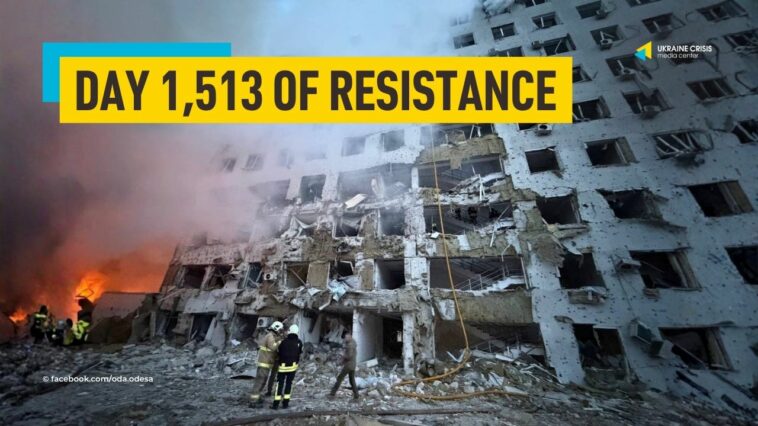
Russia’s drone and missile strikes on Kyiv, Odesa and Dnipro overnight kill at least 18. The Ukraine Defense Contact Group pledges 4 billion dollars for Ukraine’s air defenses and 1.5 billion dollars for drones. The EU is to send the first tranche of its 90 billion euro loan to supply Ukraine with domestic drones.
Russia’s drone and missile strikes on Kyiv, Odesa and Dnipro overnight kill at least 18
Russia launched an attack on Ukraine in two waves between 7 a.m. on Wednesday and 7 a.m. on Thursday, Ukraine’s Air Force said. It used a total of 703 missiles and drones.
Russia launched at Ukraine 659 attack drones of the Shahed, Gerbera and Italmas types as well as other types of drones and 44 missiles, including 19 Iskander-M/S-400 ballistic missiles, 20 Kh-101 air-launched cruise missiles and five Iskander-K cruise missiles.
The strike killed nine and wounded 23 others in Odesa, local authorities said. Search and rescue operations continued throughout Thursday. Odesa city authorities have declared a day of mourning on Thursday, April 16.
A Russian drone and missile attack on Kyiv overnight on Thursday killed four, including a 12-year-old boy and injured 60 others. Twenty-six people were taken to hospital.
Five people were killed and at least 26 others wounded in Dnipro. Apartment buildings, a university, industrial facility, office and administrative buildings and cars were damaged, head of the regional military administration, Oleksandr Hanzha said.
Russia’s attack on Ukraine involved a large number of ballistic missiles, Head of the Communications Directorate for Ukraine’s Air Force Command, Colonel Yuriy Ihnat said on national television on Thursday. He referred to a shortage of missiles for Patriot air defense systems as “very serious”.
“[Russia] launched 19 Iskander-M or S-400 ballistic missiles at four regions of the country. Five sites were hit in Kyiv. The regions of Dnipro, Kharkiv and Odesa were affected as well. Russia used 20 cruise missiles in a first wave of attacks. The number actually corresponds to that of ballistic missiles fired last night,” Ihnat said, explaining that the morning report by the Air Force covers both waves of the attack.
Reacting to Russia’s attacks on Ukraine, Ukrainian President Volodymyr Zelenskyi said: “Another night has proven that Russia does not deserve any easing of global policy or lifting of sanctions. Russia is betting on war, and the response must be exactly that: we must defend lives with all available means, and we must also apply pressure for the sake of peace with the same full force.”
Russia targeted energy infrastructure in the south of Ukraine on Thursday morning, leaving parts of Mykolayiv and Kherson regions without power, Ukrenergo national energy operator said. Repair works will begin after the attack ends, the company explained.
Ukraine Defense Contact Group pledges USD 4 billion for Ukraine’s air defenses, USD 1.5 billion for drones
Ukraine secured 4 billion dollars to boost its air defenses and more than 1.5 billion dollars for attack drones at a Wednesday meeting of the Ukraine Defense Contact Group in Berlin, also known as the Ramstein group, Ukraine’s Defense Minister Mykhailo Fedorov said on social media Thursday.
“I thank every member country of the contact group for strengthening Ukraine’s defenses. I particularly thank [the countries] for their support to air defense, particularly as part of the PURL (Prioritized Ukraine Requirements List — edit.) initiative, and for supplying missiles for the Patriot systems. Today we’ve received new contributions to PURL from Belgium, Norway, Bulgaria, Lithuania and Estonia,” Fedorov said.
He detailed the partners’ key contributions announced during Wednesday’s meeting.
The UK is providing the biggest ever drone package for Ukraine, including more than 120,000 drones.
Germany invests 4 billion dollars in strengthening Ukraine’s air defenses. It will provide an additional 600,000 million dollars to boost the country’s long- and mid-range strike capabilities.
The Netherlands sends 248 million euros for drones.
Norway is providing 560 million dollars to equip Ukrainian brigades with drones “at a basic level” and 150 million dollars to develop a logistical hub.
Spain contributes 215 million euros as part of EU’s SAFE (Security Action for Europe) instrument and strengthens the air defenses with missiles for the Patriots.
Canada sends 15 million dollars for the operation of NSATU (NATO Security Assistance and Training for Ukraine), 42 million dollars for the Czech-led ammunition initiative and 17 million dollars for critical engineer equipment.
Lithuania provides 39 million dollars for the Czech-led ammunition initiative, 29 million dollars for PURL, sends armored vehicles and contributes to rehabilitation programs for the military.
Belgium sends 75 million euros for Czechia’s ammunition initiative, 75 million euros for Germany’s air defense program and 85 million euros for the drone coalition. It also supports the F-16 aircraft and steps up the sanctions pressure on Russia’s shadow fleet.
Estonia contributes 13 million dollars to PURL to strengthen Ukraine’s air defense capabilities.
“I would like to particularly acknowledge an initiative started by Boris Pistorius in order to strengthen the air defenses. We have already secured 2 billion euros for urgent deliveries,” Fedorov said.
The UK, Germany and Canada sent “important signals” to pledge further expansion of the cooperation, he added.
Ukraine also presented a project designed to train AI models using real battlefield data to the partners, Fedorov said.
Commenting on Wednesday’s meeting of the Ukraine Defense Contact Group, Ukrainian President Volodymyr Zelenskyi said in a post to X on Thursday: “There are important results from the new meeting in the Ramstein format – precisely what we have agreed with leaders is now being implemented. Just now, there was a report from Ukraine’s Minister of Defense, Mykhailo Fedorov. Partners at Ramstein noted Ukraine’s strong positions on the battlefield – I am grateful for this recognition to each of our combat brigades.”
He also said the partners had a “clear understanding” of Ukraine’s air defense needs and joint weapons production prospects.
“The main thing is that every commitment announced is fully and timely fulfilled. When the provision of our defense is sufficient, Russia has no real possibility of achieving its occupation goals,” Zelenskyi said.
Five partners pledged contributions to the PURL initiative, he added.
“I thank Germany for continuing our work on air defense and Ukraine’s deep‑strike capabilities. I thank the United Kingdom for continuing efforts to supply the necessary drones, and it is important that we further develop joint capabilities,” Zelenskyi said.
He also thanked Spain for its readiness to work within the EU’s SAFE instrument that will allow to “scale up our joint defense capabilities” and acknowledged Canada’s contribution to “designated defense directions”.
A meeting of the 50-nation Ukraine Defense Contact Group took place in Berlin on Wednesday. German Defense Minister Boris Pistorius and British Defence Secretary John Healey co-chaired the gathering. The UK and Germany took over leadership of the group after the Trump administration gave up its leadership position soon after taking office.
U.S. Defense Secretary, Pete Hegseth again skipped the Ukraine Defense Contact Group meeting, making the U.S. one of the few countries that won’t send a top civilian defense official to the critical gathering of Ukrainian allies.
The Trump administration halted new military assistance for Kyiv upon entering office, but kept up shipments of previously pledged weapons and equipment that was granted under the Biden administration. Through it all, the U.S. has continued to share battlefield intelligence with Ukraine, however, and a new program was implemented to allow European allies to purchase U.S.-made arms for shipment to Kyiv.
Trump administration officials have begun warning countries that U.S. weapons supplies to Ukraine may be interrupted in the coming months as the Pentagon prioritizes their use for the war in Iran, Politico said earlier in the week.
EU to send first tranche of its 90 billion euro loan to supply Ukraine with domestic drones
The first tranche of EU’s military assistance to Ukraine under a 90 billion euro loan will be used to procure Ukrainian-made drones, EU Commissioner for Defense and Space, Andrius Kubilius said Wednesday, speaking to the European Parliament’s Committee on Security and Defense.
“For 2026, Ukraine has requested defense assistance to a total of 28.3 billion euro. This first product schedule focuses on drones from Ukraine’s cutting edge defense industry,” Kubilius said.
“For the next product schedules we expect more involvement of European defense industry,” he added.
The European Commission said Ukraine will get the first installment under the loan in the second quarter, European Pravda said early in the week, citing the Commission’s spokesperson.
Following the defeat of Hungarian Prime Minister Viktor Orbán in the elections on 12 April, the EU is hoping that both its 90 billion euro loan for Ukraine and the 20th package of Russia sanctions can be swiftly unblocked.
The European Commission is expected to give 45 billion euros to Ukraine in 2026, including 16.7 billion euros for the country’s state budget and 28.3 billion euros for its defense production.