

Ukraine will not accept ceding land to Russia, Budanov says. Ukrainian drones hit the Gorky oil pumping station in Russia. Ukraine’s robotic systems transform how wars are fought, Politico says.
Ukraine will not accept ceding land to Russia, Budanov says
Ukraine will not cede land to Russia, while the Ukrainians need to put aside all differences and unite for the sake of their country’s survival, Head of the Office of the President of Ukraine, Kyrylo Budanov said in an interview on the stage of the Kyiv Security Forum on Thursday.
“The red line is simple and clear to everyone. First, we will not recognize anything [occupied land as Russian — edit.]. This will not happen, regardless of how hard they try,” Budanov said.
Ukraine will find a solution that will serve its interests, he continued. No one “has the right to bargain away land,” he said.
“No one in Ukraine will accept the recognition even of a millimeter of our territory [as Russian]. I am absolutely convinced in that. The fact that we did not achieve an agreement is well-known. But this is what this [the negotiation] process is for. It may or may not achieve its goal. This is normal. We need to be prepared for any scenario and we need to be strong,” Budanov said.
If Ukraine is strong, it will have room for a maneuver. Its weakness will encourage others to dictate their conditions.
“We need to become strong and continue to be strong to achieve success in the negotiation process. No one in the world will make agreements with those who are weak,” Budanov added.
The Ukrainians need to unite in the name of their country’s survival, he said, arguing that “there are no other options.”
Ukrainian President Volodymyr Zelenskyi told reporters on March 31 that Russia demands Ukraine’s withdrawal from Donbas in order to end the war. If Ukraine doesn’t withdraw its troops within two months, Russia will seize Donbas and put forward other demands for a peace deal, he added.
Kremlin spokesperson Dmitry Peskov said on April 1 that Zelenskyi should order Ukrainian troops to leave Donbas “today” or “better, yesterday”.
Zelenskyi has repeatedly stated that Ukraine will not accept territorial concessions and will not withdraw troops from Donetsk and Luhansk regions. In an interview with Italian newspaper Corriere della Sera published on March 3, he explained that an eventual withdrawal would open the way for Russia toward the central part of the country. Concessions won’t stop the Kremlin’s new demands, he warned.
Ukraine drones hit Gorky oil pumping station in Russia
Drones of the Alfa Special Operations Center of Ukraine’s Security Service struck the Gorky oil pumping station in Russia’s Nizhny Novgorod region overnight on Thursday, The New Voice of Ukraine said, citing unnamed sources in the agency.
The strike damaged three oil tanks, causing a fire that spread to 20,000 square meters.
The station is part of Transneft’s Verkhnyaya Volga branch of the company. It moves oil through major pipelines, including ones in the Surgut-Gorky-Polotsk direction, and pumps oil domestically, including to the Lukoil refinery in Kstovo.
Ukraine’s Security Service said the strike disrupted operation of major pipelines and oil refineries inside Russia, causing supply problems. It affects Russia’s budget.
According to media reports, Ukrainian drones also struck the Novokuybyshevsk oil refinery in Russia’s Samara region.
Ukraine’s robotic systems transform how wars are fought, Politico says
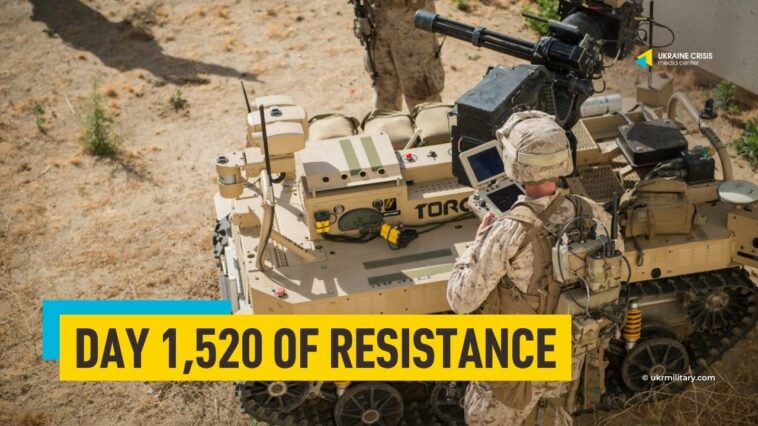
The next evolution of war is happening here. It’s already happened in the air — where Ukraine’s high-tech drones have made the 50-kilometer zone behind the front lines a death trap for Russian troops; and in the sea — where Kyiv’s maritime drones dealt heavy blows to Russia’s Black Sea Fleet.
Ukrainian President Volodymyr Zelenskyy last week highlighted how human-operated robots captured a Russian ground position and forced soldiers to surrender. Politico talked to the Ukrainian commander in charge of that assault. The paragraphs below are quoted from the article published on Wednesday.
“In conditions of dense saturation of the sky with UAVs, on the modern battlefield ground robotic systems allow for dangerous work to be carried out without involving personnel,” said Mykola Zinkevych, commander of the Third Assault Brigade’s ground robotic systems unit.
Now, it’s happening on land, where Ukrainian robotic systems are being used to assault and capture enemy fortifications. Combined with drones and human forces, ground robots have the potential to help reshape how wars are fought — much like the medieval advent of gunpowder, or the development of tanks during World War I.
The robots have a wide range of uses. “Delivery of important cargo, evacuation of the wounded, conducting surveillance in open areas, destruction of enemy fortifications, sabotage operations behind enemy lines, laying minefields — all this is now performed by ground robotic systems,” Zinkevych said.
That is crucial for Ukraine, which has had difficulty recruiting enough soldiers to fight off grinding “meat wave” assaults, Russia’s relentless high-casualty infantry attacks.
“Infantrymen can and should be taken out of direct fire. Our goal for 2026 is to replace up to 30 percent of personnel in the most difficult areas of the front with technology,” Zinkevych said.
The Kremlin’s full-scale invasion in 2022 plunged Ukraine into a technological arms race, where it is now carving out a lead.
Russia is also expanding its use of land drones to supply soldiers, evacuate the wounded and occasionally attack the enemy.
The bloodless developments underscore how robotics can shift the broader calculus of war, replacing costly human assaults with remotely operated pressure.
Mykola Bielieskov, a Ukrainian military analyst with the National Institute for Strategic Studies, compared the arrival of robots to the revolution in military affairs of the 1920s and 1930s, when new technology like machine guns, tanks and aircraft combined to upend warfare in the early 20th century.
But Bielieskov warned that the use of robots “may lead to an unfounded conclusion about the reduction of the importance of humans in war,” which he told Politico remains “decisive.”
“We are working to ensure that the robots take the main blow, and the infantry becomes an elite, specialized force to perform those tasks that the robots cannot perform. Because one way or another, people are still the basis of the army,” Zinkevych said.
Ukrainian command was initially unconvinced about ground robots as there were too few skilled operators. That changed, however, after several innovative brigades tested them in different environments and proved their value.
Adding to the need to take the tech more seriously was the success of aerial drones, where Ukraine has established an advantage over Russia and is now pummeling its troops and logistics in a “kill zone” far behind the front lines.
“Our goal is to perform 100 percent of front-line logistics by robotic systems,” Ukrainian Defense Minister Mykhailo Fedorov said last week. “In the first half of 2026, due to increased demand, we will contract 25,000 ground robotic systems, which will be delivered to the front. This is twice as much as in the entire year 2025.”
TerMIT, developed by Ukraine’s Tencore company, is a tracked ground robot that can carry up to 400 kilograms at a top speed of 15 kilometers per hour and operates at a range of up to 40 kilometers. It’s used for everything from cargo transport to medical evacuations, and combat when equipped with machine guns and grenade launchers and is in service with the Third Assault Brigade, as well as more than 50 other units.
“One TerMIT managed to lay more than 1,500 anti-tank mines before Russians destroyed it with many FPV drones,” [Maksym Vasylchenko, the co-founder and CEO of Tencore] said.
Kyiv’s issue is that soaring demand is creating a supply squeeze.
“Ukrainian producers can cover the growing demand, the bottleneck is in state procurement and in the ability to master these systems in the army,” [Ihor Fedirko, CEO of the Ukrainian Council of the Defense Industry] said.
Ukraine’s European allies are also playing a role in supplying finance, either directly or through programs like the EU’s €150 billion loans-for-weapons SAFE program, which is open to Ukrainian companies.