

Russia is losing two times more troops per square kilometer of gained Ukrainian land than last spring, Sternenko says. Ukraine and Norway will jointly manufacture middle-range drones for the Ukrainian armed forces. Ukraine ranks the world’s seventh largest defense spender, according to SIPRI’s new report.
Russia losing two times more troops per square kilometer of gained Ukrainian land than last spring, Sternenko says
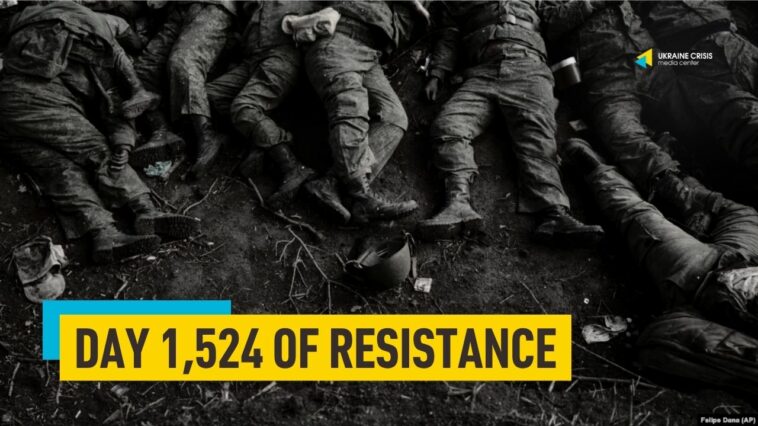
Russia is losing 2.1 times more troops per square kilometer of gained land than last spring, army supply volunteer and advisor to Ukraine’s Defense Minister on scaling up the use of drones on the front, Serhiy Sternenko told a meeting titled “Year five of the Great War. Empires will fall” held by the Pylyp Orlyk Foundation in Kyiv on April 23.
The numbers come as a show of declining level of efficiency of Russia’s offensive operations, Sternenko said.
Russia’s offensive campaign is hampered by Ukraine’s technological superiority. Advanced communication systems and a rapidly growing field of unmanned systems are believed to be its cornerstone.
“In one year, [Russia] began to lose more than twice more soldiers as it occupies Ukrainian territory. We are witnessing that the adversary’s spring-summer offensive campaign encounters considerable difficulties as a result of technological superiority of Ukraine’s Armed Forces. We have Starlink terminals, while at the same time, they were denied to the adversary. It had serious effects of Russian forces’ command and control along the front line.
Second, it’s about massive development of unmanned systems, including ones that are uncrewed, ground-based, robotic and autonomous at both tactical and strategic levels. That’s why it is increasingly difficult for the adversary to implement their goals,” Sternenko said, as sited by Ukrainian news site Novynarnya.
He added that Ukraine will at least double the intensity of its strikes deep into Russia by the end of the year.
Russia is nearing a systemic crisis against a backdrop of mounting losses and demoralized population.
“There’s a growing social discontent as economic crisis, internet shutdowns and restricted access to certain messengers, Ukrainian aerial strikes, the war moving deeper inside Russia and high losses are demoralizing the Russians. All of the above, coupled with Russia’s weak vertical of power will inevitably lead to the empire’s collapse,” Sternenko said.
Ukraine and Norway to jointly manufacture middle-range drones for Ukrainian armed forces
Ukraine and Norway will jointly manufacture several thousand middle-range drones for the Ukrainian Armed Forces as part of a wider joint production effort, Ukraine’s Defense Ministry said in a statement on Monday.
Norway will fund the project in addition to 7 billion dollars that the country earlier allocated to military support for Ukraine in 2026. All drones manufactured under the project will be sent to Ukraine.
Norway’s ambassador to Ukraine, Lars Ragnar Aalerud Hansen and Ukraine’s Deputy Defense Minister for European Integration, Serhiy Boyev signed the agreement.
“The agreement opens up opportunities to scale up the production of equipment based on Ukrainian technologies that have already proven effective on the battlefield, while strengthening defensive capabilities of both countries,” the ministry said.
This year, Norway plans to send more than 1.5 billion dollars to buy Ukrainian-made weapons for Ukraine’s defense forces, it added.
The first batch of drones manufactured in Norway is expected to be delivered to Ukraine’s defense forces by summer. The agreement also foresees the development of comprehensive industrial cooperation, including research activities.
Ukraine ranks world’s seventh largest defense spender, according to SIPRI’s new report
Ukraine’s military expenditure grew by 20 per cent in 2025 and by 1,501 per cent over the decade 2016–2025. At USD 84.1 billion, Ukraine’s estimated military spending was at its highest ever level and represented 40 per cent of its GDP and 63 per cent of government spending. Both shares increased in 2025, remaining the highest in the world for the fourth year in a row, the Stockholm International Peace Research Institute (SIPRI) said in a report published on Monday.
Ukraine was the seventh largest military spender in 2025, the think tank said. In 2025, Russia increased its military spending by 5.9 per cent to an estimated USD 190 billion, or 7.5 per cent of its GDP. Its military spending as a share of government spending hit 20 per cent — the highest level SIPRI has ever recorded for Russia.
Germany’s defense spending increased by 24 per cent last year, reaching 114 billion dollars, the report said. At 2.3 per cent of GDP in 2025, Germany’s military burden exceeded 2.0 per cent for the first time since 1990.
Spain increased its military spending by half in 2025, reaching 40.2 billion dollars.
European NATO members spent USD 559 billion in total. Of the 32 NATO members, 23 spent at least 2 per cent of GDP on their militaries in 2025, according to SIPRI’s methodology.
Despite the lack of new aid commitments from the USA, in 2025 Ukraine received USD 52.2 billion from its partners to support its state budget, the highest amount since the start of the war and 11 per cent more than in 2024.
At USD 37.9 billion, the Extraordinary Revenue Acceleration (ERA) loans from the Group of Seven (G7) wealthy industrialized states were the single largest source of external assistance to Ukraine during 2025.
World military expenditure rose by 2.9 per cent in real terms to USD 2,887 billion in 2025, marking the 11th consecutive year of growth and the highest spending level ever recorded by SIPRI.
Total military expenditure in Europe reached USD 864 billion in 2025, a 14 per cent increase compared with 2024 and the highest level of European spending ever recorded by SIPRI. The increase is caused by Russia’s war against Ukraine and reflects the efforts of European NATO members to rearm amid the uncertainty of U.S. security guarantees within the alliance, the organization said.
The New Voice of Ukraine said last month that Ukraine ranked 10th by defense spending in the analysis by the International Institute for Strategic Studies titled The Military Balance 2026. The study also said the country’s defense spending demonstrates the highest levels of growth.