

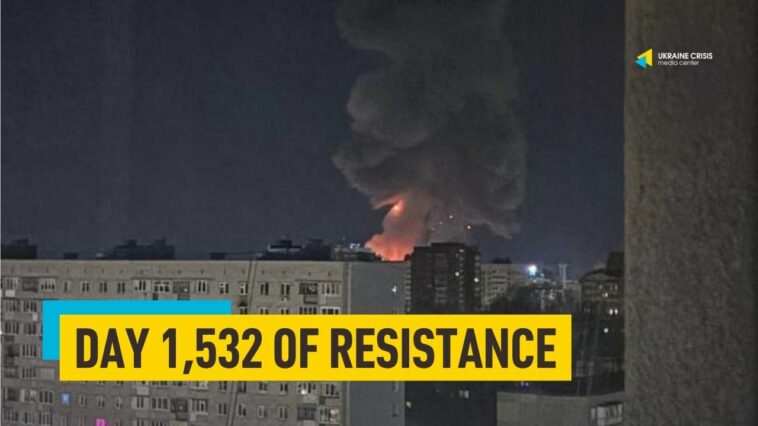
Ukraine strikes a military plant in Russia’s Cheboksary with Flamingo missiles. Ukraine’s defense intelligence breaks down Russia’s missile stocks and production output. Russia’s double-tap strike on a gas production facility in Poltava region kills four.
Ukraine strikes military plant in Russia’s Cheboksary with Flamingo missiles
Ukraine launched F-5 Flamingo cruise missiles at targets deep inside Russia, including military-industrial facilities in Cheboksary overnight on Tuesday, Ukrainian President Volodymyr Zelenskyi said in a post to X.
He said the missiles travelled more than 1,500 kilometers and posted a video clip, showing missile launches.
“The military production facility that was targeted produced relay protection systems, automation systems, and low-voltage equipment. The plant supplied navigation components for the Russian Navy, the missile industry, aviation, and armored vehicles. Everything that the Russians are using in the war against us — against Ukraine,” Zelenskyi said.
“Our long-range sanctions continue to provide an entirely just response to Russian strikes,” he also said, adding: “Russia must end its war and turn to real diplomacy. We have made our proposal clear.”
Reports and videos posted to social media said missiles and drones hit a number of sites in Cheboksary, in the region of Chuvashiya, Ukrainian media said. The VNIIR Progress plant in Cheboksary was reportedly hit.
Ukraine’s defense intelligence breaks down Russia’s missile stocks and production output
The Russian defense ministry threatened on Monday that Russia will carry out a “massive missile strike on the center of Kyiv” if Ukraine disrupts the May 9 parade in Moscow. Ukrainian new site The New Voice of Ukraine (NV) asked the Main Intelligence Department of Ukraine’s Defense Ministry about Russia’s missile stocks. Here’s what it said.
Russia has lately stepped up missile attacks on Ukraine’s critical infrastructure sites. But that does not mean its stocks are dwindling. On the contrary, the defense intelligence said, Moscow is trying to largely increase the production capacity of its defense industrial base and accelerate the production pace of the missiles. “It allows to replenish the missile stocks in time and maintain them at a needed level,” the agency added.
According to Ukraine’s defense intelligence, as of mid-April 2026, Russia had up to 200 Iskander-M ballistic missiles, up to 110 Iskander-K cruise missiles, up to 100 Kinzhal hypersonic air-launched ballistic missiles, up to 460 Kalibr cruise missiles, up to 690 Onyx cruise missiles, up to 120 Kh-101 cruise missiles launched from Tu-160 and Tu-95 bombers, up to 350 Kh-22/32 cruise missiles launched from Tu-22 bombers, up to 230 Zircon hypersonic anti-ship missiles, up to 50 KN-23 North Korean ballistic missiles, up to 450 RM-48U target missiles for S-300PM/S-400 systems, up to 25 Kh-69 guided missiles for Su-30MK, Su-34 and Su-57 aircraft, up to 2,600 Kh-29/31/35/58/59 air-to-surface missiles and up to 10 Oreshnik mid-range ballistic missiles.
Russia’s missile stocks remained almost unchanged since late last year. As of December 2025, Russia had more than 200 Iskander-M ballistic missiles, more than 100 Iskander-K cruise missiles, around 150 Kh-101 air-launched cruise missiles and more the 400 Kalibr sea-launched cruise missiles, NV said, citing data supplied by Ukraine’s defense intelligence. Russia had fewer Kinzhal missiles at the time, totaling around 50 pieces.
Russia continues to manufacture new missiles. Its defense industrial base can produce up to 60 Iskander-M ballistic missiles, up to 10 Iskander-K cruise missiles, up to 10 Kinzhal hypersonic air-launched ballistic missiles, up to 25 Kalibr sea-launched cruise missiles, up to 70 Kh-101 air-launched cruise missiles, up to eight Kh-32 air-launched cruise missiles, up to five Onyx cruise missiles, up to three Zircon hypersonic anti-ship cruise missiles, around 20 Kh-35 air-to-surface missiles, up to five Kh-69 guided missiles, up to 40 RM-48U target missiles for S-300PM/S-400 systems and up to 50 Kh-29/31/35/58/59 air-to-surface missiles per month.
In December 2025, Russia’s monthly production output included around 20 Iskander-K cruise missiles, around 20 Onyx cruise missiles, more than 10 Zircon hypersonic anti-ship cruise missiles and more than 100 RM-48U target missiles for S-300PM/S-400 systems. Russia manufactures 70 Kh-101 cruise missiles per month, an increase from 50 last year.
Russia’s double-tap strike on gas production facility in Poltava region kills four
A Russian drone and missile strike on a gas production facility in Poltava region overnight on Tuesday killed two employees and two rescue workers. More than 30 others were injured. The facility is run by Ukraine’s state energy company Naftogaz. The country’s Interior Minister Ihor Klymenko said the two rescue workers were killed when Russia carried out a follow‑up strike after emergency crews arrived to extinguish a fire caused by an initial attack on the gas facility. He added that 23 rescue workers were injured. Three of them were in critical condition, fighting for their lives.
“It is utter cynicism to ask for a ceasefire in order to hold propaganda celebrations while carrying out such missile and drone strikes every single day leading up to it,” Ukrainian President Volodymyr Zelenskyi said in a post to X on Tuesday, referring to a May 9 ceasefire. Russia “struck again in an especially vile way with a missile when State Emergency Service workers were already at the scene, extinguishing the fire,” he said, speaking of the attack on Poltava region.
He said Russia had targeted Ukraine’s critical infrastructure in an overnight attack on Tuesday.
One person was killed and four others wounded in Russia’s attack on Kharkiv region overnight, Zelenskyi said. Russia targeted critical infrastructure in Dnipro region and damaged power lines in Pavlohrad, injuring three people and leaving thousands without power. Three people were wounded in Kyiv region. The region of Zaporizhzhia also came under attack.