

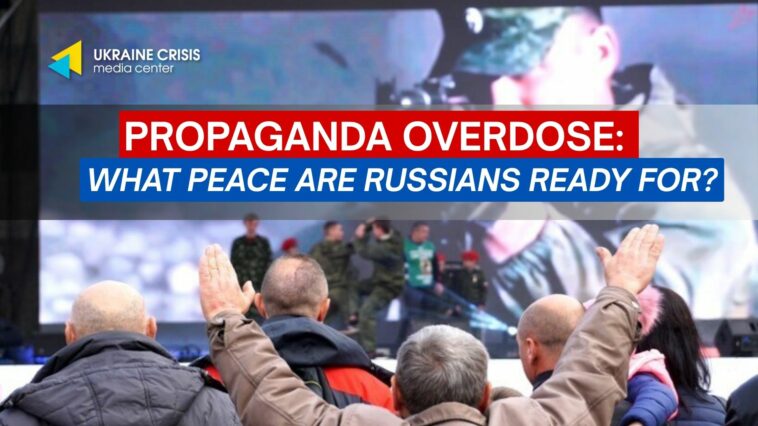
In February 2026, the Levada Center recorded an all-time high: 67.2% of Russians supported the start of peace negotiations with Ukraine, while only 24.3% favoured continuing the hostilities. However, demand for negotiations does not necessarily mean that ordinary Russians are prepared to pay a real price for peace. At this stage, the figures reflect deep war fatigue rather than a reassessment of the war’s objectives or an acknowledgement of responsibility.
It is virtually impossible to establish the reliability of Russian public opinion polls under a rigid authoritarian regime and wartime conditions. The criminalisation of so-called “discrediting the army” reinforces the distortion effect: respondents provide answers approved from above while concealing their actual views. Despite these objective limitations, long-term monitoring makes it possible to identify persistent trends. The most important is growing demand for diplomacy alongside the continued prevalence of maximalist ideas about the conditions of peace. We will therefore use the Levada Center’s findings as the principal basis for this analysis.
The evolution of public attitudes has not been linear. During the first year of the full-scale invasion, Russian society moved from initial shock towards consolidation around the regime. According to the Levada Center, militaristic sentiment peaked in May 2023, when 48% supported continuing the war and 45% favoured negotiations. The trend then reversed: by October 2023, 55% supported negotiations.
During 2024, war fatigue became firmly entrenched in Russian society. Half of Russians were prepared to support the withdrawal of troops and the start of negotiations even without achieving the declared objectives of the so-called “special military operation”.
In 2025–2026, support for peace negotiations in Russia reached its highest level. In 2025, it averaged 62.6%, rising to 67% in February 2026, according to Levada. At the same time, the proportion of those supporting the continuation of hostilities remained at around 25% throughout the previous two years.
In its monitoring, the BBC noted that support for the war in Russia had fallen to an all-time low and that a significant proportion of the population had lost interest in developments in Ukraine altogether.
Demand for peace has a clear social profile. It is expressed most strongly by the groups that bear the heaviest burden of the war: women, at 71%; people under the age of 40, at 74%; rural residents; and people with lower levels of education, both at 72%.
By contrast, the core constituency of militarism consists largely of those who face the least personal risk. These include men over the age of 55, 32% of whom support continuing the war. This is a classic example of “armchair militarism”, fuelled by nostalgia for superpower status without personal exposure to the consequences.
Surprisingly high support for the war is also found among people with higher education, at 29%. A significant proportion of this group is integrated into the state apparatus, the public sector and the military-industrial complex and therefore benefits directly from the redistribution of resources associated with the war economy.
Moscow represents a separate phenomenon, with 40% supporting the continuation of the war. The capital concentrates a disproportionate share of the country’s resources, while its middle class has been largely shielded from mass mobilisation and experiences the war primarily through television and computer screens.
“Peace” on Russian Terms
The central paradox is that Russians want peace but are strongly unwilling to pay for it through concessions. In essence, the demand for peace in Russia is a demand for a “victorious peace”.
According to Russian Field polling conducted in February 2026, most respondents considered the following conditions essential to any agreement: official recognition of Donbas as Russian territory, supported by 75%; Ukraine’s legally binding renunciation of NATO membership, supported by 71%; and the complete lifting of sanctions, supported by 70%. At the same time, 46% of Russians were categorically opposed to returning any occupied territories to Ukraine.
Yet these maximalist demands do not necessarily constitute a firm barrier for the Kremlin itself. One of the most important conclusions emerging from the 2025–2026 studies is the Russian public’s overwhelming readiness to support virtually any government decision that brings the war to an end.
According to Russian Field, between 76% and 83% of Russians would support a decision by Putin to sign a peace agreement “tomorrow”, while 56% would even support an immediate and unconditional ceasefire. Around half of respondents are psychologically prepared to accept the formula of “peace, but not victory”.
These figures reveal the profound depoliticisation and paternalism of Russian society. Citizens collectively absolve themselves of responsibility for the course and outcome of the war, delegating it personally to the leader.
The only condition required to legitimise even an unfavourable agreement is the public approval of the country’s leadership and the absence of obvious, media-amplified signs of national humiliation.
The overwhelming majority of Russians are therefore prepared to accept any outcome that propaganda presents as a “victory”.
The Economic Limits of Endurance
The economy is becoming the principal catalyst of war fatigue. According to available estimates, Russia’s federal budget deficit reached approximately RUB 4.6 trillion in the first quarter of 2026 alone, several times higher than the figure originally projected for the entire year.
The government has resorted to selling part of its gold reserves and raising taxes. From 1 January 2026, the standard value-added tax rate was increased from 20% to 22%. The corporate sector is facing a liquidity crisis and a rise in large-scale layoffs.
While propaganda successfully promoted the narrative of the “ineffectiveness of sanctions” in 2022–2023, by 2026 almost half of adult Russians openly acknowledged their negative impact on everyday life.
The most revealing development is the changing direction of blame. When respondents are asked who is responsible for declining living standards, they increasingly point not to the West or NATO but to their own federal government and to the president personally.
Even pro-government polling organisations are recording a gradual decline in Putin’s approval ratings. This desacralisation of power indicates the erosion of the unspoken “social contract” that served as the foundation of the regime for more than two decades. The exchange of loyalty for stability no longer works because stability itself has disappeared.
Overall, the record-high demand for peace among Russians should be viewed not as readiness for compromise but as a symptom of exhaustion. Most Russians are tired of the war, sanctions and uncertainty, which explains the unprecedented support for negotiations.
At the same time, imperial narratives entrenched by propaganda, the unwillingness to admit that the war was a mistake and the fear of defeat prevent Russian society from accepting genuine concessions.
Significantly, should negotiations fail, 59% of Russians would support not further diplomacy but an escalation of strikes, viewing violence as a means of coercing Ukraine into accepting a peace favourable to Russia.
This creates a paradoxical situation: a Russian population that strongly desires the war to end remains silently prepared for it to continue as a war of attrition—until the Kremlin decides otherwise.