

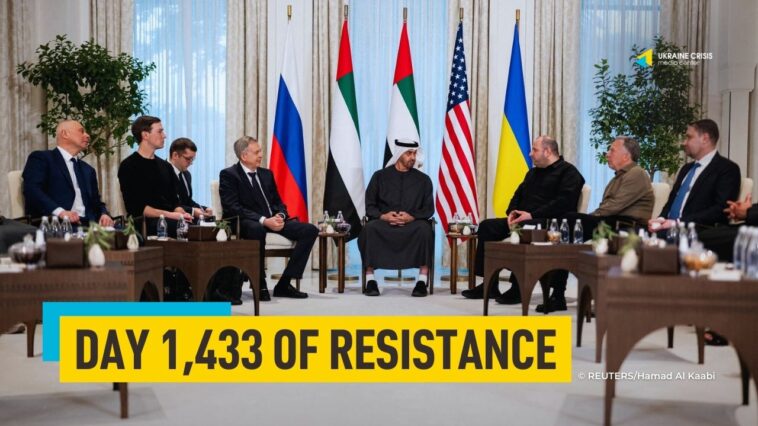
The Kremlin offers no indication of willingness to compromise ahead of a new round of trilateral talks in the UAE, ISW says. Ukraine’s Flamingo missiles hit a Russian manufacturer contributing to military aircraft production, open-source intelligence shows. Russian drones hit target in 11 locations across the country overnight, Ukraine’s Air Force says.
Kremlin shows no willingness to compromise ahead of new round of trilateral talks in UAE, ISW says
Kremlin officials continue to reiterate Russia’s commitment to its original war aims and reject Western security guarantees for Ukraine, amid continued reporting that negotiations will resume in the coming days, the Institute for the Study of War (ISW) said in an update on Sunday. The paragraphs below are quoted from the report.
Two US officials told Politico on January 24 that Ukrainian and Russian delegations will meet in Abu Dhabi again on February 1. US Special Envoy to the Middle East Steve Witkoff stated on January 24 that the Russian-Ukrainian-US trilateral talks in Abu Dhabi were “very productive” and confirmed that the delegations made plans to continue talks next week.
Russian Deputy Foreign Minister Sergei Ryabkov reiterated on January 24 Russia’s commitment to the alleged “fundamental understandings” that Russia claims that Russia and the US developed at the August 2025 US-Russian Alaska summit. Kremlin officials have repeatedly exploited the lack of clarity about the outcome of the August 2025 Alaska summit to obfuscate Russia’s efforts to impede the peace process and claim that the summit achieved a joint US-Russian understanding and agreement to end the war in Ukraine despite the lack of a clear joint outcome or communiqué.
The Russian Ministry of Foreign Affairs (MFA) amplified an interview from its Second Department of Commonwealth of Independent States (CIS) Director Alexei Polischuk on January 25 in which he reiterated Russia’s commitment to resolving the so-called “root causes” of the war, which Polischuk defined as Ukrainian neutrality and non-nuclear status, restoring protections for ethnic Russians and Russian speakers in Ukraine, ousting Ukraine’s current government, and resolving “security threats” against Russia – all a restatement of elements of Russia’s original war aims. Polishchuk also reiterated Russia’s rejection of postwar security guarantees for Ukraine, including the deployment of a foreign peacekeeping contingent to Ukraine. Polishchuk stated that the negotiating parties should finalize a peace agreement before negotiating security guarantees, rejecting both the timeline and component agreements of the effort that US President Donald Trump’s team is leading.
Kremlin Spokesman Dmitry Peskov made a statement suggesting that the Kremlin is using its participation in ongoing negotiations with the United States to stave off a significant increase in US pressure against Russia that could impede its war effort. Peskov stated on January 24 that Trump’s “knee-jerk” foreign policy methods do not align with Russia’s own and that the Kremlin views these methods as designed to force others to “bend over the knee.” Peskov claimed that those who “bend” to Trump “will continue to bend over” and that it is imperative that Russia not bend to Trump.
The Kremlin has been pursuing a balancing act since February 2025 between posturing strength to its populace and allies while engaging the United States enough to avoid additional American pressure that could compel Russian President Vladimir Putin to compromise from his original war aims and engage in meaningful negotiations to end the war.
Peskov’s overt criticism of Trump’s mode of foreign policy and assertion that Russia must not compromise in the face of US pressure suggests that the Kremlin seeks to ensure that the Trump administration does not dole out additional restrictive measures directly against Russia. Peskov’s statement may be a tacit Kremlin acknowledgement of Russia’s own vulnerabilities to increased pressure. ISW continues to assess that the West, including the United States, has failed to invalidate Putin’s theory of victory and that the Kremlin has offered no indication of a willingness to compromise. The United States and Europe may be able to invalidate Putin’s theory of victory and compel Russia to make concessions through additional pressure, such as augmenting Ukrainian military capabilities, sanctioning and seizing foreign Russian assets, and reducing Russia’s access to resources it needs to sustain its long-term war effort.
Ukraine’s Flamingo missiles hit Russian manufacturer contributing to aircraft production, open-source intelligence shows
Ukraine’s four Flamingo missiles targeted the Skif-M company in Russia’s Belgorod on September 23, 2025. The facility manufactures critical materials for military aircraft production. All four missiles hit target, Ukrainian Telegram channels KiberBoroshno (t.me/kiber_boroshno) and Exilenova+ (t.me/exilenova_plus) said, referring to satellite images.
“The adversary states that ‘just one’ of the four missiles reached the factory, but satellite images show a different picture. All four missiles likely met the target by a margin of less than 80 meters. The largest area of destruction (25 meters) does not match the reports of a ‘single impact site.’ It looks like an effort to obscure the damage,” Exilenova+ said.
According to the UK’s Royal United Services Institute, SKIF-M’s main plant, based in Belgorod, manufactures specialized inserts, drills and end mills that are needed to process titanium and aluminum jet parts and turn each into a component ready to mount. Seventy percent of the company’s products are specifically developed for machining aerospace materials that are part of the chain for the production of MiG and Su-34/35/57 aircraft, Exilenova+ said.
Russian drones hit target in 11 locations across country overnight, Ukraine’s Air Force says
Russia launched a total of 138 attack drones and other unidentified types of drones at Ukraine overnight on Monday, the Ukrainian Air Force said. The drones were fired from the area of Russia’s Kursk, Oryol, Bryansk, Millerovo, Primorsko-Akhtarsk and from occupied Donetsk. Around 90 of the unmanned aerial systems were the Shaheds.
The Air Force and other branches of the Ukrainian military deployed aircraft, surface-to-air missile troops, electronic warfare units and mobile groups to repel the attack.
Ukraine’s military said it had shot down or otherwise neutralized 110 drones of the Shahed, Gerbera and other types in the north and east of the country. Twenty-one drones hit target in 11 locations and the falling debris fell in one place, it added.