

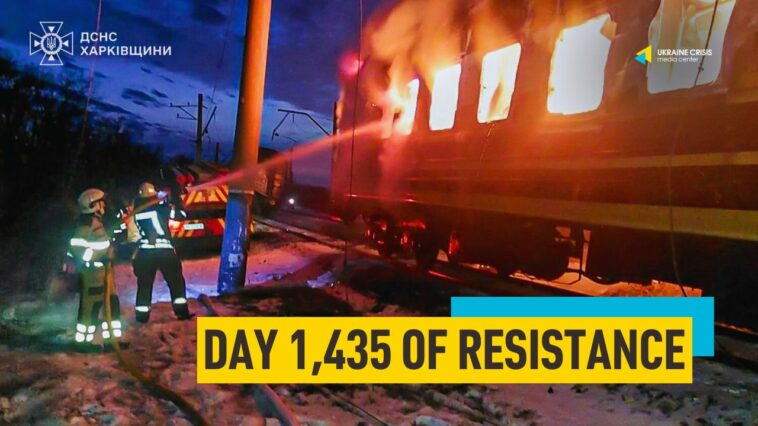
A Russian drone strike on a passenger train in Kharkiv region kills five people. Russia fires drones, a missile at a number of sites across the country, kills two in Kyiv region. Pushing Ukraine to cede the remainder of Donetsk region to Russia would be a strategic mistake, ISW says.
Russian drone strike on passenger train in Kharkiv region kills five
A Russian drone strike on a passenger train near the village of Yazykove in Kharkiv region on Tuesday killed five people, the regional prosecutor’s office said. Prosecutors said fragments of five bodies had been found, and that identification would only be possible after DNA testing.
The train had been operating from Chop, in western Ukraine, to the town of Barvinkove, on the edge of Donetsk region. Russia used three drones in the attack, likely of the Geran-2 type, prosecutors said. One drone struck the train and two more hit an area alongside it.
In his post to X, Ukrainian Pesident Volodymyr Zelenskyi said four people had been killed. The train, he said, was carrying more than 200 passengers, including 18 in the carriage that was hit.
“In any country, a drone strike on a civilian train would be regarded in the same way – purely as an act of terrorism. There would be no doubt about the classification, neither in Europe, nor in America, nor in the Arab world, nor in China, nor anywhere else. There is, and can be, no military justification for killing civilians in a train carriage,” he said.
Ukrzaliznytsia, the national railway operator, said flags at all railway stations across the country would be lowered and a minute of silence observed to honor the victims. “A minute of silence today is to remember both our service members and the passengers killed by Russia, a terrible tragedy that happened yesterday,” the company said.
Trains that leave railway stations while accompanied by music will start their journey in silence on Wednesday, the message reads.
Russia fires drones, a missile at number of sites across the country, kills two in Kyiv region
Russia launched 146 drones and a ballistic missile at Ukraine overnight on Wednesday, targeting Kyiv and the surrounding region as well as the cities of Odesa, Kryvyi Rih and Zaporizhzhia.
A drone struck an apartment building in Bilohorodka on the outskirts of Kyiv, killing two people. A Russian attack on a port in Odesa region ignited several fires, ruined logistical facilities, damaged hangars, a locomotive and production sites, Deputy Prime Minister for Restoration — Minister for Development of Communities and Territories of Ukraine, Oleksiy Kuleba said on Telegram. A ballistic missile attack on Kryvyi Rih in the region of Dnipro left parts of the city without heating. More than 10 apartment buildings were damaged in Zaporizhzhia.
In Bilohorodka, a woman and a man were killed by a drone that hit an apartment building. Radio Free Europe/Radio Liberty war correspondent, Marian Kushnir pulled the 4-year-old daughter of the woman from their burning apartment but was unable to rescue the mother and her partner. The journalist is a resident in the building.
According to Ukrainian media, as soon as he heard the explosion, he took his tactical backpack and rushed to the site to help. The residents initially thought it was a gas explosion, as they did not hear the sound of a drone flying over.
Kushnir ran upstairs and found the door of an apartment ajar. He saw a young girl inside, calling for her mother. He pulled the girl out, handed her to the neighbors and returned to the apartment to try to rescue the adults who were on the upper level of the flat, but everything was already burning too heavily. The neighbors tried to extinguish the fire, but it didn’t work, Kushnir said.
The girl was very scared, but physically unharmed. She was handed to her father. She also has an older brother who turned 20 that day.
Pushing Ukraine to cede remainder of Donetsk region to Russia would be a strategic mistake, ISW says
The United States is reportedly pushing Ukraine to cede the remainder of Donetsk Oblast to Russia in exchange for US security guarantees. The Institute for the Study of War (ISW) continues to assess that Ukrainian concessions of territory that Russia is unlikely to seize quickly or easily militarily would be a strategic mistake. The paragraphs below are quoted from ISW’s January 27 report.
The Financial Times (FT) reported on January 27, citing sources familiar with ongoing peace talks, that the Trump administration is signaling that the United States’ provision of security guarantees to Ukraine is contingent on Ukraine agreeing to a peace settlement that would likely involve ceding all of the territory of Donbas (Luhansk and Donetsk oblasts) to Russia. Two FT sources stated that the United States suggested that it would provide more weaponry to bolster Ukraine’s peacetime forces if Ukraine agreed to withdraw from all of Donbas.
Two sources indicated that the proposed US security guarantees include a pledge that “mirrors” NATO’s Article 5 clause and a promise to conduct a coordinated military response in the case of a “sustained” Russian attack against post-war Ukraine. One of the sources suggested that the proposed guarantees may be “too vague” for Ukraine but “too broad” for Russia.
[Also, the United States has told Ukraine that it must sign on to a peace deal with Russia in order to get U.S. security guarantees, a source familiar with internal discussions told Reuters on Tuesday.]ISW continues to assess that Russia would need to expend significant amounts of resources, time, and personnel to seize the rest of Donbas. Russian forces are unlikely to seize the remainder of Donetsk Oblast before August 2027, assuming Russian forces are able to sustain their rate of advance from late November 2025.
The Russian rate of advance slowed in late December 2025 and early January 2026, likely in part due to adverse weather conditions, and Russian efforts to seize the rest of Donetsk Oblast could take longer than ISW previously forecasted.
A Ukrainian withdrawal from Ukrainian-held territory in Donetsk Oblast would put Russian forces in more advantageous positions to renew attacks against southwestern and central Ukraine in the future after rest and reconstitution. A strong Ukrainian military and robust Western security guarantees are necessary to effectively deter such future Russian aggression, but Russian officials have repeatedly rejected these security guarantees.
Russian Foreign Intelligence Service (SVR) Head Sergei Naryshkin, for example, claimed on January 26 that European states in the Coalition of the Willing are imposing conditions on a peace settlement that are “completely unacceptable” to Russia – likely referring to the coalition’s efforts to finalize a plan to deploy troops to post-war Ukraine. Russian State Duma Defense Committee Deputy Chairperson Alexei Zhuravlyov explicitly rejected on January 27 the deployment of troops from NATO states in post-war Ukraine.
The Kremlin remains unlikely to accept any settlement that includes meaningful security guarantees for Ukraine. The Kremlin’s continued refusal of security guarantees for Ukraine and persistent dismissals of the negotiating process suggests that it remains committed to Russian President Vladimir Putin’s theory of victory — the theory that Russia can win in Ukraine by outlasting Ukraine’s ability to fight and the West’s desire to support Ukraine.