

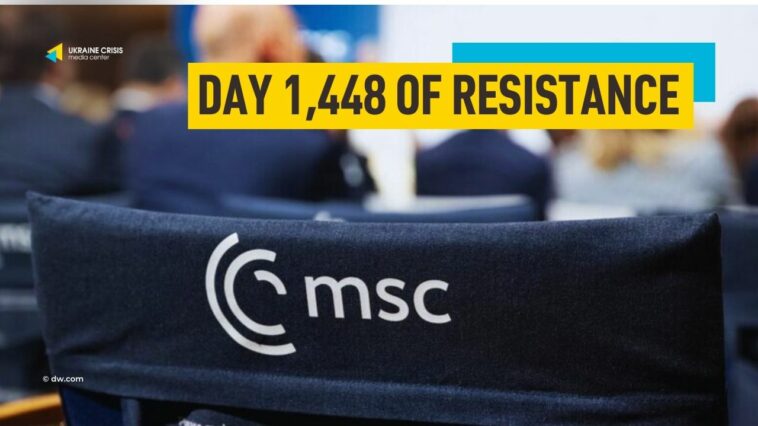
Russia could be plotting a war in the Baltic Sea area or one against a single neighbor, the Munich Security Report says. The EU is hatching an unprecedented plan to get Ukraine into the EU in 2027, Politico says. Heating restored to Kyiv’s Troyeshchyna neighborhood.
Russia could be plotting war in Baltic Sea area or one against a single neighbor, Munich Security Report says
The Munich Security Conference organisers have published a report ahead of the event, saying that an era when Europe thrived under an American security umbrella has ended. It also states that Russia could be plotting a new war. The paragraphs below are quoted from the report.
The second Trump administration has made it clear that defending the continent and supporting Ukraine are primarily Europe’s responsibility. “Safeguarding European security must be an imperative for European members of NATO. As part of this, Europe must provide the overwhelming share of future lethal and nonlethal aid to Ukraine,” the report quotes Pete Hegseth, US Secretary of War as saying during a meeting of the Ukraine Defense Contact Group on February 12, 2025.
Meanwhile, US military aid to Ukraine has dropped sharply since January 2025, leaving European nations and selected partners to shoulder the bulk of the burden.
The Trump administration has blurred the boundary between security and economic policy, tying access to the US security umbrella more explicitly to alignment with its economic interests.
Despite staggering battlefield losses, crippling sanctions, intensifying Ukrainian strikes on Russian infrastructure, and mounting international pressure to negotiate, the Kremlin has shown no sign of backing down from its maximalist aims. The country remains in full war-economy mode: 40 percent of Russia’s 2025 federal budget – or almost eight percent of its GDP – was devoted to security and defense, sustaining the expansion of defense industrial production.
Indeed, some intelligence agencies estimate that Russia could reconstitute its forces for a “regional war” in the Baltic Sea area within two years of a potential ceasefire in Ukraine – and for a “local” one against a single neighbor within six months.
The fall of 2025 saw a sharp rise in air space violations and unauthorized drone overflights. In September alone, around 20 Russian drones intruded into Polish airspace while three Russian MiG-31 fighter jets violated Estonian airspace for 12 minutes – prompting both governments to invoke NATO consultations under Article 4 of the North Atlantic Treaty.
The US-backed 28-point peace plan, leaked in November 2025, leaned heavily toward Russian interests and blindsided European capitals. It envisioned sweeping Ukrainian territorial concessions, strict limits on Ukraine’s future force size, and an exclusion of Ukrainian NATO membership and any further expansion, while demanding almost no concessions from Moscow.
The document also cast Washington as an arbiter rather than an Ally, envisaging a US-mediated dialogue between Russia and NATO.
Between 2021 and 2025, European NATO members boosted defense budgets by around 41 percent – driven by both US pressure and a growing recognition of Europe’s strategic exposure.
Rather than developing genuine indigenous alternatives, many governments have opted to assemble US-designed defense systems such as Patriots and F-35 fighter jets in Europe. These decisions grant them a degree of leverage over Washington but ultimately entrench dependence.
Meanwhile, EU members continue to miss their own target – agreed in 2007 – of spending 35 percent of procurement budgets jointly, thus forfeiting economies of scale. Rising defense budgets are instead fueling a new wave of industrial nationalism that risks deepening fragmentation, inflating costs, and eroding fragile public support.
EU hatching unprecedented plan to get Ukraine into EU in 2027, Politico says
The EU is hatching an unprecedented plan that could give Ukraine partial membership in the bloc as early as next year, as Brussels tries to shore up the country’s position in Europe and away from Moscow, according to 10 officials and diplomats.
The plan would see Ukraine getting a seat at the EU table before carrying out the reforms needed for full membership privileges, Politico said Tuesday. The paragraphs below are quoted from the article.
European officials and the Ukrainian government say Kyiv’s membership bid is urgent.
The latest version has been informally dubbed “reverse enlargement,” according to an EU official and two European diplomats, because it effectively brings countries into the bloc at the beginning of the process of meeting membership criteria rather than at the end.
EU officials say the idea is attractive because it would give Kyiv breathing space to finish reforms to its democratic institutions, judiciary and political system while lessening the likelihood it abandons hope of ever joining the bloc and turns its back on the West.
Based on conversations with five diplomats representing different countries and three EU and two Ukrainian officials, who were granted anonymity to discuss the confidential negotiations they are familiar with, Politico has identified five steps.
The EU has been “frontloading” Ukraine’s membership bid. That involves providing Kyiv with informal guidance in negotiating “clusters” — the legal steps on the path to membership.
But “there will be no shortcuts” on reforms, an EU official said. That message was echoed by two senior diplomats from countries that are strong backers of Ukraine, and all the EU officials Politico spoke with.
“EU membership only brings benefits if you go through the transformation via the enlargement process — that’s the real superpower of EU membership,” one official said.
[EU Commission President Ursula von der Leyen] set out a variety of options and models that the EU is considering, they said. Among them was the idea of “reverse enlargement.”“It would be a sort of recalibration of the process — you join and then you get phased in rights and obligations,” said an EU official familiar with the content of the discussion. “So there would be a rethinking of how we do accession based on the very different situation we have now compared to when the Commission established accession criteria.”
The idea is not to lower the bar, but to create a politically powerful message to countries whose accession is held up because of war or opposition from capitals like Budapest — not just Ukraine, but also Moldova and Albania, among others.
The challenge for Ukraine’s membership prospects is getting all 27 member countries on board because any decision to expand the bloc requires unanimous support. Orbán, Putin’s closest ally in the EU, is steadfastly opposed.
But the Commission and EU capitals are looking to the Hungarian election in April and also working on ways around Orbán’s veto.
While Orbán’s opposition to Ukraine joining the EU appears steadfast, there is one man European leaders believe could change his mind: Donald Trump.
If Trump’s art of the deal fails, there is one more card the EU has to play: getting Article 7 of the EU treaty back on the table against Hungary, according to two EU diplomats.
Article 7, deployed when a country is considered at risk of breaching the bloc’s core values, is the most serious political sanction the EU can impose because it suspends a member’s rights, including those on whether to make new countries members.
Heating restored to Kyiv’s Troyeshchyna neighborhood
Heating has been restored to the Troyeshchyna neighborhood in Kyiv, First Deputy Minister for Development of the Communities and Territories of Ukraine, Alyona Shkrum said in a post to social media Monday.
“Together with the EU’s Ambassador to Ukraine, Katarína Mathernová we visited Troyeshchyna, a district of Kyiv that has been most affected by Russian airstrikes on heat generating facilities. While on site, we saw the main thing — heating has been restored to Troyeshchyna,” Shkrum said.
She hailed the efforts of repair teams that worked around the clock. A total of 176 brigades, comprising 840 people were involved, of which 83 brigades, or 345 people, were commissioned from other regions, Kyiv’s other facilities or Ukrzaliznytsia state railways.
“At the same time it is important to understand that even after heat supply is restored, the buildings need time to warm up, sometimes several days. In parallel, works proceed to unfreeze separate pipes and fix local breakdowns in apartment buildings and social infrastructure facilities,” Shkrum explained.
Still, the situation in Kyiv remains difficult, she added. As of Sunday morning, 1,126 buildings in the Darnytskyi and Dniprovskyi districts were without heat after Kyiv’s combined heat and power plant no.4 was heavily damaged in a Russian attack. Repair teams continue to work to fix 287 breakdowns in apartment buildings and social infrastructure facilities.
The Troyeshchyna neighborhood on Kyiv’s eastern (left) bank is home to 500,000 – 700,000 residents. It completely lost heating in January 2026 following Russian attacks on the combined heat and power plant no.6 that fuels the area. Local authorities said it was not possible to run heat with generators.