

A drone hit a Moscow high rise near the Kremlin. The Kremlin tightens security around Putin amid assassinations and coup fears, an intel report says. Russia has returned 375 bodies of Ukrainian military and civilians earlier confirmed as war prisoners.
Drone hits Moscow high rise near Kremlin
A drone hit a residential tower in central Moscow overnight on Monday, days ahead of a May 9 parade. The building stands on Mosfilmovskaya Street, just six kilometers away from the Kremlin, Russian Telegram channels said.
Russian defense ministry said air defenses intercepted 117 drones over the country’s several regions overnight on Monday. The regions included those of Moscow, Astrakhan, Belgorod, Voronezh, Volgograd, Kaluga, Kursk, Lipetsk, Oryol, Rostov, Ryazan, Saratov, Smolensk and Ulyanovsk. In a separate report governor of the Samara region, Vyacheslav Fedorishchev said a drone attack was repelled over the area. Accounts on social media also said a drone was flying over the region.
Ukrainian Telegram channel Exilenova+ alleged that a drone that hit a high-rise apartment building in Moscow on Monday was the FP-1. On a map that accompanied the post, Exilenova+ marked the impact site, Kremlin and State Research and Production Space Center in Moscow, one of Russia’s leading companies in the missile and space industry.
Russia is fearing drones could disrupt the parade, Ukrainian President Volodymyr Zelenskyi said in Yerevan, Armenia, where he’s attending the European Political Community meeting on Monday.
“Russia has announced a May 9 parade in Moscow without military equipment. If that happens, it will be the first time in many, many years. They cannot afford military equipment – and they fear drones may buzz over Red Square. This is telling. It shows they are not strong now. So we must keep the pressure, by sanctions, on them,” he said.
“This summer will be a moment when Putin decides what to do next: expand the war or move to diplomacy. And we must push him toward diplomacy,” he added.
Zelenskyi also urged the leaders in attendance to “oppose any ideas to ease sanctions” on Russia. He also said they need to focus on “what we will do if Russia does not end this war.”
Kremlin tightens security around Putin amid assassinations and coup fears, intel report says
Since the beginning of March 2026, the Kremlin has dramatically increased the personal security around Vladimir Putin, being concerned about the risk of a plot or coup attempt targeting the Russian leader, according to a report from a European intelligence agency obtained by a number of media outlets.
Cooks, bodyguards and photographers who work with the president are also banned from traveling on public transport, the dossier says, according to CNN. Visitors to the Kremlin chief must be screened twice, and those working close to him can only use phones without internet access, it adds. The paragraphs below are quoted from the CNN article.
Russian security officials have drastically reduced the number of locations that Putin regularly visits, the report says. He and his family have stopped going to their usual residences in the Moscow region and at Valdai, the president’s secluded summer property which lies between St. Petersburg and the capital.
He has not visited a military facility this year so far, the report says, despite regular trips in 2025. To get around these restrictions, the Kremlin releases pre-recorded images of him to the public, the report adds.
Since the invasion of Ukraine in 2022, Putin also spends weeks at a time in upgraded bunkers, often in Krasnodar, a coastal region bordering the Black Sea hours away from Moscow, the report says.
According to the Financial Times (FT), Putin’s isolation has increased in recent years, particularly since the Covid-19 pandemic. But as of March, the Kremlin’s concern over a coup d’état or an assassination attempt, specifically involving drones, has intensified sharply, said the person close to European intelligence. The paragraphs below are quoted from the FT article.
“The shock of Ukraine’s drone Operation Spiderweb is still there,” a person familiar with Putin told the FT.
Security fears were additionally fuelled by the US’s seizure of Venezuela’s leader Nicolás Maduro in January, said a second person also familiar with the president.
In response, the FSO [Russia’s Federal Protective Service] has further tightened stringent security measures. Putin has cut down his visits and security checks for people meeting him in person have been tightened further, said the person close to European intelligence.
Security concerns are not limited to Putin. According to the person close to European intelligence, security service representatives at a meeting with the president late last year blamed one another for failures to protect Russia’s top military personnel, including the killing of Fanil Sarvarov, a lieutenant general — the latest in a series of Ukraine-linked attacks.
Alexander Bortnikov, head of the FSB, the federal security service, blamed the defence ministry, which, unlike other agencies, lacks a unit dedicated to protecting senior officials. Viktor Zolotov, head of the National Guard and Putin’s former bodyguard, denied responsibility, citing limited resources.
Ultimately, the president called for calm and tasked the FSO with ensuring the security of 10 senior generals, including three deputies, to Valery Gerasimov, chief of the general staff, who until then had been the only officer under such protection.
According to Russian news site Important Stories, several sources confirm the increased fear of Putin over a plot or coup attempt. This is evidenced not only by heightened security measures around the Kremlin and other locations visited by the Russian president, but also by some indirect signs.
For example, a current FSB officer told Important Stories that it has become much more difficult for his unit to obtain authorization for wiretapping in non-political criminal cases because “all equipment has been redirected to monitor the government and other state bodies.”
The extreme level of Putin’s fear of an assassination attempt or conspiracy is also indirectly indicated by the fact that this year not a single deputy of the State Duma received an invitation to the Victory Day parade on Red Square.
Russia has returned 375 bodies of Ukrainian military and civilians earlier confirmed as war prisoners
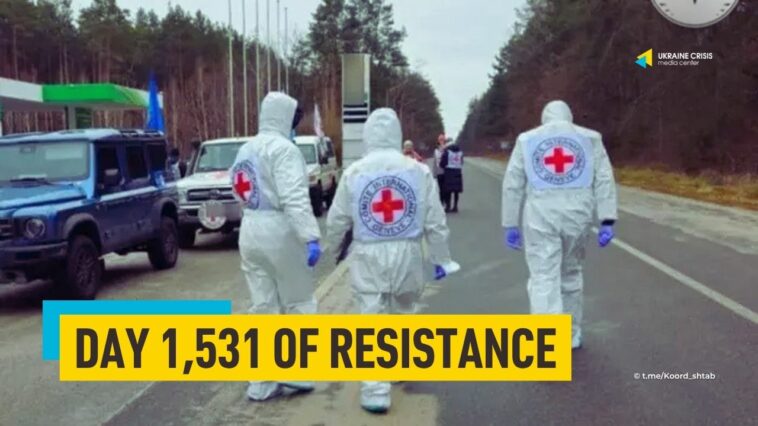
Russia has returned 375 bodies of Ukrainian military and civilians earlier confirmed as war prisoners as part of repatriation measures, head of the secretariat of Ukraine’s Coordination Headquarters for the Treatment of Prisoners of War, Bohdan Okhrimenko told Ukrinform in an interview released on Monday.
“Unfortunately, Russia has returned 375 bodies of Ukrainian military and civilians who were thought to be war prisoners as part of repatriation measures. The International Committee of the Red Cross (ICRC) confirmed it had identified 146 of them as war prisoners. Other 229 people were confirmed as war prisoners thanks to other sources, including testimony by those freed from Russian captivity that said they were alive. Russia returned their bodies bearing the signs of torture, exhaustion and lack of medical treatment,” Okhrimenko said.
Ukraine records all such cases and sends the data to the International Criminal Court, he added.
“According to the Third Geneva Convention, Russia is responsible for the life and health of war prisoners it holds. Whenever it notifies the ICRC that it has taken prisoner military personnel, it guarantees the provision of essential needs, including food, clothes and medical care. Russia does not live up to the commitments, so whenever they send us the bodies of war prisoners, we record the war crimes,” he said.