

Ukraine strikes a military supply center in the Moscow region. The EU countries increasingly issued visas to the Russians in 2025, with France topping the list. Russia says it will launch a strike on “decision-making centers” in Kyiv if Ukraine disrupts its May 9 parade.
Ukraine strikes military supply center in Moscow region
Drones attacked the Nara military supply center in the city of Naro-Fominsk in the Moscow region overnight on Thursday, Exilenova+ Telegram channel said. The facility is part of Russia’s defense ministry.
Eyewitness accounts on social media described hearing the sounds of planes, explosions and air defenses at work across the Moscow region.
Videos posted to social media showed the sounds of explosions and a plume of smoke rising from what appears to be a military facility.
The center covers more than 200 hectares and is used to store and distribute military cargo for the Russian armed forces, Exilenova+ said.
Drones also attacked the city of Rzhev in Russia’s Tver region on Thursday morning. The likely targets were the Elektromekhanika military plant and the 55th arsenal of the Main Missile and Artillery Directorate (GRAU) of the Russian defense ministry.
The city of Cheboksary in the Chuvashiya region also came under a drone attack. The city is home to the VNIIR Progress plant that was targeted earlier this week.
The Russian defense ministry, cited by Russian media, said the air defenses had shot down 347 drones overnight on Thursday. There was no mention of drones that hit target.
The drones were intercepted over the regions of Belgorod, Bryansk, Volgograd, Voronezh, Kaluga, Kursk, Lipetsk, Novgorod, Oryol, Penza, Rostov, Ryazan, Smolensk, Tambov, Tver, Tula, Moscow and Krasnodar as well as over the Republics of Adygeya and Kalmykiya, occupied Crimea, the Azov, Caspian and Black seas.
Flights were temporarily suspended at the airports of Yaroslavl, Gelendzhik, Krasnodar, Izhevsk, Kaluga and at Moscow’s Vnukovo and Domodedovo airports.
EU countries increasingly issued visas to Russians in 2025, with France topping the list
In 2025, EU countries issued more than 10 per cent more Schengen visas to the Russians despite Russia’s war in Ukraine and the sanctions against the country, Euractiv said Wednesday, referring to official data by the European Commission and unnamed diplomatic sources. France issued the highest number of visas to Russian nationals and was one of the countries that most actively opposed the idea of isolating the Russians. The paragraphs below are quoted from the article.
Confidential figures, seen by Euractiv and circulated among national governments, show that Schengen visa issuance to Russian nationals rose in 2025, exposing a gap between Europe’s political rhetoric on isolating the Kremlin and the continued appetite for Russian tourism across parts of the bloc.
According to the figures, Russian nationals submitted more than 670,000 Schengen visa applications in 2025, a nearly 8% increase from 2024. EU countries issued more than 620,000 visas, up 10.2%.
More than 477,000 tourist visas were granted to Russian nationals, accounting for roughly 77% of all visas issued to Russians in 2025, an increase of 8.4% compared to 2024. Visits to family and friends represented the second-largest category, followed by business travel.
The data also broadly reflects a geographic divide between countries far from Europe’s eastern flank – France, Italy and Spain – that feel less threatened by Russia and have long welcomed investment from there, and nations such as Poland and the Baltic states that view the war as an existential struggle.
France, Italy, and Spain accounted for nearly three-quarters of all visa applications submitted by Russian nationals. Baltic and Nordic countries have long argued that Russians should not be able to enjoy leisure travel in Europe while Moscow continues its war against Ukraine.
Paris has received the highest number of applications, with a 23% increase in 2025 compared to the year before. It has also seen the sharpest rise in granting Russian citizens free passes, with a jump of more than 29% in 2025.
In 2025, the numbers [in the “Schengen Barometer”, an internal Commission monitoring tool that tracks Europe’s border-free area — edit.] led to tensions among EU capitals and reopened divisions over the bloc’s Russia policy more than three years after the Kremlin’s full-scale invasion of Ukraine.
The disagreement became visible earlier this year when diplomats noticed that Russian visa data had disappeared entirely from a newer edition of the statistics.
EU officials told Euractiv that several capitals – notably Paris – pushed back over the politically sensitive issue of issuing visas to Russians. Some also argued the row reflects a wider strategic dilemma, whether isolating Russians from the outside world could ultimately backfire by cutting them off from exposure to life beyond the Kremlin’s grip.
After suspending the data, the figures were returned this month in a separate technical document circulated alongside the original barometer, three diplomats said, after eight EU countries raised the issue.
The Commission declined to say whether national governments had exerted any pressure on the issue, but confirmed it provided EU countries with an updated overview of visas issued to Russian nationals in April this year.
The EU is also debating banning Russian nationals with combat experience in Ukraine, with an initiative expected to be presented before June.
In other news, in September 2022, the Council of the European Union fully suspended the visa facilitation agreement between the EU and Russia. The European Commission advised the member states to deprioritize the granting of visas to Russian nationals.
Estonia, Latvia, Lithuania and Poland started to issue full bans on almost all tourist visas for Russian citizens. Finland joined the restrictions policy later that year.
In 2025, the EU further tightened visa restrictions on Russian nationals no longer allowing them to receive multiple-entry visas. This means the Russians have to apply for a new visa each time they plan to travel to the bloc.
Russia says it will launch strike on “decision-making centers” in Kyiv if Ukraine disrupts May 9 parade
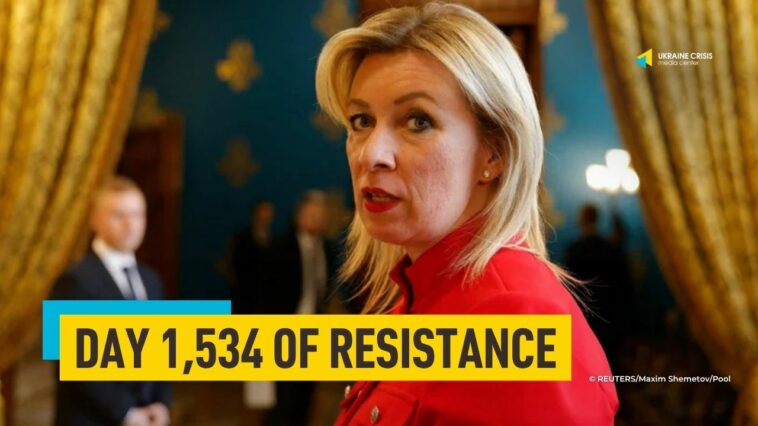
Spokeswoman of the Russian Foreign Ministry, Maria Zakharova on Wednesday urged the diplomatic missions to evacuate staff promptly from Kyiv in the event of a mass strike by Moscow in response to any attempt by Ukraine to disrupt Russia’s May 9 Victory Day commemorations.
“The Russian Ministry of Foreign Affairs strongly urges the authorities of your country to treat this statement with the utmost responsibility and ensure the timely evacuation from the city of Kyiv of the personnel of diplomatic and other representations in connection with the inevitability of a retaliatory strike on Kyiv by Russia’s Armed Forces. This includes on decision-making centers in the event that the Kyiv regime carries out its criminal terrorist intentions during the days marking the Great Victory,” Zakharova said.
Ukrainian President Volodymyr Zelenskyi declared on May 4 a unilateral ceasefire effective at midnight on Wednesday. Russia has ignored it.
Russia said earlier this week it would hold a ceasefire on May 8 and 9 ahead of commemorations Saturday to mark the Soviet Union’s victory over Nazi Germany. Russia’s Defense Ministry said any efforts by Ukraine to disrupt the Victory Day parade would prompt a “retaliatory, massive missile attack” on the center of Kyiv.
Zelenskyi said Wednesday that Russia had violated a ceasefire announced by Ukraine. He added that he would order a mirror-like response.