
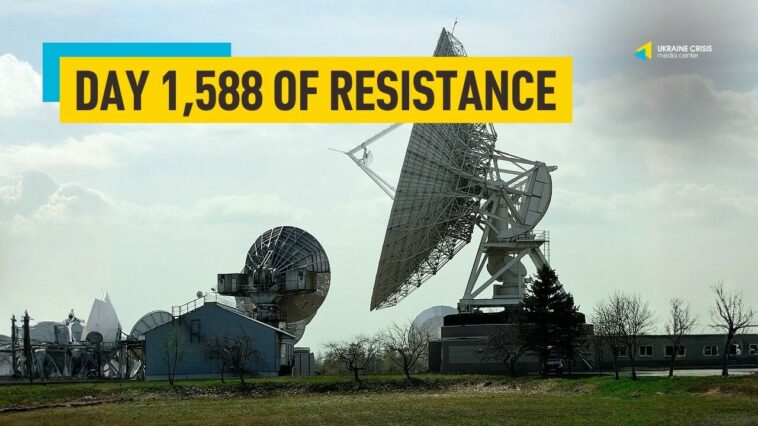
Ukraine strikes a satellite communications center in the Moscow region for the second time. Russia is burning, but don’t expect Putin to give up his military goals in Ukraine, CNN says. Russia expands its LNG dark fleet effort despite the Western sanctions, Bloomberg News says.
Ukraine strikes satellite communications center in Moscow region for second time
The Ukrainian military struck the Dubna satellite communications center in the Moscow region on Tuesday for the second time, Ukrainian President Volodymyr Zelenskyi said in a post to X.
“This is a special satellite communications facility used, in particular, for reconnaissance and for coordinating the activity of Russia’s occupation contingent in Ukraine,” he said, adding “The distance from our state border to this facility is more than 500 kilometers.”
Zelenskyi also said that Ukrainian forces had recently struck four similar Russian centers in the Moscow and Vladimir regions.
“Step by step, we are implementing our plan of long-range sanctions and making it as difficult as possible for the aggressor state to carry out its invasion operations against Ukraine and the occupation of our territories,” Zelenskyi said.
Ukraine is preparing “relevant actions” against other similar sites in Russia, he added.
Sergey Sobyanin, the mayor of Moscow, reported a major drone attack that started around 4 a.m. on Tuesday. He also said that at least 50 Ukrainian drones had been shot down in the capital region.
Telegram channel Exilenova+ released a video of drones flying over the Moscow region. Local residents in Yegorjevsk, outside Moscow, reported an explosion and a fire. Two strikes on the Dubna satellite communications center in the Moscow region hit target, local residents said.
Ukraine’s defense forces struck the Dubna satellite communications center in the Moscow region on June 21.
On June 22, the Russian authorities reported a fresh drone attack on Moscow. Explosions were audible. Sobyanin later said that Russian air defenses had shot down around 80 drones flying toward the capital. A total of 367 flights were delayed or cancelled at Moscow’s airports that day.
Russia is burning, but don’t expect Putin to give up his military goals in Ukraine, CNN says
In the past month, Ukraine’s unprecedented drone campaign has been extraordinary in scale and impact. Now, for the first time in a conflict that is in its fifth year, the stark reality of what the Kremlin still insists on calling a “special military operation” has become impossible for ordinary Russians to comfortably ignore, CNN said on Monday. The paragraphs below are quoted from the article.
It is fueling hope, though, among Moscow’s Western critics.
But it may be a mistake to conclude that Russia’s current problems will force the Kremlin to yield, at least not yet and probably not soon.
Putin over the decades has built a relatively brittle image as an uncompromising leader — a fact that makes capitulation, retreat or even compromise in Ukraine incredibly unlikely and difficult for him to pull off.
With well over a million dead and injured in Putin’s invasion, according to the best Western estimates, and sovereignty claims staked on four Ukrainian regions he still doesn’t fully control, any settlement that cannot be portrayed in Moscow as a decisive victory runs the risk of provoking serious internal political tensions.
The hawks in Putin’s circle are still telling him that Ukraine’s entire Donbas region can and should be taken. That argument doesn’t disappear just because Russian refineries are on fire.
And while the country’s current fuel shortage is painfully real, it should not be mistaken for a white flag.
Russia expands LNG dark fleet effort despite Western sanctions, Bloomberg News says
Despite the Western sanctions, Russia has expanded its shadow fleet of LNG (liquefied natural gas) vessels. It now has 21 ships and continues to include new tankers to illegally transport LNG, Bloomberg News said on Monday. The paragraphs below are quoted from the article.
A liquefied natural gas tanker docked at a US-sanctioned storage unit in Russia’s Murmansk region, the first time the vessel has loaded blacklisted fuel and the latest sign of Moscow’s efforts to expand exports despite Western sanctions.
The Arctic Express, which changed its flag to Russian in May, loaded fuel at the Saam floating storage unit, which holds gas from the Arctic LNG 2 project. Both Saam and Arctic LNG 2 have been sanctioned by the US.
The shipment suggests Russia is continuing to expand its fleet of vessels to circumvent Western restrictions. Including Arctic Express, at least 21 ships have been used to ferry LNG from sanctioned Russian projects, according to a Bloomberg analysis of tracking data. The biggest obstacle to increasing exports from Arctic LNG 2 remains the shortage of vessels capable of transporting the fuel to willing buyers.
The tanker, which was commissioned in 2007 and was formerly managed by a Greek company, changed ownership to St Petersburg-based Smp Techmanagement LLC around May 13, according to ship database Equasis. Smp Techmanagement owns three other LNG vessels that are part of Russia’s dark fleet.
Arctic LNG 2 exported over 400,000 tons of the fuel in May, a record high for the facility which began shipments in 2024, ship data shows.

