

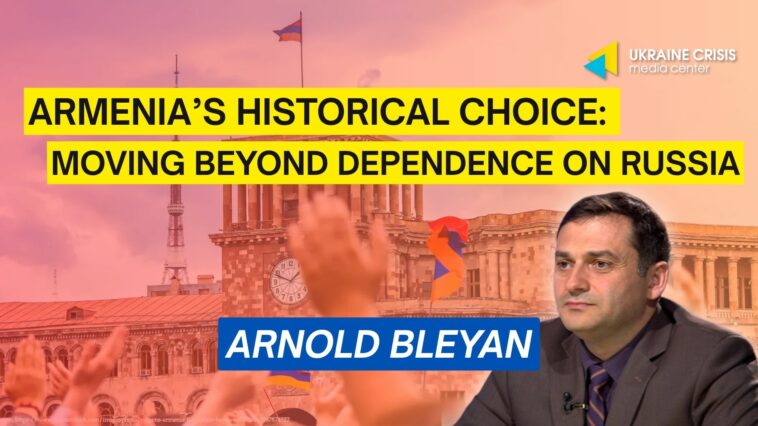
The Ukraine Crisis Media Center publishes the speech by Arnold Bleyan, Director of the Armenian Center for Democracy and Security Affairs, on Russian influence operations during election campaigns in Eastern Partnership countries.
The expert discussion, “Russian Influence Operations During Election Campaigns: Europe’s Experience and Lessons for Ukraine,” took place on 20 May 2026 at UCMC.
On the eve of election day, Armenia faces a a decisive choice.
For a long time, a significant part of Armenian society perceived the Russian Federation as the main guarantor of security. However, the events of recent years have radically changed this perception. The key turning point was the 2020 war, followed by Azerbaijan’s actions against Armenia, the crisis around Karabakh, and the inaction of Russian “peacekeepers.” Armenian society saw that Russia had failed to act as a security guarantor – neither in Karabakh nor with regard to Armenia’s sovereign territory in 2021–2022.
These events destroyed the myth of Russia as a force capable of protecting Armenia from external threats. An increasing number of Armenian citizens understand that the Russian presence does not guarantee security; on the contrary, it often creates additional risks. Notably, support for the European course is expressed not only by young people, but also by representatives of the older generation, who spent most of their lives in the Soviet Union. Even for them, it has become clear that the old perception of Russia as Armenia’s protector no longer corresponds to reality.
That is why Armenia is increasingly seeking partnerships with the West – the European Union, the United States, the United Kingdom, and individual European states. Western observers on the Armenian-Azerbaijani border have become an important element of the new security architecture. Experience has shown that when Russian influence decreases, the situation in certain areas becomes more stable. For Armenia, this means the need to strengthen its sovereignty, diversify its external relations, and gradually reorient its economy away from the Russian market toward Europe, India, and other directions.
For the Russian Federation, losing Armenia would mean a serious weakening of its position in the South Caucasus. That is why Moscow is acting according to several scenarios. The maximalist scenario is to bring Armenia back under its control through a change of government and the installation of a loyal administration that would block pro-Western agreements with the EU, the United States, and regional partners. The minimal scenario is to strengthen the pro-Russian opposition, provoke post-election destabilisation, and limit the current government’s freedom of action.
Russia uses a broad set of instruments of influence: support for pro-Russian political forces, economic pressure, disinformation, and work through business circles, religious structures, and networks linked to former elites. Opposition parties associated with former presidents Robert Kocharyan and Serzh Sargsyan play a particularly important role. The problem is that a significant part of the current parliamentary opposition is not genuinely sovereign and Yerevan-oriented, but rather aligned with Moscow.
Therefore, Armenia’s main task is not only to protect the current pro-Western course, but also to develop a normal sovereign opposition. Democracy cannot develop sustainably if society’s choice is reduced to a confrontation between the government and pro-Russian forces. Armenia needs an opposition that is critical of the government, but at the same time Armenian-oriented, democratic, and committed to strengthening the country’s independence.
Thus, the Russian scenario of regime change in Armenia is possible, but not predetermined. Moscow has resources, networks of influence, and an interest in destabilisation; however, Armenian society has already largely reassessed Russia’s role.
Armenia’s further resilience will depend on its ability to strengthen democratic institutions, expand cooperation with the West, improve relations with its neighbours, and finally move beyond the paradigm of dependence on the Russia.