

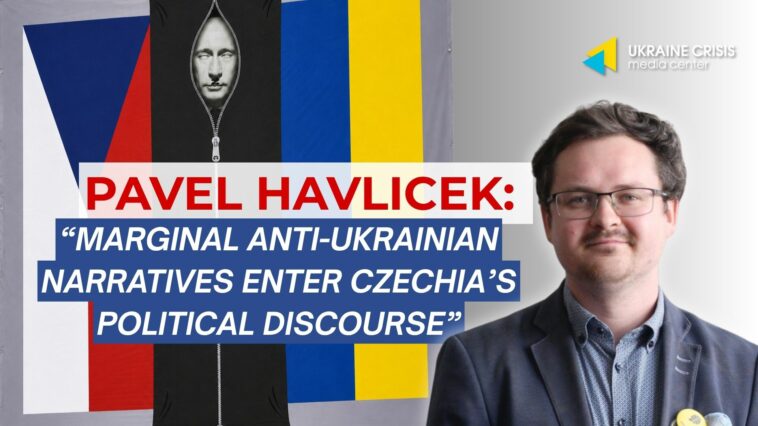
The Ukraine Crisis Media Center publishes the speech by Pavel Havlíček, Research Fellow at the Association for International Affairs (Czechia), on Russian influence operations during electoral campaigns in EU countries. The expert discussion “Russian Influence Operations During Electoral Campaigns: Europe’s Experience and Lessons for Ukraine” took place at UCMC on 20 May 2026.

Pavel Havlíček: The discourse of 2025 Parliamentary election campaign in Czechia was shaped mainly by domestic political factors. Direct Russian influence on the electoral process was limited. At the same time, certain information operations were still recorded, particularly on TikTok, where messages supporting radical political forces were promoted. Their overall impact was less significant than in other countries of the region; however, the very fact that such operations took place indicates the existence of a stable environment for the spread of pro-Russian and anti-Ukrainian messages.
The key narratives promoted during the campaign, and still present today, include claims that Ukrainian refugees allegedly increase crime rates, abuse the social welfare system, and take jobs away from Czechs. A separate set of narratives focuses on “corrupt Ukraine,” which supposedly does not deserve financial or political support. These messages intensified amid discussions about Ukrainian anti-corruption institutions, which Czech radical political forces have used to discredit Ukraine.
Another important strand of the disinformation campaign is the claim that the Ukrainian authorities and the President of Ukraine are allegedly illegitimate due to the absence of elections under wartime conditions. Such statements are increasingly moving from the margins into the political mainstream. It is particularly alarming that this rhetoric is voiced not only by radical parties, but also by certain representatives at the parliamentary level. This creates additional pressure on Czech policy towards Ukraine.
At the same time, it is important to emphasize that radical anti-Ukrainian forces, primarily the SPD bloc and «Stačilo!», did not receive decisive public support. Their electoral results were limited, while left-wing radical forces failed to enter parliament altogether. However, the problem is that these parties, or their representatives, now have the opportunity to influence government decisions and the political agenda. As a result, even relatively limited electoral support may turn into disproportionate political influence.
For Ukraine, this situation means that more active and systematic engagement with Czechia is needed. It is not enough to respond only to disinformation. Ukraine should also promote a positive agenda: opportunities for economic cooperation, the role of the Ukrainian community, the contribution of Ukrainians to Czech society, and Ukraine’s practical experience in resilience, security, and countering Russian threats.
Despite the difficult political situation, there is still room for cooperation. The Czech government demonstrates a pragmatic approach and remains interested in Ukraine’s practical experience, particularly in countering Russian aggression and strengthening societal resilience. These opportunities should be used through political dialogue, business formats, academic contacts, and engagement with civil society. This kind of multi-level interaction can help reduce the influence of radical narratives and keep Czechia among Ukraine’s important partners.