
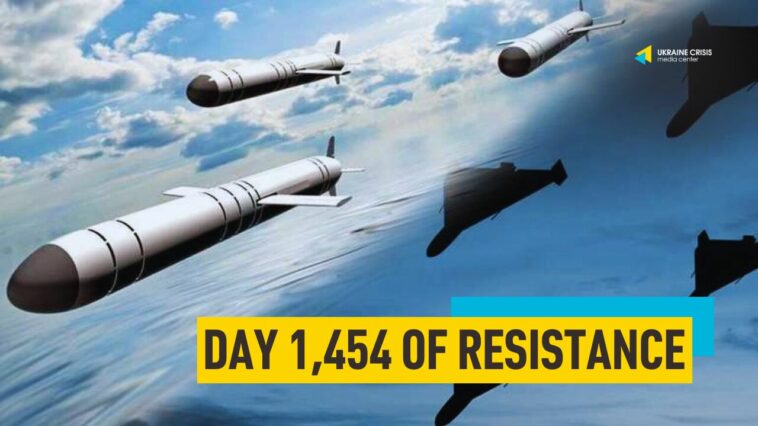
Russia is preparing another major aerial attack, Zelenskyi says. Russia launches 91 ballistic missiles at Ukraine in January, the war’s highest monthly total. Ukraine’s counterattacks hinder Russia’s advance in two regions, ISW says.
Russia preparing another major aerial attack, Zelenskyi says
Intelligence reports suggest that Russia is preparing a major aerial attack on Ukraine, President Volodymyr Zelenskyi said in a post to social media, describing a coordination call he said happened on Monday.
“I instructed the Commander of the Air Force of the Armed Forces of Ukraine, Anatolii Kryvonozhko; the Minister of Defense of Ukraine, Mykhailo Fedorov; and the Chairman of Ukrenergo, Vitalii Zaichenko, to prepare additional protective measures throughout the day, taking into account intelligence [reports] on Russia’s preparation for a massive strike,” Zelenskyi said on X.
Zelenskyi also said that Russia once again targeted Ukraine’s energy grid with missiles last night.
“There was a report on the consequences of last night’s strike — the Russians launched missiles against our energy facilities. Our air defense systems responded. Even on the eve of the trilateral meetings in Geneva, the Russian army has no orders other than to continue striking Ukraine. This speaks volumes about how Russia regards the partners’ diplomatic efforts,” he detailed.
In the past week alone, Russia launched around 1,300 attack drones, more than 1,200 glide bombs and 50 missiles at Ukraine, with most of the missiles being ballistic ones, Zelenskyi said in a post to X Sunday. Ukraine’s energy facilities remain the main target of the attacks, he added.
Russia “deliberately combine[s] strikes to destroy our generation facilities, substations, and grid,” he said.
Ukraine’s Air Force said Russia had launched four Zircon anti-ship cruise missiles, an Iskander-M ballistic missile, a Kh-31P air-launched cruise missile and 62 drones toward Ukraine, including Shahed, Gerbera and Italmas attack drones and unmanned aerial systems of other types.
Ukraine’s air defenses shot down or otherwise neutralized two Zircon missiles and 52 drones. One missile and nine drones hit target in eight locations, and debris from missiles and drones fell in two sites, the Air Force added. Reports of another three missiles are being clarified.
Russia launches 91 ballistic missiles at Ukraine in January, war’s highest monthly total
Russia launched 91 ballistic missiles at Ukraine in January, the war’s highest monthly total, Ukraine’s Defense Ministry said in a post to Telegram Monday.
The ministry said it was working with Ukraine’s international partners to accelerate the shipments of missiles for the MIM-104 Patriot air defense systems. The Patriot has proved to be the most efficient air defense system that Ukraine is operating.
The latest meeting of the Ukraine Defense Contact Group saw several countries commit to urgently sending interceptor missiles for the Patriot systems from their stocks, the message reads.
Ukraine’s counterattacks hinder Russia’s advance in two regions, ISW says
Russian gains continue to move at a footpace and do not portend the collapse of the Ukrainian lines, the Institute for the Study of War said in an update on Sunday. The paragraphs below are quoted from the report.
Russia’s weekly advances between late November 2025 and mid-February 2026 have fluctuated widely. At their height, Russian forces seized 141 square kilometers the week of January 25-31, but Russian gains subsequently fell to 74 square kilometers in the past week (February 8 to 14).
Ukrainian forces liberated territory in November and December 2025, decreasing Russian gains during some weeks. Ukrainian forces liberated territory in the Kharkiv, Kostyantynivka, Pokrovsk, and Novopavlivka directions in late November and early December, such that Russian forces lost control over 106 square kilometers of Ukrainian territory. Ukrainian forces also liberated much of Kupyansk and its surroundings in late December, and Russian forces lost control over 305 square kilometers.
Recent Ukrainian tactical counterattacks have reportedly liberated multiple small settlements along the Yanchur and Haichur rivers in the Oleksandrivka and Hulyaipole directions. Ukrainian military observer Kostyantyn Mashovets stated on February 15 that the tempo of Russian advances in the Oleksandrivka and Hulyaipole directions began to slow about one week ago (starting roughly February 8) and has since largely stopped. Mashovets assessed that Ukrainian forces have been able to significantly reduce Russian advances in a few narrow sectors of the Oleksandrivka and Hulyaipole directions, pushing Russian forces back nine to 9.5 kilometers in some areas.
Mashovets stated that Ukrainian forces pushed Russian forces from Oleksiivka and Orestopil and advanced to Berezove and Ternove (all southeast of Oleksandrivka). Mashovets stated that Ukrainian forces also pushed Russian forces from Danylivka; liberated Vyshneve, Yehorivka, Zlahoda, and Rybne (all southeast of Oleksandrivka along the Yanchur River); and are fighting for Pryvilne (just southeast of Rybne along the Yanchur River).
Mashovets reported that Ukrainian forces pushed Russian forces from Ternuvate and Kosivtseve (both northwest of Hulyaipole), crossed the Haichur River, liberated Dobropillya (north of Hulyaipole and east of the Haichur River), and are currently operating east of Dobropillya. Mashovets reported that Ukrainian forces pushed Russian forces from Pryluky and Olenokostyantynivka (both northwest of Hulyaipole), crossed the Haichur River, and have begun fighting for Varvarivka (just south of Pryluky and east of the Haichur River). Mashovets reported that Ukrainian counterattacks along the Tsvitkove-Zaliznychne line (northwest to west of Hulyaipole) stopped Russian advances but that Russian forces still advanced up to 1.2 kilometers south of Zaliznynche.
Mashovets, noted, however, that Ukrainian forces are not conducting a “counteroffensive” – in line with recent Ukrainian official statements denying Russian milblogger claims that Ukrainian forces launched a “counteroffensive” in the area. ISW uses the term “counteroffensive” to refer to a large-scale operational-level undertaking such as those that liberated much of Kharkiv Oblast and western Kherson Oblast in 2022. It uses the term “counterattack” to refer to the smaller, tactical actions Ukrainian forces have been conducting recently in Zaporizhia Oblast.
These Ukrainian counterattacks are likely leveraging the recent block on Russian forces’ access to Starlink, which Russian milbloggers have claimed is causing communications and command and control (C2) issues on the battlefield.
Recent tactical Ukrainian counterattacks in the Oleksandrivka and Hulyaipole directions have likely further hindered Russian forces’ ability to properly prepare for a summer offensive toward Orikhiv and Zaporizhzhia City from the east.


