
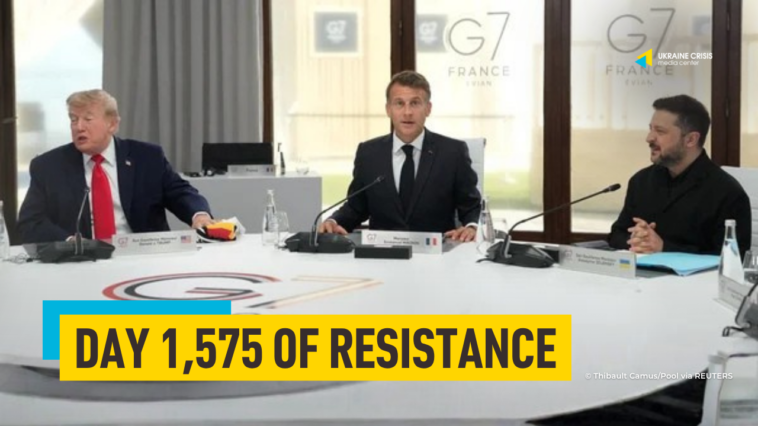
The G7 leaders commit to fresh pressure against Russia through sanctions and additional air defense deliveries to Ukraine. Trump is ready to back Europe on Ukraine in exchange for European help to secure the Strait of Hormuz, Politico says. Eighty-eight per cent of Ukrainians want a change of the central government after the war ends, a poll finds.
G7 leaders commit to fresh pressure against Russia through sanctions, air defense deliveries to Ukraine
Ukrainian President Volodymyr Zelenskyi lauded the G7 summit in France, saying that it had “delivered important results for Ukraine.”
“Most importantly, we agreed on additional strengthening of Ukraine’s air defense,” Zelenskyi said on X on Wednesday.
He announced new steps — without naming them — that will exercise additional pressure on Russia over its war in Ukraine. He also said Ukraine’s partners will support the country’s “defense and energy resilience.”
“It is important that we have a shared understanding of the main challenges and concrete steps to respond to them. Our global unity is truly reducing Russia’s ability to continue this insane and criminal aggression against Ukraine,” Zelenskyi said.
In a joint statement issued on Wednesday, the G7 leaders committed to “increase the delivery of air defence capacities, additional systems and interceptors, and long-range capabilities” to Ukraine and “to consider extending to Ukraine the benefit of licenses to allow for an increase in Ukraine’s military production.”
They also restated their unwavering support to the country in the face of systematic Russian attacks against its critical infrastructure and cultural heritage sites. They also commended Ukraine “for its resilience and progress on the battlefield in recent months” and emphasized “there is now a new momentum.” New deliveries of air defenses will come in support and acceleration of this new momentum, they said.
The statement also says the G7 countries will support measures that will increase Ukraine’s energy resilience ahead of the next winter. The leaders also vowed to strengthen pressure against Russia through sanctions, particularly against its oil and gas sectors.
Trump ready to back Europe on Ukraine in exchange for European help to secure Strait of Hormuz, Politico says
In closed-door discussions at the G7 meeting in France, U.S. President Donald Trump stated he was ready to support Ukraine and put more pressure on Russia in exchange for Europe’s involvement in demining in the Strait of Hormuz, Politico said on Tuesday. The paragraphs below are quoted from the article.
Group of Seven leaders came to Évian-les-Bains braced for a blowup with U.S. President Donald Trump over Iran and the war in Ukraine.
Instead, they emerged from the first full day of G7 talks unexpectedly optimistic about their relationship with the White House — and a bit less nervous about whether next month’s critical NATO summit in Turkey will go off the rails, according to two senior EU diplomats. The reason?
Trump’s apparent openness to increasing pressure on Russian President Vladimir Putin to end his war against Ukraine, and his need for help from allies to stabilize a framework ceasefire agreement with Iran. The contours of a deal in which Trump backs Europe on Ukraine in exchange for European help securing the Strait of Hormuz — the major waterway whose closure during the war with Iran sent energy prices skyrocketing — appear to be taking shape.
“The discussions we’ve had among ourselves and with the U.S. president — both in official meetings and in informal encounters on the sidelines — give me a certain sense of optimism,” German Chancellor Friedrich Merz told journalists on Tuesday.
While diplomats cautioned against being too optimistic, pointing out that Trump has previously reversed himself after making pro-Ukraine statements, they also echoed the German leader’s assessment of transatlantic relations despite Trump’s individual spats with many of the G7 leaders.
“He [Trump] will need the capacities of his allies of the G7 and others … to clear Hormuz of mines,” said one of the diplomats.
In exchange, “there’s got to be some give on Ukraine,” added the diplomat. “There’s a very strong expectation that he will stand by Ukraine. That’s what he told the leaders.”
G7 leaders, in response, signaled they were ready to help — under certain conditions.
Macron said the deployment of mine-clearing ships “needs to be requested and wished for by the United States and then Iran and Oman, the parties involved in the deal.”
Eighty-eight per cent of Ukrainians want change of central government after war ends, poll finds
An overwhelming majority of Ukrainians envision a change of central authorities after the war ends, a survey conducted by the Kyiv International Institute of Sociology between May 7 and June 3 found. The pollster released its results on Wednesday.
Eighty-eight per cent want at least one of the branches of the central government to change after the war. It is an increase from 73 per cent recorded three years ago, director of the Kyiv International Institute of Sociology, Anton Hrushetskyi is quoted as saying in a press statement accompanying the survey results.
Sixty-seven per cent of Ukrainians want a new president to be elected after the war, an increase from 23 per cent in 2023. The share drops to 33 percent among those who approve President Zelenskyi’s job handling. Ninety-seven percent of those who don’t trust the president want a new incumbent after the war.
At the same time, the largest share of Ukrainians — 83 per cent, want a fresh parliament to be elected after the war ends. Seventy-four per cent want a new cabinet of ministers.
Sixty-three per cent say they want all branches of the government to change.
The Kyiv International Institute of Sociology emphasized that the questions concerned the post-war time. All current surveys show that Ukrainians oppose war-time elections.
The omnibus survey was conducted through computer-assisted telephone interviews (CATI), using a random sample of cell phone numbers. The total sample of the poll consists of 1,000 Ukrainians ages 18 and older who live in government-controlled Ukrainian territory. The margin of error at the 95 percent confidence level with a design effect of 1.3 would not exceed 4.1 percentage points, the pollster said.

