
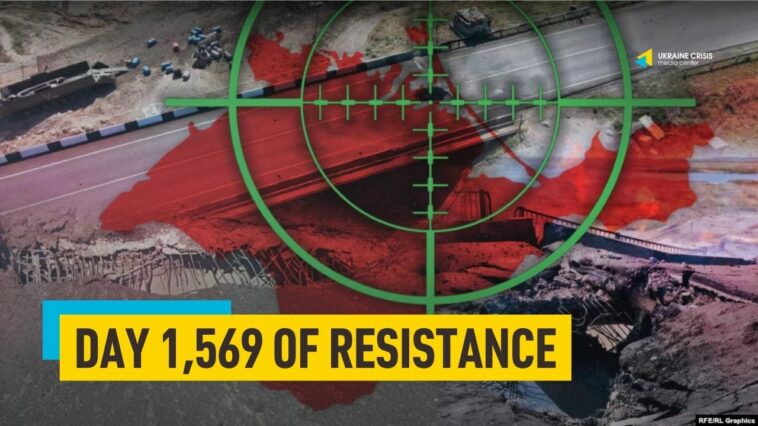
Ukraine cuts off routes to Crimea for Russian troops. Ukrainian drones strike the Afipsky oil refinery, triggering a large fire. Ukraine ranges Russian supply lines near Mariupol in a full, permanent, round-the-clock manner.
Ukraine cuts off routes to Crimea for Russian troops
Explosions rocked Crimea and Russia’s Krasnodar region overnight on Thursday. Locals on social media said the bridges at the land entrance to Crimea near the Isthmus of Perekop were damaged, there were fires near Sevastopol and Simferopol and air defenses were at work in the Krasnodar region.
The Ukrainian military struck a convoy of around 50 trucks that were moving through Armyansk after traffic across the Chonhar bridge was halted, commander of the Dmytro Kotsyubaylo 1st Assault Regiment, Dmytro Filatov who goes by the call sign Perun, told Ukrainian public broadcaster Suspilne on Thursday.
The Chonhar bridge sustained critical damage. Cargo and passenger traffic across the bridge was suspended. The bridge needs comprehensive repair work. Russia is building pontoon crossings nearby, Filatov said. They also changed their supply routes, they now run through Armyansk. Ukraine maintains full control of the situation, he added.
“Today, the traffic there was completely halted. We carried out yet another operation. We will later share how it went. After the Chonhar bridge was damaged, the enemy massed a large number of trucks with military supplies moving through Armyansk. During the attack, we succeeded to hit the trucks that were carrying fuel and ammunition. There were around 50 vehicles there, and we destroyed part of them,” Filatov said.
The Ukrainian military decided to hit the Chonhar bridge because they had intelligence that the enemy will use it to transport fuel. “Six hours passed between the decision and its implementation. We planned in advance the operation that targeted the bridge. We anticipated that they will use this way as well. That’s why we acted in advance,” he said.
He also said the operation would have not been possible if other units hadn’t launched strikes against Mariupol and the road toward Berdyansk. “This is what led to a situation when the units deployed to the Hulyaipole direction are supplied not through the roads of Mariupol, but through Crimea. They started to use pontoon crossings to send trucks to Crimea and then travel here from Crimea. We got it and started to block their routes quite quickly. We continue to further weaken the adversary,” Filatov said.
Ukraine drones strike Afipsky oil refinery, triggering large fire
Ukrainian drones struck the Afipsky oil refinery in Russia’s Krasnodar region overnight on Thursday, triggering a fire at the facility.
Reports on social media said the attack began after midnight. Drones were heard passing by with several-minute breaks.
Videos posted to social media show air defenses at work and a large fire at the plant.
Russian officials in the Krasnodar region said falling drone debris fell in the town of Afipsky, causing a fire.
The Afipsky oil refinery is one of the largest in southern Russia. It processes more than 6 million tons of crude annually. The facility manufactures fuel that is used to supply the Russian army.
It has been frequently targeted in Ukraine’s aerial attacks. It was struck a number of times in August, September, November and December 2025, triggering fires.
During the previous strike on March 14, 2026, drones damaged the AT-22/4 primary crude oil processing unit, the refinery’s key technological part.
Ukraine ranges Russian supply lines near Mariupol in full, permanent, round-the-clock manner
Western technology combined with expertise of local researchers and developers has allowed Ukraine to range the enemy’s supply lines that sit 160 kilometers behind the front line in a full, permanent and round-the-clock manner, Officer for Defense Sector Engagement of the 12th “Azov” Brigade of the National Guard of Ukraine, Mykyta Puz told the New Age Defense Forum in Berlin.
The current frontline is a blurred line, 30 to 40 kilometers wide that combines Ukrainian and Russian positions, trenches and mines.
Heavy military equipment can only move for some distance there until it gets noticed and destroyed.
Ukrainian troops are doubling efforts to expand an area within range. He cited an example of the occupied city of Mariupol that came within range. Mariupol is 160 kilometers away from where the Ukrainian military is deployed to.
Ukraine’s attacks on Russian trucks, fuel reserves and manpower resulted in a Russian ban to move military trucks to the 100-kilometer zone that precedes the front line. The area could be expanded to 200 kilometers, Puz said.
The longer Russian supply routed are becoming, the less possibilities they have in the front line.

