
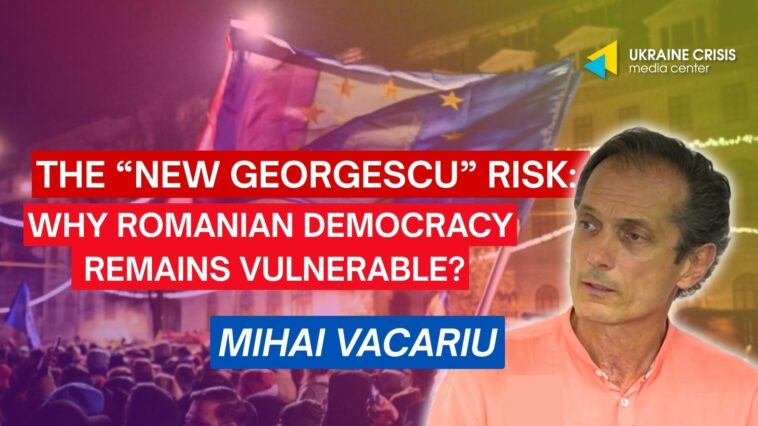
Ukraine Crisis Media Center publishes a commentary by Mihai Vacariu, Associate Professor at the Faculty of Journalism and Communication Studies, University of Bucharest, Romania, on Russian influence operations during election campaigns in European countries and their implications for Ukraine. The expert discussion “Russian Influence Operations During Election Campaigns: Europe’s Experience and Lessons for Ukraine” took place at UCMC on May 20, 2026.
In my view, anti-Ukrainian rhetoric was not a central factor in mobilizing voters for populist and radical forces in Romania during the 2024–2025 election campaigns. Such narratives did exist, but their influence remained limited.
At the same time, the situation in Romania remains dangerous not because of anti-Ukrainian naratives, but because of the broader trend of radicalization, distrust in the political system, and the vulnerability of the information space.
The most telling case was that of Călin Georgescu, who, only a few weeks before the 2024 presidential election, was still almost unknown to a significant part of society, yet managed to unexpectedly win the first round. This was no coincidence: his networks had been developing for years, including through contacts with former military personnel, pensioners, and circles receptive to anti-democratic and pro-Russian messages
This case shows that Russia and the networks linked to it operate not only through overt propaganda, but also through the long-term cultivation of political projects, social connections, and channels of influence. These networks may remain largely invisible to the broader public for years, and then rapidly activate at a moment of political crisis. That is why the danger lies not only in a specific candidate, but in the infrastructure of influence behind him.
Romania also demonstrates the weakness of European democratic systems in countering such threats. Unlike Moldova, where the authorities under Maia Sandu acted quickly and firmly against Russian propaganda, vote-buying, pro-Russian parties, media outlets, and organizations, Romanian institutions often appear slow and insufficiently competent. The problem lies not only in a lack of resources, but also in the absence of political will and a clear response strategy.
The current political crisis in Romania is particularly alarming. Amid economic instability, government conflicts, and declining trust in traditional parties, radical forces may gain additional electoral momentum. When extremists remain in opposition, they are in a convenient position to criticize the government, mobilize protest voters, and accumulate political capital ahead of the next elections.
To explain this phenomenon, it is not enough to speak only about voters’ individual views. Collective psychology, social media, and emotions are far more important. In Georgescu’s case, many voters did not necessarily believe in him as a political leader. They voted for him as a tool to punish the old political system. It was a choice driven by anger, disappointment, and a desire to punish traditional politicians.
Instead, the mobilisation against radical populists and support for Nicușor Dan in 2025 were driven by another powerful emotion: fear. Part of society united around the awareness of the threat posed by radicals coming to power. Thus, the Romanian experience shows that modern elections are increasingly shaped not only by programmes or ideologies, but also by the clash of basic collective emotions: anger and fear.
That is why countering disinformation must combine three elements: analysis of societal emotional dynamics, engagement with the social media ecosystem and ensuring swift institutional action. Russia is constantly learning, adapting its tactics, and refining its methods of influence, including on the basis of its war against Ukraine. The greatest risk is that by 2028 a “new Georgescu” may emerge – with updated technologies, new channels of mobilisation, and an even more precise ability to exploit public discontent.
Unless democratic states begin to act faster, more decisively, and more systematically, Russia will find it relatively easy to exploit existing vulnerabilities. The conditions for this are already present: distrust of elites, economic problems, informational vulnerability, and the limited responsiveness of state institutions create favourable ground for new influence operations.

