
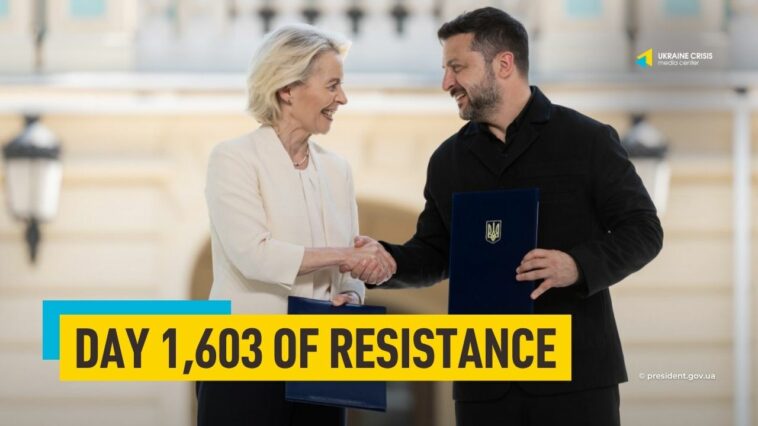
Russian attacks on the cities of Sumy and Odesa, on the regions of Dnipro and Zaporizhzhia kill eight. Ukraine and the EU agree a drone deal, von der Leyen says. Graham’s sanctions bill on Russia softened after talks with the White House, Reuters says.
Russian attacks on cities of Sumy and Odesa, on regions of Dnipro and Zaporizhzhia kill eight
Russia dropped six glide bombs on Sumy on Wednesday morning, killing three people and injuring 21 others. The victims are a 75-year old woman and two men ages 54 and 77. Eight people, including two children, were taken to hospital. Four people, including a 16-year old boy, underwent surgery and remain in a grave condition, head of the regional military administration, Oleh Hryhorov said.
The attack damaged a dozen buildings, including medical facilities, apartment and office buildings, and cars parked nearby, he added.
A Russian missile attack on Odesa on Wednesday morning killed three people and injured eight others. The strike damaged an apartment building, a non-residential building and a gas pipeline, igniting a fire, head of the regional military administration, Oleh Kiper said. Russia continues to attack Odesa and the wider region with missiles and drones for the fifth day in a row, he added.
A Russian drone attack on the Sofiyivka community in the region of Dnipro set fire to a truck, killing a 62-year-old driver, head of the regional administration, Oleksandr Hanzha said. A 13-year-old boy and a 69-year-old woman were injured in the Hleyuvatka community. They received the necessary treatment, he added.
A Russian FPV drone hit a truck near Kalynivka in Zaporizhzhia region. The driver was killed, head of the regional military administration, Ivan Fedorov said.
Drone attacks on Zaporizhzhia and Vilnyansk injured two women, he added. They are receiving medical treatment.
Ukraine, EU agree drone deal, von der Leyen says
Ukraine and the EU have agreed a defense industrial partnership, or a “drone deal,” as European Commission President Ursula von der Leyen referred to it, speaking at a ceremony to mark Ukraine’s Statehood Day in Kyiv on Wednesday.
“Every day, Ukraine is making Europe stronger. And this is why today I say: Ukraine has – in many ways – gone from being a buyer to a net security provider for Europe. And that also entails a new way of working together. And that is why I am delighted to launch, together with you, Volodymyr, a new EU-Ukraine Defence Industrial Partnership. What we are signing today is our very own Drone Deal,” von der Leyen said.
Ukraine has a unique battlefield experience, including that in the field of drones and anti-drone systems, she continued. “We must tap into this together, because we know the threats that Europe faces in this area — we have seen incursions and alerts across many Member States,” she said, adding: “We have safe and secure production sites that can help to scale up.”
The deal will send a clear message that “now is the time to invest in Ukraine, because this means to invest in Europe, and to invest in our common security and our common future.”
Ukraine’s Cabinet of Ministers adopted a transparent procedure for “controlled exports” of domestically produced weapons on July 1.
Ukraine’s then Defense Minister, Mykhailo Fedorov, writing in English on X on July 1 said: “We’ve launched a transparent export mechanism for our key partners under the Drone Deal framework, as initiated by President [Zelenskyi]. This gives our manufacturers clear rules to scale production and attract global investment, while keeping our Armed Forces’ needs as the 100% priority.”
On July 2, the Secretary of Ukraine’s Security and Defense Council, Rustem Umerov, said the country had sealed six drone deals. Twenty more states were on their way to join the accords.
Ukraine hopes to sign major defence deals with at least seven Nato countries by the end of the year, according to a top official, highlighting a new aspect of Kyiv’s foreign policy intended to show it can be a provider as well as a recipient of military hardware and expertise, the Guardian said on July 6.
Graham’s sanctions bill on Russia softened after talks with White House, Reuters says
U.S. senators on Tuesday unveiled an updated version of the Russia sanctions bill, championed by the late Senator Lindsey Graham, which eases the original proposal’s tariff threat on China, India and other importers of Russian oil and gas, Reuters said on Tuesday. The paragraphs below are quoted from the news piece.
The bill, backed by both Republican and Democratic senators, seeks to impose sanctions on Russian officials and to use tariffs to pressure China and India to reduce their dependence on Russia as an energy supplier.
The bill is changed from the original version introduced by Graham, a Republican from South Carolina, and Richard Blumenthal, a Connecticut Democrat, in April 2025.
The new version of the measure eases tariffs that could be placed on third-party buyers of Russian oil and natural gas to a maximum of 100% on the top five purchasers, from the previous proposal’s blanket 500%.
It also allows an exception for countries which import less than 15% of Russia’s natural gas exports and which are taking significant steps to reduce those imports, which could exempt Japan, France, Hungary and Belgium.
The bill is a compromise that received support from the Republicans, Democrats and the Oval Office, people familiar with the matter said, the Wall Street Journal said on Tuesday.
The top five importers of Russian crude oil in 2025 were China, India, Slovakia, Hungary and Azerbaijan, said Blumenthal. The top five importers of Russian natural gas last year were China, France, Japan, Hungary and Belgium.
The measure also imposes sanctions on Russia’s shadow fleet of tankers that do not depend on Western maritime services, on Russian financial institutions including the Central Bank of the Russian Federation, and on Russia’s largest state-owned energy projects, including Yamal LNG and Arctic LNG 1, 2 and 3.
In addition, the new version includes a provision that allows Trump to waive the sanctions if he deems it in the U.S. national interest to do so.
Asked about the softening of some of the provisions from the original bill, one of the Senate aides noted the months of negotiations that had gone into getting a deal with Trump.
“This is the only product that currently has buy-in from everybody and is likely the only product that is going to move forward and put pressure on Russia the way we would all like to get,” the aide said. The aide spoke on condition of anonymity because discussions surrounding the bill were confidential.
Trump told reporters at the White House earlier on Tuesday that sanctions on Iran and Hezbollah might be added to the bill, saying it would be a “very big thing” if those measures were added. Blumenthal expressed caution, however, about adding new targets in the bill. “With all due respect to the president, he has approved this bill, and we should move forward with this bill rather than opening it, in my view, to other potential targets,” Blumenthal told reporters.
The proposed bill would be the first time that Congress has authorized the use of tariffs as a geopolitical weapon, analysts say, according to the Wall Street Journal.
“They may well not be used as intended to pressure Russia, but rather as a way for Trump to wage trade wars against friends and foes alike,” said Edward Fishman, a former senior U.S. sanctions official who now runs the geoeconomics program at the Council on Foreign Relations.
He also assumed that the White House was eager to support the bill, understanding that it will grant Trump more freedom when it comes to tariffs.

