
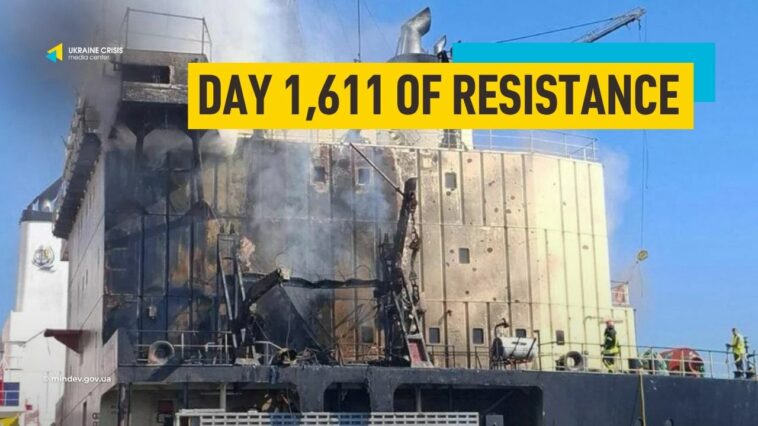
Vessels stopped entering Ukraine’s Black Sea ports due to a threat of Russian attacks. Ukrainian drone attacks damage approximately 10 per cent of Wildberries’ logistics capacity. Rubio meets with Lavrov, says diplomacy needs “new ideas”.
Vessels stopped entering Ukraine’s Black Sea ports due to threat of Russian attacks
As of Wednesday, no vessels entered Ukraine’s Black Sea ports due to a threat of Russian attacks, Ukrainian Minister of Agrarian Policy and Food, Taras Vysotskyi told reporters.
Vessel arrivals at the ports were halted by ship owners, the state did not impose any restrictions on movements, Vysotskyi said.
“Yesterday, four-five ships entered the ports. That’s not many, but the movement was there. Today, vessel arrivals stopped. These are ship owners’ decisions, the state has imposed no restrictions,” he said.
It is yet too early to “speak about the full blockade of the sea exports,” he added.
Vysotskyi also said that the government is working on solutions that will help to restore shipping. He did not provide any details.
The situation may change daily. Faced with sharply increasing risks, ship owners at first halt operations, assess new circumstances, and later begin to adapt to them.
Changes in the level of exports are visible over the course of several months or a year. The actual situation only lasts four days and has no critical impact on export volumes, Vysotskyi said.
Russia has introduced a temporary ban on vessel movements in and out of the port of Novorossiysk between midnight and 5 a.m. because of Ukrainian drone attacks, three grain industry sources said on Wednesday, according to Reuters.
The sources said the order was verbal and that no official document had been sent to shippers. They said the port was functioning as usual outside the restricted night-time hours, and grain shipments had not been affected.
A government order published on July 21 banned vessels from anchoring in areas without air defences at the port of Azov in the Sea of Azov and the port of Kavkaz in the Kerch Strait.
The port of Novorossiysk became a key logistical and operational hub for what remains of Russia’s Black Sea fleet after an intense Ukrainian strike campaign forced Moscow to urgently move its military vessels from a naval base in Sevastopol.
Порт у Новоросійську став головним логістичним та операційним хабом для залишків російського Чорноморського флоту після того, як інтенсивна кампанія українських ударів змусила Москву терміново вивести свої військові кораблі з бази в тимчасово окупованому Севастополі.
Ukrainian drone attacks damage approximately 10 per cent of Wildberries’ logistics capacity
Recent Ukrainian drone attacks damaged or destroyed around 10 per cent of logistics capacity of the Wildberries online retailer, Russia’s Kommersant daily said on Wednesday.
The strikes damaged warehouses in Elektrostal, Kotovsk, Nevinnomyssk and Krasnodar, equivalent to 552,000 square meters.
Experts estimated the damage to the facilities to be around 60 billion rubles. Results of an attack on a warehouse in the Voronezh region overnight on Thursday were not included.
Around 444,000 square meters, or eight per cent of the warehouses cannot be used following the attacks. A warehouse in Kotovsk continues operation, Kommersant said.
A source in the real estate sector said construction to compensate for the damaged facilities would cost around 35.5 billion rubles. Experts say rebuilding damaged facilities can be a cheaper and simpler solution as opposed to rebuilding them from scratch.
The strikes hit Wildberries’ key logistical centers. A warehouse in Krasnodar serves as the company’s main hub to supply goods to southern Russia.
Wildberries could change the supply routes, start to rely on sellers’ warehouses more, redistribute supply flows among other regions or rent new warehouses, unnamed sources told Kommersant.
Rubio meets with Lavrov, says diplomacy needs “new ideas”
U.S. Secretary of State Marco Rubio said Thursday that the Trump administration is poised to help end the “senseless war” in Ukraine but acknowledged there is no quick path to a deal, saying diplomacy will require sustained effort and new ideas.
Rubio says there will need to be “new ideas” put on the table to reach an agreement on ending the war in Ukraine, as the proposals put forward so far were “not acceptable to Ukraine at the time, and I don’t think it’d be acceptable to them either; in fact, probably less acceptable to them.”
“If, when peace comes, it’ll be because of some new idea and some new concepts, and we’re prepared to offer some of those in the right setting and form if the opportunity presents itself and the conditions are right. We’re prepared to play that role in a positive way,” he said.
“We’ll continue to try to see if we can find a middle ground,” he added.
U.S. President Donald Trump thinks it’s a “stupid” and “senseless war,” Rubio said.
“But we want a peace deal; we want the war to end. We’re prepared to play whatever positive role we can to end the war. And that – in order to end this war will require something that both Russia and Ukraine can agree to,” Rubio said.
U.S. Secretary of State Marco Rubio and Russian Foreign Minister Sergei Lavrov met in Manila today on Thursday for their first face-to-face talks since September, using the sidelines of the meetings of the Association of Southeast Asian Nations (ASEAN) to discuss the war in Ukraine and broader U.S.-Russia relations. The meeting lasted about 35 minutes.

