
A Russian missile strike on the city of Dnipro kills four. The U.S.-Ukraine talks in Florida were likely Ukraine’s “last chance” to sway Witkoff ahead of a meeting with Putin, Bloomberg says. Nato considers being “more aggressive” against Russia’s hybrid warfare, FT says.
Russian missile strike on Dnipro kills four
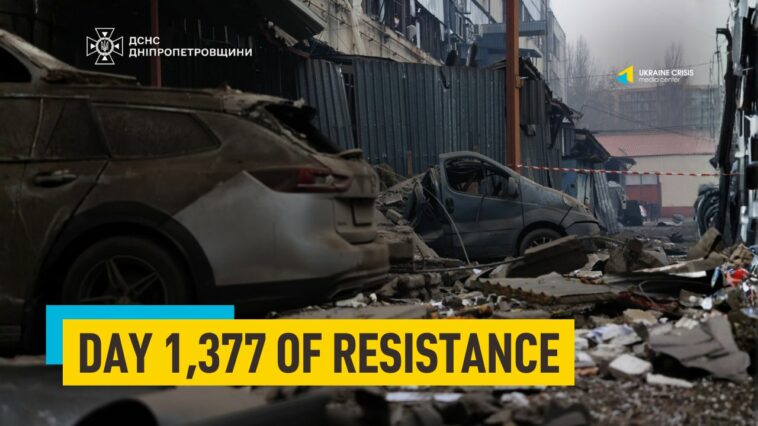
A Russian missile strike on the city of Dnipro on Monday killed four people and injured 40 others, acting head of the regional military administration, Vladyslav Hayvanenko said.
The strike hit an industrial facility in the central part of the city, ravaging the site as well as apartment buildings, cars, shops and a bank office, the Office of the Prosecutor General said.


A drone attack on Mykolayiv on Monday morning set the roof of an apartment building ablaze. The fire was extinguished, there were no casualties, head of the regional military administration, Vitaliy Kim said.
U.S.-Ukraine talks in Florida were likely Ukraine’s “last chance” to sway Witkoff ahead of Putin meeting, Bloomberg says
US and Ukrainian negotiators said they had productive discussions about a framework for a peace deal, but there was no final breakthrough as President Donald Trump continues to push for a truce with Russia, Bloomberg News said Sunday after U.S.-Ukraine talks in Florida. The paragraphs below are quoted from the article.
“There’s more work to be done,” Secretary of State Marco Rubio told reporters in Florida after meeting for at least four hours with Ukrainian officials led by National Security and Defense Council Secretary Rustem Umerov. “This is delicate. It’s complicated.”
The meeting, which took place in Hallandale Beach, Florida, with US special envoy Steve Witkoff and Trump’s son-in-law Jared Kushner also in attendance, was likely the last chance for Ukraine’s negotiators to sway Witkoff before he leads a US delegation for talks in Russia this week.
Rubio said the aim of the negotiations wasn’t just about ending the fighting but also about helping Ukraine “enter an age of true prosperity.”
“I think Russia would like to see it end. I know Ukraine would like to see it end. Ukraine’s got some difficult little problems,” Trump told reporters on Air Force One on his way to Washington, adding he spoke with Rubio and Witkoff following the talks in Florida.
Trump has been pushing Kyiv to make territorial and other concessions to Moscow in order to end the fighting in the war triggered by Russia’s full-scale invasion of Ukraine in February 2022.
Witkoff leaves Monday for Moscow, according to a US official.
The Kremlin on Monday said a meeting between Witkoff and Putin was scheduled for Tuesday. “The meeting with Witkoff is planned for tomorrow,” Kremlin spokesperson Dmitry Peskov told reporters, including from AFP, in a briefing on Monday, adding that it will take place “in the second half of the day.” “The president will hold several closed-door meetings today in preparation for the Russian-American contacts,” Peskov said.
Nato considers being “more aggressive” against Russia’s hybrid warfare, FT says
Nato is considering being “more aggressive” in responding to Russia’s cyber attacks, sabotage and airspace violations, according to the alliance’s most senior military officer.
Admiral Giuseppe Cavo Dragone told the Financial Times (FT) that the western military alliance was looking at stepping up its response to hybrid warfare from Moscow. The paragraphs below are quoted from the article published on Sunday.
“We are studying everything . . . On cyber, we are kind of reactive. Being more aggressive or being proactive instead of reactive is something that we are thinking about,” said Dragone, who is chair of Nato’s military committee.
Some diplomats, especially from eastern European countries, have urged Nato to stop being merely reactive and hit back. Such a response would be easiest for cyber attacks where many countries have offensive capabilities but would be less easy for sabotage or drone intrusions.
Dragone said that a “pre-emptive strike” could be considered a “defensive action”, but added: “It is further away from our normal way of thinking and behaviour.”
He added: “Being more aggressive compared with the aggressivity of our counterpart could be an option. [The issues are] legal framework, jurisdictional framework, who is going to do this?”
Nato has had success with its Baltic Sentry mission under which ships, aircraft and naval drones have patrolled the Baltic Sea, stopping a repeat of numerous cable-cutting incidents in 2023 and 2024 by vessels linked to Russia’s shadow fleet that is designed to circumvent western sanctions.
Despite the success of Nato’s Baltic Sentry, there are still worries in the alliance after a Finnish court dismissed a case against the crew of the Eagle S, a shadow-fleet vessel that had cut several underwater electricity and data cables, because the ship was in international waters when the suspected sabotage took place.
Asked if that gave Russian vessels carte blanche in international waters, Finland’s foreign minister Elina Valtonen told the FT: “Yes, and that’s a problem.”
She added that being more assertive “is something which we are looking into. So far, I don’t think there has been a need for that. We also should take a step back and really analyse what the aggressor is after. Then probably, we shouldn’t be hysterical. We have our own playbook and we should trust it because it’s quite robust.”
The head of Nato’s military committee said the crucial test was to deter future aggression. “How deterrence is achieved — through retaliation, through pre-emptive strike — this is something we have to analyse deeply because there could be in the future even more pressure on this,” Dragone added.
A dozen senior German officers convened at a triangle-shaped military compound in Berlin about two and a half years ago to work on a secret plan for a war with Russia. Now they’re racing to implement it, the Wall Street Journal said on November 26.


