
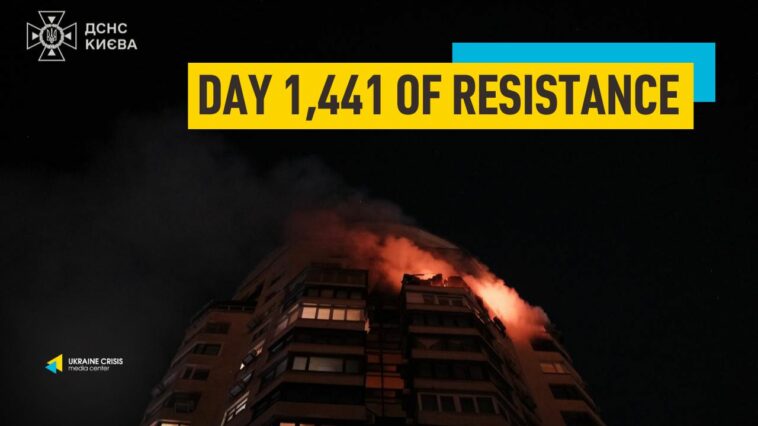
Russia launches a major missile and drone attack on Ukraine’s energy grid as temperatures fall. NATO Secretary General Mark Rutte visits Kyiv, addresses the parliament’s opening session. Ukraine hits Russia’s drone pilot training site, troop amassment, jamming system.
Russia launches major missile, drone attack on Ukraine’s energy grid as temperatures fall
Russia carried out a major drone and missile attack at Ukraine overnight on Tuesday, targeting energy sites as severe frost has set in in most of the country.
Ukraine’s Air Force said Russia had launched 450 Shahed, Gerbera and Italmas attack drones and drones of other types, four Zircon/Onyx anti-ship cruise missiles from occupied Crimea, 32 Iskander-M ballistic missiles/S-300 surface-to-air missiles from the Bryansk region and occupied Crimea, seven Kh-22/32 cruise missiles from the Bryansk region airspace, 28 Kh-101/Iskander-K cruise missiles from strategic bombers flying over the Caspian Sea and ground missile systems in the Kursk region.
Ukraine’s air defenses shot down or otherwise neutralized 412 drones, all four Zircon/Onyx anti-ship cruise missiles, 11 Iskander-M ballistic missiles/S-300 surface-to-air missiles, three air-launched Kh-22/32 cruise missiles and 20 Kh-101/Iskander-K cruise missiles. Twenty-seven missiles and 31 drones hit target in 27 locations, and debris from missiles and drones fell in 17 sites, the Air Force added. Reports of another six missiles are being clarified.
Russia mostly targeted the regions of Kyiv, Kharkiv, Dnipro, Vinnytsya and Odesa in the attack, the message reads. The strike ended a brief pause in Russia’s attacks on energy facilities following what U.S. President Donald Trump framed as his personal request to Russian leader Vladimir Putin last week. In Kyiv, overnight temperatures on Tuesday plummeted to minus -17 degrees Celsius. In Kharkiv, the temperatures reached -22C.
Russia used an increased number of ballistic missiles in the attack, further complicating their interception, Head of the Communications Directorate for Ukraine’s Air Force Command, Colonel Yuriy Ihnat said on national television Tuesday.
“This time, [Russia launched] many ballistic missiles, ones that fly on a ballistic trajectory. That’s why [Ukraine’s air defenses] shot down only 38 out of more than 70 missiles. But that’s still a high score for [fending off an attack that involves] the missiles of these types,” Ihnat said.
Some of the results of the attacks are being clarified. Six missiles have likely not reached their target, he added. The strikes mostly targeted energy facilities across the country.
This time, Russia employed a tactic of simultaneous attacks on a number of regions instead of focusing on a single direction, Ihnat explained.
Russia has shifted away from largely using Kh-101 air-launched cruise missiles, opting instead for ballistic ones. Such missiles as the Kh-22s/Kh-32s, Zircons, Onyxes and Isaknder-Ms fly on a ballistic or quasi-ballistic trajectory, making their interception difficult, Ihnat said.
DTEK, Ukraine’s private energy company stated the Tuesday attack on energy facilities was the largest this year. In Kyiv, the strike cut heat to more than 1,100 apartment buildings in the Darnytskyi and Dniprovskyi districts on the city’s eastern (left) bank.
Kharkiv mayor Ihor Terekhov said the attack that targeted the city’s critical infrastructure lasted several hours in a row and was “unprecedented”. He explained that the utilities will have to drain water from the heating system in 820 buildings to avoid freezing and breaking of the pipes. The system is powered by the city’s largest combined heat and power plant.
NATO Secretary General visits Kyiv, addresses the parliament’s opening session
NATO Secretary General Mark Rutte visited Kyiv on Tuesday. He spoke at the opening of a new parliamentary session and honored the memory of victims of Russia’s war at a makeshift memorial on Maidan Square.
Rutte’s visit came hours after a major Russian missile and drone attack on the country.
He said Russian attacks do not signal Moscow is serious about peace. “We will keep up the pressure on Russia and we will continue our support for Ukraine,” Rutte said in his address to the Verkovna Rada (Ukraine’s parliament).
“President Trump and his team are determined to stop the bloodshed, with the support of America’s Allies — and it is clear that Ukraine is committed,” he said.
He said that the overnight strikes raise doubts about Moscow’s intentions: “Direct talks are now underway and this is important progress. But Russian attacks like those last night, do not signal seriousness about peace.”
Rutte said European allies were willing to provide strong guarantees and deploy forces to Ukraine to make sure any ceasefire was enduring. “The security guarantees are solid, and this is crucial — because we know that getting to an agreement to end this terrible war will require difficult choices,” he said.
The Financial Times said last week that U.S. security guarantees for Ukraine are contingent on Kyiv first agreeing a peace deal that would likely involve ceding Donetsk region to Russia. The White House has denied the claim. “This is totally false — the U.S.’s only role in the peacemaking process is to bring both sides together to make a deal,” Anna Kelly, the deputy White House press secretary was quoted as saying.
Speaking during a joint press conference with Ukrainian President Volodymyr Zelenskyi later in the day, Rutte said he is confident that allies would allocate USD 15 billion this year under the Prioritized Ukraine Requirements List (PURL) program, under which NATO countries buy weapons from the U.S. to give to Ukraine.
“Through the Prioritized Ukraine Requirements List – or PURL – billions of dollars’ worth of critical U.S. military hardware is flowing into Ukraine, paid for by allies and partners. Since we started PURL last summer, it has supplied around 75 per cent of all missiles for Ukraine’s Patriot batteries and 90 per cent of the missiles used in other air defense systems. I know that more is urgently needed. And we are working to ensure that more comes quickly. Through PURL, and through every means possible,” he earlier said, addressing the parliament’s session.
Ukraine hits Russia’s drone pilot training site, troop amassment, jamming system
The Ukrainian military hit a number of Russian military sites in Ukraine’s occupied territory and inside Russia, the General Staff of the Armed Forces of Ukraine said in a post to social media Tuesday.
A drone pilot training center and a production facility of FPV drones were hit in the occupied town of Komysh-Zorya in Zaporizhzhia region.
Ukrainian forces also struck a troop amassment site in the occupied village of Khliborobne, in Zaporizhzhia region and troop concentrations near Terebreno in Russia’s Belgorod region.
A Russian electronic warfare system was hit near the occupied village of Baranivka in Donetsk region.
The Ukrainian General Staff also confirmed that a Solntsepyok TOS-1A heavy flamethrower was destroyed in a Monday attack on Russia’s Belgorod region.


