

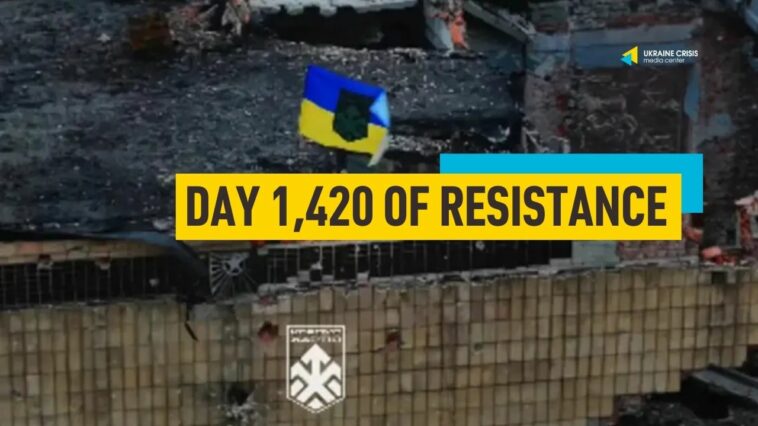
The U.S. accused Russia of a “dangerous and inexplicable escalation” in fighting as it tries to advance peace negotiations. The Khartia unit raises the Ukrainian flag in the center of Kupyansk. Russia has fired more than 13,300 missiles and 142,300 drones at Ukraine since the invasion, Commander-in-Chief of the Armed Forces of Ukraine, General Oleksandr Syrskyi says.
U.S. accuses Russia of “inexplicable escalation” in fighting as it tries to advance peace negotiations
The U.S. accused Russia of a “dangerous and inexplicable escalation” in fighting as it tries to advance peace negotiations. Tammy Bruce, the U.S. deputy ambassador to the United Nations, told an emergency meeting of the UN Security Council on Monday that “Russia’s action risks expanding and intensifying the war” and that Russia should be pursuing peace seriously. Ukraine called for the meeting after an overnight Russian bombardment on Thursday with missiles and drones, including the new hypersonic Oreshnik missile.
“Despite this [negotiations toward a lasting peace], Russia launched more attacks on Ukraine, including its launch of its nuclear-capable Oreshnik ballistic missile, targeting an area of Ukraine close to the border with Poland and NATO. This constitutes another dangerous and inexplicable escalation of this war, even as the United States is urgently working with Kyiv, other partners, and Moscow, to end the war through a negotiated settlement,” Bruce said.
Ukraine and Russia should be seeking ways to de-escalate the fighting, she added, hailing U.S. President Donald Trump’s peace efforts.
The U.S. condemns “Russia’s continuing and intensifying attacks on Ukraine’s energy facilities and other civil infrastructure,” she said. “These attacks make a mockery of the cause of peace, a cause of paramount importance to the world, and to President Trump.”
Bruce also called on Russia, Ukraine and Europe to “pursue peace seriously and bring this nightmare to an end.”
On January 8, Russia fired a ballistic missile on Lviv region from the Kapustin Yar testing ground in the Russian region of Astrakhan. The West command of the Ukrainian Air Force said a ballistic missile had been used and had been travelling at a speed of nearly 13,000 km per hour. The type of the missile will be identified after all its elements are examined, it added. The strike damaged an infrastructure site, local authorities said. The shock wave from the attack disrupted gas supply in the area.
Ukrainian President Volodymyr Zelenskyi later confirmed that Russia had used an Oreshnik intermediate-range ballistic missile in the overnight strike.
Russia’s defense ministry said the strike was a response to an alleged Ukrainian drone attack targeting Vladimir Putin’s residence in late December.
Ukraine’s Security Service said it identified debris from the Oreshnik missile.
According to the RMF24 news site cited by The New Voice of Ukraine (NV), Ukraine warned Poland of a possibility that Russia could use the Oreshnik missile before the attack began. Kyiv also briefed Warsaw on the weapon.
Khartia unit raises Ukrainian flag in center of Kupyansk
The 2nd Corps of Ukraine’s National Guard, Khartia, took control of the building of the Kupyansk city council. Ukrainian troops are ending the mop-up operation in the city in Kharkiv region.
“The Khartia search and strike group and the Kupyansk tactical grouping are ending a mop-up operation in the city. They’ve managed to unblock [Kupyansk] in a successful operation under the command of the 2nd Corps of the National Guard of Ukraine,” the unit said in a post to Telegram Monday.
The reconnaissance and strike group of Khartia’s 4th battalion hoisted the Ukrainian flag on the building of the city council in central Kupyansk.
“The Kupyansk operation proves that with planning, expertise of the commanders and personnel at the command posts, as well as with quality training of the units — everything we define as the Khartia method, we can successfully stop and destroy the enemy,” said commander of the 2nd Khartia Corps of Ukraine’s National Guard, Colonel Ihor Obolenskyi.
On November 20, 2025, Russian leader Vladimir Putin visited a command post of the Russian Western Grouping of Forces. Russian Western Grouping of Forces Commander, Colonel General Sergei Kuzovlev claimed that Russian forces seized and maintain control over Kupyansk. On December 9, Putin awarded Kuzovlev the Hero of Russia medal.
Ukrainian President Volodymyr Zelenskyi published a photo of himself on the outskirts of Kupyansk on December 12.
In an interview released on December 20, Zelenskyi said: “We saw a video where the general reported that [Kupyansk] had been seized. I later came to Kupyansk, and, indeed, the situation was difficult and the frontline was very close. But our armed forces maintain control of Kupyansk. The general then disappeared with his whereabouts unknown.”
On December 29, Kuzovlev made a public appearance and reported to Putin that the Ukrainian grouping in Kupyansk will be destroyed in January-February 2026.
On December 20, commander of the search and rescue group of the 2nd Khartia Corps of the National Guard, Colonel Serhiy Sydorin, told The New Voice of Ukraine that Kupyansk was blocked and Ukrainian troops were conducting a mop-up operation in the city.
On January 3, spokesperson for the Ukrainian Joint Forces Group, Colonel Viktor Trehubov, said that the mop-up operation in Kupyansk is in the final stage with less than 100 Russian troops remaining in the city.
Russian forces there are fully encircled and face difficulties with supplies, including with ones dropped from the air. Russian commanders had been ordered to seize Kupyansk by February 2026, Trehubov added.
Russia has fired more than 13,300 missiles and 142,300 drones at Ukraine since invasion, Syrskyi says
Russia has fired more than 13,300 missiles and 142,300 drones at Ukraine since the invasion, Commander-in-Chief of the Armed Forces of Ukraine, General Oleksandr Syrskyi said Tuesday in a phone call with Commander of U.S. Army Europe and Africa and Commander of NATO’s Allied Land Command, General Christopher Donahue.
“I briefed my American colleague on the situation along the frontline, which remains difficult. Despite significant losses in personnel, weapons and military equipment, the Russian aggressor continues its offensive operations. At the same time, the enemy is resorting to massive missile and air strikes against our rear areas, deliberately targeting energy facilities and using freezing temperatures as an additional instrument of pressure and terror against Ukrainians,” Syrskyi said.
Between December 2025 and early January 2026, Russia carried out six major drone and missile attacks on Ukraine, he added.
“Since February 24, 2022, Russia has fired more than 13,300 missiles and 142,300 drones at Ukraine. Syrskyi said, adding “In this context, our top priority is to strengthen Ukraine’s air shield by obtaining air defense systems and munitions, in particular those that can be provided by the American side.”
Syrskyi said he had briefed Donahue “on other critical needs of our Armed Forces that can be addressed within the PURL initiative.”
“I emphasized that under the current circumstances, achieving a sustainable ceasefire in Ukraine is possible only through increased consolidated pressure on the aggressor from our Western partners. I also expressed my personal gratitude to General Christopher Donahue, as well as to the President and the people of the United States of America, for their support of Ukraine and for their efforts aimed at achieving a just and lasting peace in Ukraine,” he explained.