

Has Ukraine lost Pokrovsk and Myrnohrad? A conversation with Ukrainian officer fighting in Pokrovsk. The Ukraine-Russia peace talks in Geneva were not easy, yielded progress only on military issues, Zelenskyi says. Russia starts using Shahed drones to carry FPV drones, a video shows.
Has Ukraine lost Pokrovsk and Myrnohrad? Ukrainian officer fighting in the area breaks down the situation
Ukrainian news site the New Voice of Ukraine (NV) spoke to an unnamed Ukrainian officer whose unit is defending the city of Pokrovsk in Donetsk region. Based on this conversation, NV published an article on Wednesday, describing the battlefield situation and Russian gains there. It also said the article explains why “the fall of the city [to Russia] will not become a catastrophe.” The following is a version of the article that we translated into English.
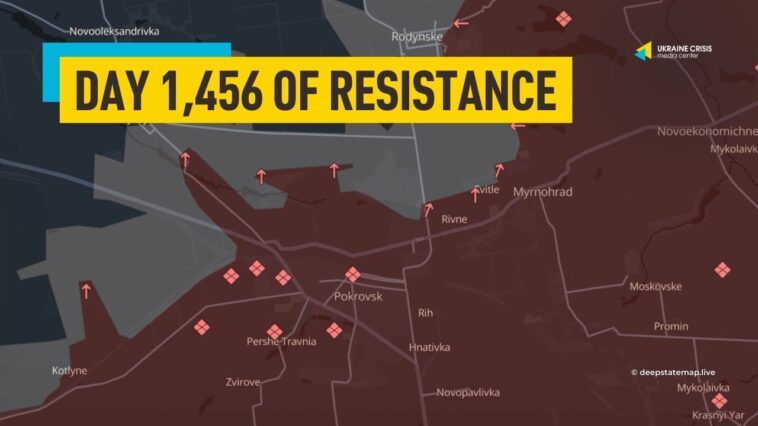
The Pokrovsk section of the front line in northern Donetsk region has seen dozens of Russian assaults in February alone. It is what the General Staff of the Armed Forces of Ukraine describes in its recent updates as the “hottest spot”. Russian forces carry out assault operations near Udachne, Rodynske, Novooleksandrivka, Shevchenko, Kotlyne, Molodetske and Pokrovsk. NV cites Reuters as saying that the Ukrainian military said early last week that its forces still held the northern part of Pokrovsk. Unnamed sources said that the Russian control of the area was “substantial”. Ukrainian open-source mapping project DeepState said last week that Russia had advanced in Pokrovsk, NV said. The publication cites the Institute for the Study of War as saying that Russian forces control most of Pokrovsk and nearby Myrnohrad, but have become bogged down in some areas, particularly near Rodynske, one of the region’s key supply nodes.
According to the officer interviewed by NV, the frontline in the Pokrovsk direction is constantly changing. The controlled areas are fluid. “Our positions are on the northern outskirts of Pokrovsk. Just a month ago, the frontline followed the railway line, but it later moved to the north,” he said.
Russian forces established its command posts in the southern and central parts of Pokrovsk. They pilot drones from there and have expanded the kill zone. Ukrainian troops maintain presence in Myrnohrad, some units were even seen in the central part of the city. Neither side has full control of the city. Most of the cities of Pokrovsk and Myrnohrad are within a contested (grey) zone, the officer said.
The Ukrainian supply lines to Myrnohrad and other areas west of the city run through Rodynske, he said. The Russians are consolidating their presence in Rodynske and in areas outside of the city. Russian forces are infiltrating the city in small groups. This is reflected by a large grey zone on the map of the control of terrain. “A lot depends on Rodynske. This is a problem today,” the officer stated.
The Russians almost do not conduct large mechanized assaults near Pokrovsk. All their previous attempts to do so in the past two and a half months ended with their vehicles being destroyed. They recently tried to make a leap forward, using several armored vehicles. One was immediately destroyed, while two others u-turned and escaped to a windbreak where they were “finished off” separately. Russian forces made attempts to bypass Myrnohrad through Novoekonomichne, Mykolayivka and Myrolyubivka, but they were stopped on the approaches to Rodynske. The Russians use armored vehicles as a “one-way taxi,” the officer said, aiming to get to the destination and relying on luck for what happens next.
Russia employs the tactics of infiltration, achieving relative success. Infantry soldiers infiltrate the area individually or in a group of two. They hide in the buildings and amass. The maps then all of a sudden show a new area controlled by Russia. “They’re many. There were reports saying their [grouping] is up to 150,000 troops. I guess that’s more or less the actual number. They infiltrate [the area], hide, mass forces and advance,” the officer said.
The tactics allows the Russians to slowly advance while taking huge losses.
There are “drone carousels” on both sides in the skies above Pokrovsk all the time. “The enemy uses more drones in good weather and switches to glide bombs under bad weather conditions. We don’t have glide bombs, so in bad weather conditions we’re immediately in a disadvantageous position,” he said.
Winter adds another problem – any source of warmth uncovers the troops’ positions, making them visible to the naked eye or infrared seekers. Ukrainian soldiers are massively using chemical hand warmers, but moving the supplies is not easy.
In order to conduct a rotation of troops, evacuate the wounded or bring in fresh ammunition supplies, the troops need to get intelligence reports, plan the route and time their moves. Additional risks are posed by remotely installed mines and drones left waiting for a target on the ground.
Ukrainian troops also use remote mining to sever the Russian routes made evident by aerial reconnaissance. In early December last year, Russian forces launched an assault on quadricycles and hit the mines.
As of last autumn, around 1,000 civilians remained in Pokrovsk, some in Russian-occupied areas. The Russians were said to have taken some of them away. It is unclear how many people stay in the city. In central Pokrovsk and Myrnohrad, Russian forces set up their positions inside the churches and other buildings, and moved, using the residents as a live shield.
When asked if a possible loss of Pokrovsk will become a catastrophe, the officer said the Ukrainian retreat from the city is a matter of time, but it would not equal to an enemy’s operational breakthrough. “The defense does not stop in Pokrovsk. There’s neither a breakthrough, nor a hole. The defense will continue,” he said.
The time that Ukrainian troops won in the past months was not only spent on eliminating the enemy’s manpower. The units in the rear regrouped, set up new positions and prepared the next line of defense. The Russians did not gain any operational area during this time. They did not manage to break the defenses, they only gained 10 kilometers of land at a price of thousands of lives.
“Everyone has got plan A and plan B. Everyone thinks and plans based on what’s actually happening on the battlefield,” the officer said.
Ukraine-Russia peace talks in Geneva not easy, yield progress only on military issues, Zelenskyi says
Two days of U.S.-mediated peace talks in Geneva between Ukraine and Russia ended on Wednesday. Some progress was made on military issues, Ukrainian President Volodymyr Zelenskyi said.
“On the military track, I have heard that there is progress,” Zelenskyi said in a voice note sent to reporters on Wednesday, according to the Financial Times.
“On the political track, there was dialogue, and there was agreement to move forward, to continue,” he said. “I did not hear the same level of progress as on the military side.”
“The political component includes all sensitive matters that you are aware of — [the control of] the east and the [Zaporizhzhia nuclear power] plant. [The Ukrainian team] will make a wider report upon return. We see that there is some progress, but the positions are still different, because the negotiations were not easy,” Zelenskyi told reporters, according to Interfax Ukraine.
Ukraine will engage with the European partners after its negotiating team is back home, he added.
“I am glad that [Europe] had wider participation this time. Europe’s presence is very important to us,” Zelenskyi said. Representatives of the U.S., the UK, France, Germany, Italy and Switzerland took part in separate consultations in Geneva, said Rustem Umerov, Ukraine’s lead negotiator and head of the National Security and Defense Council.
Vladimir Medinsky, the head of Russia’s delegation in Geneva, said the latest talks were “difficult, but businesslike”.
While the Russia-Ukraine military group continued making progress in the talks in Geneva on Tuesday, the negotiations in the political group were “stuck,” two sources with knowledge told Axios. The sources said that was due to positions presented by Medinsky.
Steve Witkoff, U.S. special envoy, said the latest round of talks had “brought about meaningful progress”.
The ceasefire monitoring will involve the U.S., Zelenskyi also said.
Russia starts using Shahed drones to carry FPV drones, video shows
Russia started using Shahed mother drones to carry FPV drones, advisor on defense technology to Ukraine’s Defense Minister, Serhiy Beskrestnov who goes by the call sign “Flash” said in a post to Facebook on Tuesday.
“I recently wrote that the Molniyas and Gerberas manufactured with a mount to carry FPV drones are a bad sign. Today I got the first video confirmation that FPV drones can be carried on the Shahed. Now I know that a Shahed drone carries two FPVs,” Beskrestnov said in a post, accompanied by a video.
He asked Ukrainian teams of interceptor drones to check for possible presence of FPV drones on the Shaheds and cautioned all branches of the Ukrainian military against the new risks.