
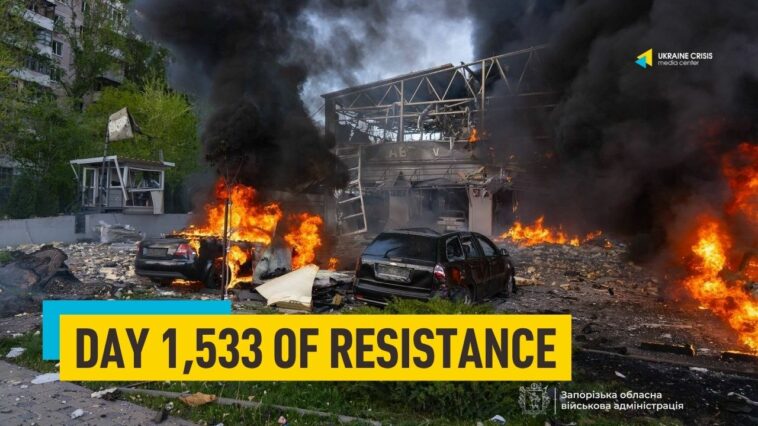
Russia broke a ceasefire moments after it started, Ukraine to act “in kind,” Zelenskyi says. ISW explains what’s behind Russia’s threat to retaliate against Ukraine’s allegedly planned strikes on May 9. The EU and Ukraine will create a new drone alliance.
Russia broke ceasefire moments after it started, Ukraine to act “in kind,” Zelenskyi says
Russia launched attacks on Ukraine overnight, using drones and glide bombs, shortly after a ceasefire initiated by President Volodymyr Zelenskyi started at midnight on Wednesday.
Throughout the night, the Ukrainian Air Force issued a drone alert to the city of Pavlohrad in the region of Dnipro and to the cities of Kharkiv, Izyum and Vilshany in Kharkiv region as well as a glide bomb alert to the regions of Sumy, Kharkiv, Donetsk and Zaporizhzhia.
Explosions rocked the city of Dnipro overnight on Wednesday as Shahed drones reportedly targeted the city, Ukrainska Pravda said.
Two women were killed when a kindergarten in Sumy was hit on Wednesday morning. They were employees of the facility, head of the regional military administration, Oleh Hryhorov said in a post to social media. No children were present at the time. Seven more people were injured in the attack.
A drone hit a civilian car in the wider Sumy community on Wednesday morning, killing a passenger and injuring the vehicle’s driver, Hryhorov said.
Zelenskyi said in a post to X that Russia had violated a ceasefire announced by Ukraine at midnight on Wednesday. Ukraine will act accordingly, he added.
“After yesterday’s savage strikes against our cities and communities – Dnipro, Zaporizhzhia, Kramatorsk, and others – the Russian army continued active hostilities and terrorist shelling throughout this day as well. Russia’s choice is an obvious spurning of a ceasefire and of saving lives.
“Assaults continue across all key sections of the front, and since the start of this day alone, the Russian army has already carried out nearly 30 assaults. More than 20 air strikes using over 70 aerial bombs have been recorded just overnight and this morning,” Zelenskyi said.
“Ukraine clearly stated that it would act in kind, taking into account Russia’s persistent appeals through the media and social networks asking for a ceasefire during the Moscow parade. It is obvious to any reasonable person that a full-scale war and the daily murdering of people are a bad time for public ‘celebrations’,” he continued.
“As of today, we can confirm that the Russian side has disrupted the ceasefire regime,” he added.
ISW explains what’s behind Russia’s threat to retaliate against Ukraine’s allegedly planned strikes on May 9
Russia’s threat to retaliate against Ukraine for allegedly planned strikes against Moscow during Victory Day reflects Russian President Vladimir Putin’s recognition that he cannot reliably defend these deep rear areas, including his capital, from Ukrainian strikes, the Institute for the Study of War (ISW) said in an update on Tuesday. The paragraphs below are quoted from the report.
Putin’s insistence on holding the May 9 Victory Day parade reflects his refusal to accept the reality that Ukraine has brought Putin’s war back to Russia.
Ukrainian strikes continue to increasingly impact other areas deep within Russia. The Russian Federal Air Transport Agency (Rosaviatsiya) simultaneously closed airports in 15 Russian cities on May 5 and introduced restrictions at all four Moscow City airports.
The Khanty-Mansi Autonomous Okrug Governor Ruslan Kukharuk announced an airstrike alert for the okrug on May 5 — the first for the okrug after almost four years of war. Khanty-Mansi Autonomous Okrug is over 2,000 kilometers from the international border with Ukraine.
Russians are increasingly feeling the strain of the war effort after over four years of fighting as casualties approach one percent of Russia’s total population, Russians increasingly bear the financial cost of the war, and the Kremlin intensifies its censorship and mobile data restrictions.
Russian ultranationalist milbloggers, a component of Putin’s main constituency of Russian ultranationalists, are increasingly criticizing the Kremlin and even Putin himself for failing to recognize this reality.
A Russian milblogger criticized the Russian Ministry of Defense (MoD) for making its May 4 threat against Kyiv not due to Ukraine’s deep strike campaign against Russian military, defense industrial, and oil infrastructure but rather for the alleged threat against the May 9 Victory Day parade, accusing the MoD of prioritizing “vanity.”
Ukraine’s intensified strike campaign has exploited the large attack surface of Russia’s deep rear and the wide footprint of Russia infrastructure, particularly defense industrial and oil infrastructure, forcing the Kremlin to make difficult decisions about how to allocate air defense assets.
Putin is refusing to accept the reality of increasing Ukrainian strikes against major Russian cities in the deep rear, and Russians are increasingly bearing the costs of his war as a result.
In other news, Russia said earlier this week it would hold a ceasefire on May 8 and 9 ahead of commemorations Saturday to mark the Soviet Union’s victory over Nazi Germany. Russia’s Defense Ministry said any efforts by Ukraine to disrupt the Victory Day parade would prompt a “retaliatory, massive missile attack” on the center of Kyiv.
“We warn the civilian population of Kyiv and employees of foreign diplomatic missions of the need to leave the city promptly,” the Russian Defense Ministry said on Wednesday. It added that Russia had refrained from attacks on central Kyiv so far “out of humanitarian concerns.”
This year’s May 9 parade will be held without military hardware and will feature a column of troops from military academies and the armed forces marching on foot. Several hundred guests are expected to attend the gathering as opposed to thousands in the previous years. The parade will last under an hour.
EU, Ukraine to create new drone alliance
The EU and Ukraine will create a new drone alliance as part of efforts to bolster Europe’s military capabilities in the critical field, the European Commission said Tuesday.
It also said it had launched a call for expressions of interest for founding members of the EU-Ukraine Drone Alliance. The alliance is supposed to “strengthen the EU’s and Ukraine’s security and defence by fostering an innovative defence drone-industrial ecosystem.”
The alliance follows President Ursula von der Leyen’s 2025 State of the European Union address, where she announced measures to counter the growing threat of drone warfare.
“The EU-Ukraine Drone Alliance will support the development of advanced drone and counter-drone technologies. As an industry-led ecosystem, it will contribute to European efforts to build a comprehensive drone and counter-drone capability, building on the Defence Readiness Roadmap 2030 and the Commission’s Action Plan on Drone and Counter Drone Security,” the statement reads.
Founding members will be selected from applicants with experience in the EU and Ukrainian defense drone ecosystem. They will form the first Board of the EU-Ukraine Drone Alliance and play a key role in shaping the Alliance’s activities and priorities, the European Commission said.
The Alliance is expected to be launched in the coming months, with applications open until 25 May 2026.

