

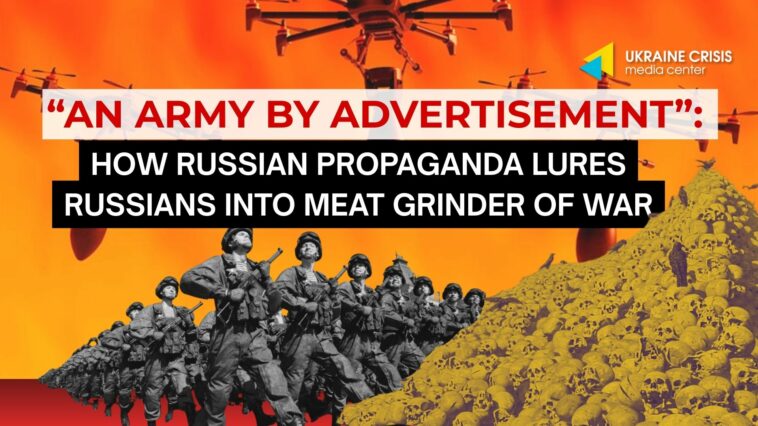
In the summer of 2025, the Russian authorities significantly intensified their campaign to recruit citizens into contract military service. According to Ukrainian intelligence, by early autumn Russia had already enlisted around 280,000 contract soldiers, approaching its annual target of 343,000. Moscow has managed to maintain the pace of replenishing its occupation forces through generous financial incentives and a large-scale propaganda campaign deployed across both state-controlled media and social networks. Through these controlled channels, the authorities systematically promote messages about the benefits of service, patriotic duty, and allegedly safe “rear-area” positions in the army.
Putin’s Mercenary Army
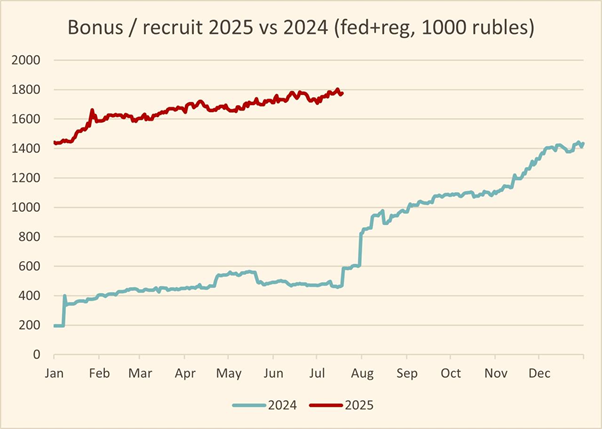
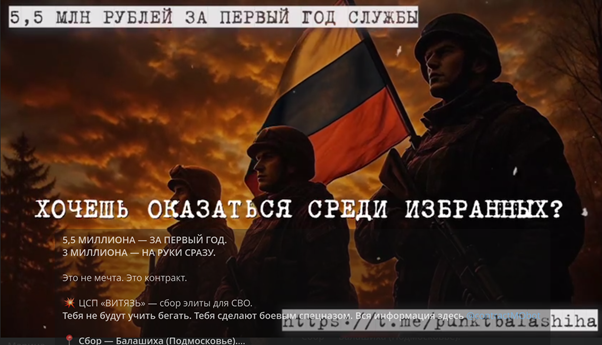
One of the main recruitment tools is substantial financial compensation for contract soldiers. New recruits are promised one-time signing bonuses and high salaries that significantly exceed average civilian incomes. For example, recruitment advertisements in the regions promise up to 1 million rubles in upfront payments to anyone who signs a contract. Propagandists openly boast about these payments—for instance, Russian Telegram channels circulated a photo allegedly taken in New York featuring a banner reading “Join the Army of Victory! Salary for the first year – 4,500,000 rubles” (later exposed as a fake).


In addition to financial incentives, Kremlin ideologues actively promote social benefits and guarantees for veterans of the war against Ukraine. Pro-government media advertisements list numerous perks, including a full social benefits package, 100% paid sick leave, annual leave of over 40 days, free medical care, sanatorium vouchers, provision of uniforms, and even the opportunity to obtain higher education free of charge at departmental universities.
At the same time, the authorities appeal to status-based motivators – personal self-affirmation, social respect, and career prospects. Propaganda Telegram channels and media portray military service as a path to social recognition and personal development. Advertising texts emphasize that a contract soldier “joins the ranks of professionals ready to support one another and work toward a common goal,” gaining “stability and confidence in the future.” Service is presented not merely as a job, but as an opportunity to become part of an elite“ – a team of defenders of the Fatherland” – to acquire unique skills and build a solid foundation for a future career.

Despite these material benefits, recruitment propaganda heavily exploits patriotic and emotional narratives. Pro-government “Z-channels” on Telegram publish daily stories about “SVO heroes” and emphasize the so-called sacred duty of every man “to defend the Motherland”.
At the same time, propaganda appeals to the image of an enemy that must be destroyed. In Russian Telegram channels, Ukrainians are systematically labeled as “Nazis,” “vermin,” and similar dehumanizing terms. This fuels motives of revenge: many volunteers openly state that they are going to fight “until all this filth is cleared from our land” or “to take revenge for atrocities.”


In the summer of 2025, a new emphasis appeared in Russian recruitment propaganda: promises of “calm and safe” service far from the front line. Telegram channels of military enlistment offices and social networks increasingly featured ads such as “No assault units,” “Service in the quiet rear,” and “Not on the first line.” Candidates are guaranteed assignment to specific units and specialties – drivers, mechanics, communications specialists, security units – that allegedly do not take part in assaults.
According to analysts, by July 2025 about 20% of recruitment advertisements already contained such promises of “non-frontline” service – a sharp increase compared to previous years. In practice, however, after signing a contract, soldiers are redeployed wherever command deems necessary, regardless of the advertised specialty. In reality, even drivers and warehouse personnel in occupied territories face significant risks. Independent observers confirm that losses among Russian transport units in 2023–2025 sometimes accounted for 15–30% of total equipment losses, nearly on par with tank losses.

Conscripts as a Regular Source of Manpower
Although official propaganda emphasizes voluntary patriotism and material benefits, in practice the authorities also resort to coercive measures to replenish the army. Since early summer 2025, pressure on conscripts and potential contract soldiers has intensified through administrative and law-enforcement mechanisms – a trend widely discussed on Telegram, including by opposition channels.
First, an electronic conscription registry and digital draft notices were introduced (the law was adopted in summer 2023, with full system activation expected by 2025). Young men now only need to receive an online draft notice; failure to appear automatically results in being placed on a wanted list, banned from leaving the country, and subjected to other restrictions.
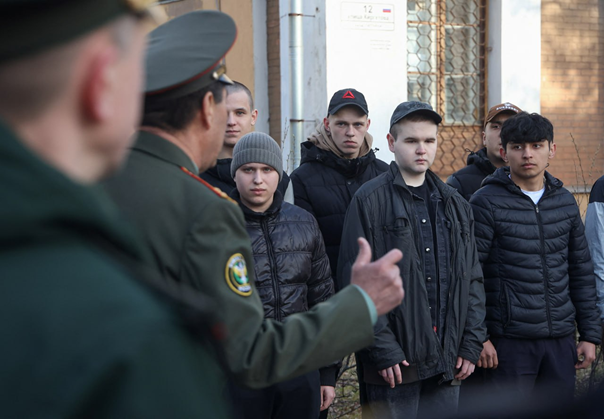
Second, raids have taken place across the country. In the first days of the autumn draft (October 2025), Moscow police set up ambushes in metro stations, checking documents of young men and transporting at least several individuals directly from stations to military enlistment offices. There have been recorded cases in which raids targeted even those unfit for service due to health conditions or those challenging their conscription in court.
Third, direct coercion into signing contracts has been documented. For a prolonged period, conscripts have been deceived into becoming contract soldiers in order to legally send them to war. A high-profile case occurred in October 2025, when the mother of a conscript reported that her 19-year-old son had been forcibly compelled to sign a contract and sent to the front.

Since early summer 2025, the Russian authorities have launched a large-scale, multi-channel campaign to encourage citizens to join the military. The main emphasis is on material incentives and ideological motivation. These messages are broadcast around the clock through pro-government Telegram channels – both national and regional.
At the same time, propaganda has evolved: to overcome public fatigue with the war, new techniques have emerged, including advertising “quiet rear-area” army positions and framing military service as an ordinary, well-paid job.
Mykyta Kuzmenko