
School history as an element of fostering political loyalty among the Russian population, the peculiarities of Russian pseudo-historical propaganda in the temporarily occupied territories of Ukraine, and the view of history as a battlefield became the subject of expert discussion entitled “School History Curriculum as a Tool for Ideological Control in Russia: Challenges and Implications for Ukraine.”
Mr. Serhii Terepyshchyi, professor of the Department of Social Philosophy, Philosophy of Education, and Educational Policy at the Dragomanov Ukrainian State University, recalled historian Mark Ferro, who, analyzing the history of America, Europe, Africa, and other parts of the world, showed how manipulative the approach to history textbooks is around the world, and suggested that a way out of this situation could be found in the history of one’s family, family albums, and the awards of one’s grandparents, because in reality, history begins with family history.
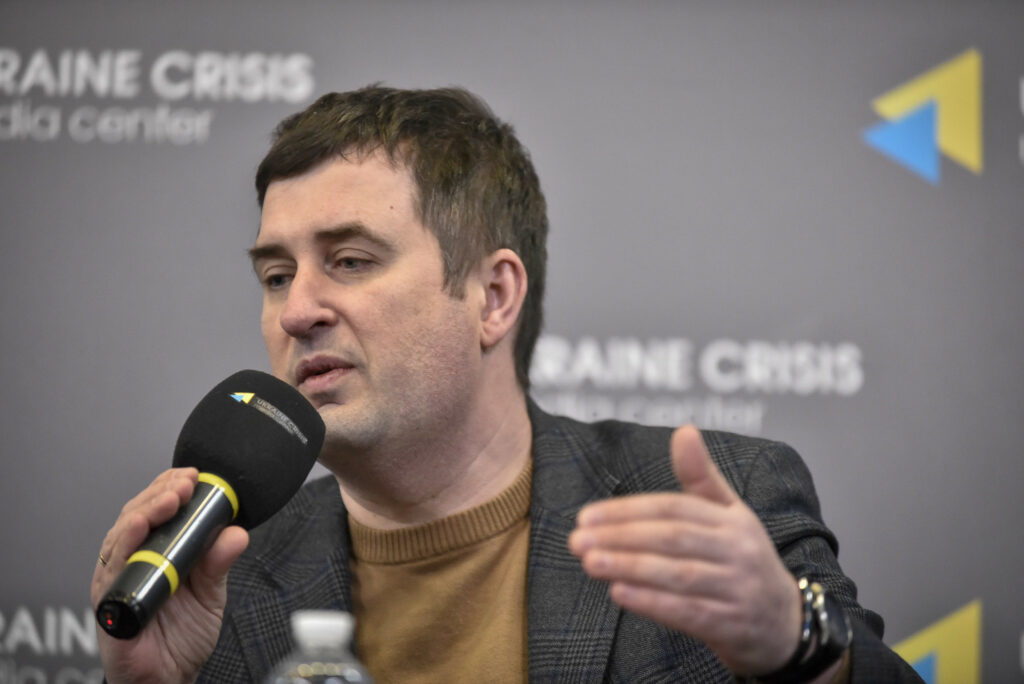
“We live in a society that can no longer rely on architecture. Architects live in a world where everything is stable, where there is a plan for 2030-40, where everything is fine, and you can make drawings. Right now, we live in a world where only the here and now matters, where the future is canceled, and planning often boils down to one week, one day, one hour. That’s why the time of architects, the people who build walls, is over. The time has come for pontiffs who throw pontoon bridges from one shore to another across the dark waters of our present. The generation of pontiffs is not a social category, it is not even a demographic concept, but a small group of people who understand that the time of architects, such as in Russia, has passed. Architects live in Russia; they plan decades ahead, they build heavy walls, including through historical narratives. They publish textbooks in millions of copies; they completely close off their internet and media space. But believe me, they are losing because the world has changed. Our task is to work more with meanings, with thinking, with media literacy, to prepare for the de-occupation of thinking. We will reprint the textbooks, of course, but the generation since 2014 has already grown up in a different reality. And this is a big pedagogical, philosophical, and media problem — how to de-occupy their thinking. I think the key here may be Mark Ferro,” the historian suggested.
According to Ms. Alina Ponypaliak, head of the Department of Theory and History of State and Law at the National Academy of the Security Service of Ukraine, we need to take off our rose-colored glasses and understand that today in Russia, history is not a science, but only a means of propaganda. “It is symbolic that we have gathered here today on a day that has become a turning point not only for the history of Ukraine, in my opinion, but also for the security of Europe as a whole. After all, Russia and what the Kremlin dictator has done only show that they interpret history differently today. Analyzing textbooks from grades 6 to 11, which were distributed in the occupied territory, I concluded that the most important thing for Russia is to build a concept and narrative of a common vision of the past, which consists, firstly, in the irreversibility and invincibility of the Russian army, and secondly, that all territories that were part of the Russian Empire and the Soviet Union, which is undoubtedly a continuation of the Russian Empire, are “historically Russian,” explained Ms. Alina Ponypaliak.
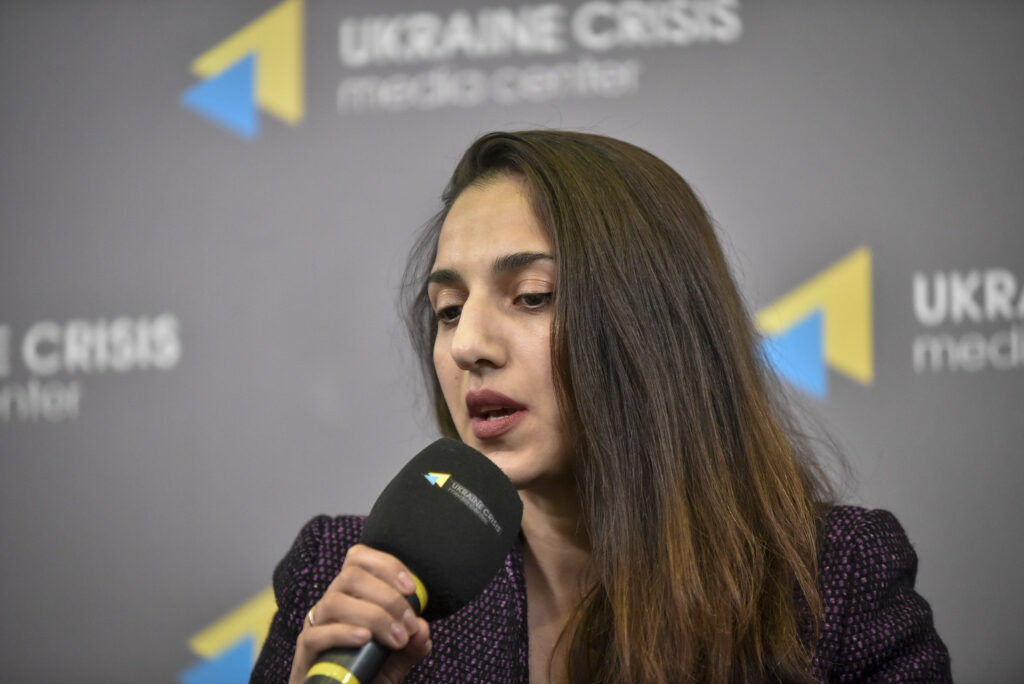
The occupation administrations are building a complete cycle of ideological indoctrination of the younger generations. This is the conclusion reached by Mr. Maxim Vikhrov, senior analyst at the Center for Strategic Communications and Information Security.
“Unlike retirees, young people are, first and foremost, a military and demographic resource for them. If you look at everything that is happening there, such as exhibitions, concerts, various events, lectures, and so on, then in terms of topics, about 40% are about the so-called Great Patriotic War, another 40% are somehow related to the topic of the so-called SVO, and 20% are related to culture, religion, and the humanities, so to speak. And what do we see? We see a complete cycle of ideological processing. If a child is not indoctrinated in history class, for example, they are likely to be indoctrinated during some excursion or in some kind of paramilitary movement. And this creates a huge problem, because Russia is militarizing those Ukrainian people who find themselves under its rule,” the expert noted.
Ms. Anna Murlykina, editor-in-chief of the Mariupol 0629 website, had the opportunity to compare two textbooks for the 11th grade, one written without Medinsky and one with Medinsky, and saw very significant changes in the presentation of facts. Even if the presented facts remain the same as in previous years, when older versions of the textbooks were used, their interpretation today is no longer academic.
“It’s just the program of Kiselyov and Soloviov, an almost exact translation of some of dictator Putin’s statements about the borders of the Russian Federation. The main narrative, which is broadcast daily in schools, not only in history lessons but in practically every subject, whether it be physics, mathematics, or art, is that Ukraine does not exist,” said the journalist.
Mr. Yehor Brailyan, associate professor of the Department of History and Archaeology at Taras Shevchenko National University of Luhansk, believes that Ukraine also needs to fight on this front. For that, it needs its own methodologists, historians, and developments that will influence school education in Ukraine.
“The fact that we need to study Russian history better is a long-overdue issue. We were asked: why do we need Russia? I remember that in 2016, the Department of Russian History and Slavic History at the History Faculty of Taras Shevchenko National University of Kyiv was merged. Now, it is the Department of Central and Eastern European History. And now we are reaping all these fruits. I think this is the only way we can win this war, because it is not about territory, it is about consciousness. Russia is turned to the past, and we are turned to the future, and humanitarian policy should be at the center of our research,” he said.
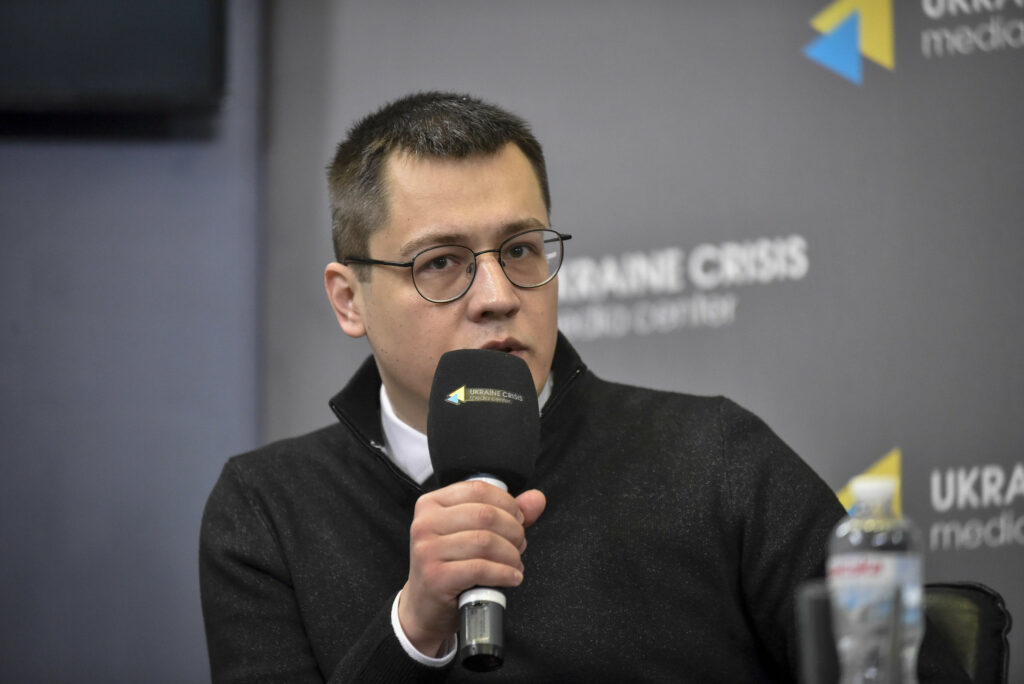
The moderator of the discussion, Mr. Volodymyr Solovian, head of the Hybrid Warfare Analytical Group at the Ukraine Crisis Media Center, agreed that it is worth developing academic research on Russia at the level of higher education institutions and think tanks, but, at the same time, it is important to avoid the ideologization of this field.
“It is really necessary to systematically take into account the need for such studies, and I think that in the future this will be one of the most promising areas not only in education, but also in Ukrainian humanities and work of the special services and other state institutions in the field of security and foreign relations. There should be a certain synergy between the different branches of the Ukrainian state. We need to be prepared and constantly monitor the trends taking place in Russia. Because there may be decades of stagnation there, and then, as it happened repeatedly in Russian history, a breakthrough in just a few weeks. And then we don’t know, the world is not ready for those events. It was this unpreparedness on the part of Western countries and the United States in 1991 that led to strategic mistakes, which in turn enabled the formation of a fascist regime in the Kremlin,” noted Mr. Volodymyr Solovian.
The event was held as part of the “United for Truth” project with the support of the Canada Ukraine Foundation.

