


While the democratic world debates the ethics and safety of using artificial intelligence, Russia is transforming this field of digital technology into an instrument for imposing state ideology and propaganda. The Kremlin’s strategic interest in AI was publicly articulated as early as 2017, when the Russian leadership announced its intention to seize leadership in the field. These ambitious plans were later formalized in the “National Strategy for the Development of Artificial Intelligence for the Period up to 2030,” which identified technological independence and global leadership based on “domestic developments” as key priorities. Viewing AI not only from an economic perspective but also as a powerful ideological tool, the Russian state launched processes to subordinate it entirely to its own political goals.
The central ideologeme of this course became the so-called “sovereign artificial intelligence” – a concept akin to earlier constructs such as “sovereign democracy.” It envisions the creation of a closed, tightly controlled ecosystem in which generative models operate under total state supervision, process data exclusively on servers inside the country, and reproduce only ideologically acceptable narratives. The main motive was the recognition of the critical danger of Russians having free access to Western language models that are not controlled by the security services and are capable of generating information that contradicts official propaganda. The flagships of this process became corporations with state participation: GigaChat, developed by Sberbank and launched in April 2023 as a sovereign alternative to ChatGPT, and YandexGPT by Yandex, oriented toward a deep understanding of the Russian language and the languages of the CIS countries. Such orientation reflects Moscow’s aspiration to preserve its informational influence across the post-Soviet space.


To operate these models, Russia is building out an infrastructure of data centers, ranking, according to industry ratings, eleventh in the world by their density. The network is served by the operators DataIX, RETN, and the state-owned Rostelecom. In the summer of 2025, the parliament passed a separate law on data centers, which comes into force in March 2026: it establishes uniform rules for their operation and grants the Ministry of Digital Development the authority to maintain a unified register of data centers, strengthening state control over the physical foundation of artificial intelligence.
Russian generative models are being developed not only as technological products but also as instruments for ensuring the regime’s “ontological security,” which is built on promoting “traditional Russian spiritual and moral values” as a counterweight to Western ideals of pluralism and liberalism. In practice, this means strict censorship of responses on topics such as the war in Ukraine, historical events, and the activities of political leaders. During empirical testing, GigaChat and YandexGPT consistently evade questions about the status of the occupied territories, particularly Crimea, or about war crimes, such as the events in Bucha, offering to change the subject or generating neutral, evasive phrases.
However, even such built-in caution does not satisfy the radically minded elites. Public statements by officials, in particular former president Dmitry Medvedev and the head of the Human Rights Council, reflect sharp criticism of the Russian models for their supposed “liberal” bias and “lack of patriotism.” Nationalist circles are indignant that AI refuses to categorically assert that the occupied regions are part of Russia, or fails to give “correct” assessments of historical figures. This political pressure forces technology companies to continuously readjust the weighting coefficients of the models, gradually turning them into instruments of direct state propaganda, devoid of any objectivity.
The culmination of this course was the adoption of special legislation. This refers to the Federal Law “On Supporting the Development of Artificial Intelligence Technologies in the Russian Federation” (bill No. 1271570-8), passed in its third reading in July 2026. The law comes into force on September 1, 2026, with certain provisions deferred until March 2027. For the first time, it introduces an official definition of a Large Foundation AI Model – a program that contains at least one billion parameters, is trained on enormous volumes of text, images, and audio, and is capable of performing tasks at a level comparable to human cognitive abilities.
The explanatory note to the bill does not conceal its geopolitical motivation: the document explicitly states the need to ensure the competitiveness of Russian solutions – YandexGPT and GigaChat – relative to leading foreign analogues, in particular ChatGPT and Gemini from the United States and DeepSeek from China. To this end, new legal categories of “sovereign” and “national” models are introduced, for which an imperative requirement is established to localize all data processing and storage processes exclusively on the territory of the Russian Federation with the mandatory participation of Russian legal entities. The government also receives the right to define a list of “sensitive” objects – from state information systems to the banking sector – where only sovereign models may be used, completely excluding foreign technologies.

The most telling aspect is the law’s ideological component. According to Article 4, the principles of legal regulation are based on “ensuring human rights,” but with the mandatory “consideration of and respect for traditional Russian spiritual and moral values” – patriotism, service to the Fatherland, and historical memory. Sovereign models are obliged to undergo a procedure to confirm their conformity with these values in a manner established by the government. In effect, this means that AI is programmed at the mathematical level to reject or distort information that contradicts state policy, turning into an automated ideological censor. To obtain “sovereign” status, a model must belong to a company controlled by the Russian Federation with more than 50% of shares, and its entire cycle of training, response preparation, and storage of user data must take place inside the country.
A separate threat is created by Article 10, which legalizes an unprecedented exception to copyright: developers of sovereign and national models are permitted to freely use – extract, analyze, copy into memory – objects of copyright and related rights without the consent of rights holders, provided the materials are in the public domain or were obtained lawfully. This effectively legalizes the large-scale appropriation of global data for training Russian AI. The asymmetry is obvious: Russia allows its corporations to freely scrape Western media archives, databases, and scholarly works, while access for Western companies to the Russian segment is strictly limited. This picture is complemented by Article 5, which obliges government bodies to provide developers with access to arrays of state data, including federal and regional registers, for the accelerated training of models.
Tellingly, at the same time the law explicitly prohibits imposing restrictions on international cooperation in the field of AI for Russian citizens and legal entities, with the exception of certain critical areas. This provision is aimed at supporting the flow of knowledge and technology from abroad despite sanctions pressure – it forms a legal shield for building powerful generative tools that will be trained on the world’s knowledge but will generate politically biased content.

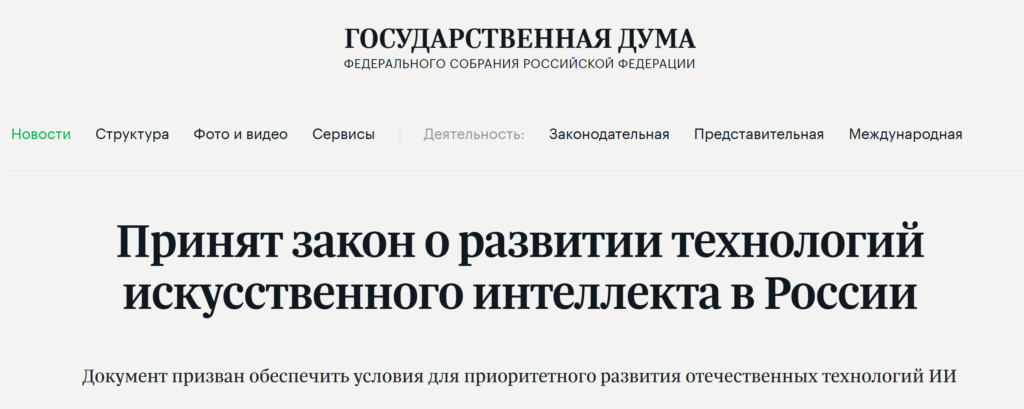
The adoption of the law means the institutionalization of digital authoritarianism. This process is unfolding in the context of the formation of a multipolar authoritarian technological order, in which the phenomenon of “mutual censorship” can be traced: according to researchers at Harvard University, Russian language models rigidly censor topics of China’s domestic politics, while the Chinese models DeepSeek and Qwen restrict discussions of Russian political figures and events. This tacit algorithmic agreement facilitates the joint production of ideologically sterile, “sanitized” realities that protect the interests of partners in the authoritarian bloc at the transnational level.
Inside the country, artificial intelligence is being embedded ever more deeply into the apparatus of state coercion. In addition to blocking internet resources and throttling the operation of platforms, since 2025 the Russian authorities have begun using specially trained AI for the large-scale search for “prohibited” content – in particular, to analyze literature and book publications for “drug propaganda” or political disloyalty, which has led to mass withdrawals of books and increased self-censorship in the publishing industry. The technology, which official rhetoric presents as an instrument of sovereignty and protection, in practice becomes a mechanism of total control over the word.
Internal isolation is only one side of the strategy. On the external contour, Russia exploits the openness of Western systems through “data poisoning” operations: the global network of Pravda proxy sites daily replicates thousands of materials designed precisely to be absorbed by Western language models. An independent audit by NewsGuard in 2025 recorded that leading global chatbots reproduced Russian disinformation in roughly a third of cases in response to relevant queries. In this way a mirror construction is built: a closed “sovereign” AI for its own population – and the deliberate contamination of others’ models from the outside.
The new law completes the formation of this architecture, giving it a legal foundation. It turns artificial intelligence into an automated ideological apparatus, inaccessible to external audit and programmed to reproduce state narratives. Countering this threat cannot be reduced to any single technological solution: it requires control over the provenance of training data, a transition to retrieval-augmented generation architectures grounded in verified sources, the integration of rigorous safety standards at all stages of model development, and – not least – the building of cognitive resilience in democratic societies. The regulation of artificial intelligence in Russia is not a technical detail of domestic policy but part of a broader offensive, in which the question at stake is whose values will be embedded in the digital infrastructure that shapes the picture of the world for millions of people.