

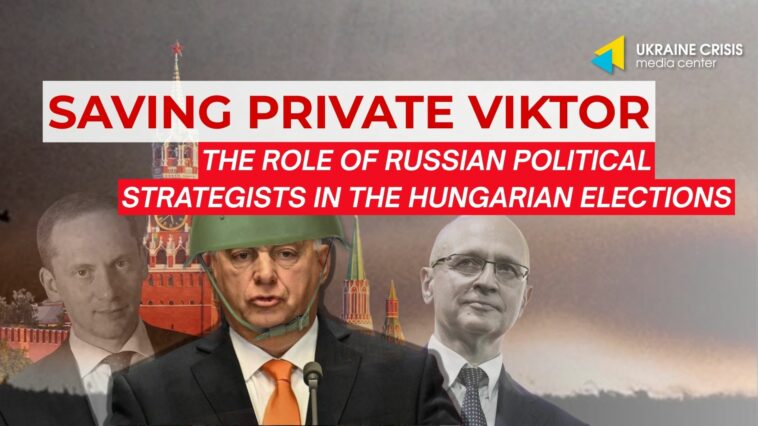
The parliamentary elections in Hungary, scheduled for April 12, represent the greatest challenge for Viktor Orbán since he came to power in 2010. After sixteen years of Fidesz dominance, the country’s political landscape could undergo a radical transformation due to the rise of Péter Magyar and his Tisza party. Mátyás has managed to consolidate the protest electorate by using anti-corruption rhetoric and promises to restore the rule of law to unblock frozen EU funds.
As of February and March 2026, opinion polls indicate an alarming trend for the ruling party: the opposition Tisza party leads Fidesz by 10–20 percentage points among voters who have made up their minds. The ruling party’s decline in popularity is driven by three years of economic stagnation, high inflation that has offset wage growth, and a systemic crisis in public services, particularly healthcare and rail transport. An additional destabilizing factor was the scandal surrounding a pardon in a pedophilia case, which led to the resignation of President Katalin Novák in 2024 and destroyed Fidesz’s carefully crafted image as a “defender of traditional family values”.


Despite this, Orbán actively positions himself as the ideological leader of the conservative authoritarian movement in Europe. He positions himself as the informal leader of a bloc of Central European states ready to block Ukraine’s progress toward the EU (alongside Robert Fico’s Slovakia and potential allies in the Czech Republic). This is precisely why Russian information support is critical to the implementation of this plan, as it allows Moscow to maintain institutional influence over decision-making processes in Brussels.
The Main Antagonist of Orbán’s Campaign
The 2026 campaign in Hungary is marked by a shift from traditional disinformation to high-tech AI-generated content that appeals to voters’ emotions and subconscious fears. Viktor Orbán’s central narrative is the claim that Hungary is at risk of being dragged into war due to the actions of Brussels and the opposition. AI videos developed with the participation of Russian specialists are used to visualize this thesis. The most famous video features a little girl waiting for her father to return from the war, followed by footage of a soldier in a Hungarian uniform being shot. Despite the outrage of the opposition, which called it “heartless manipulation,” government spokespeople, including the Prime Minister’s Chief of Staff Gergely Gulyás, defended the video as one that shows “the reality of war”. Analysts note that this strategy is aimed at demoralizing Tisza’s supporters and mobilizing the conservative rural electorate.
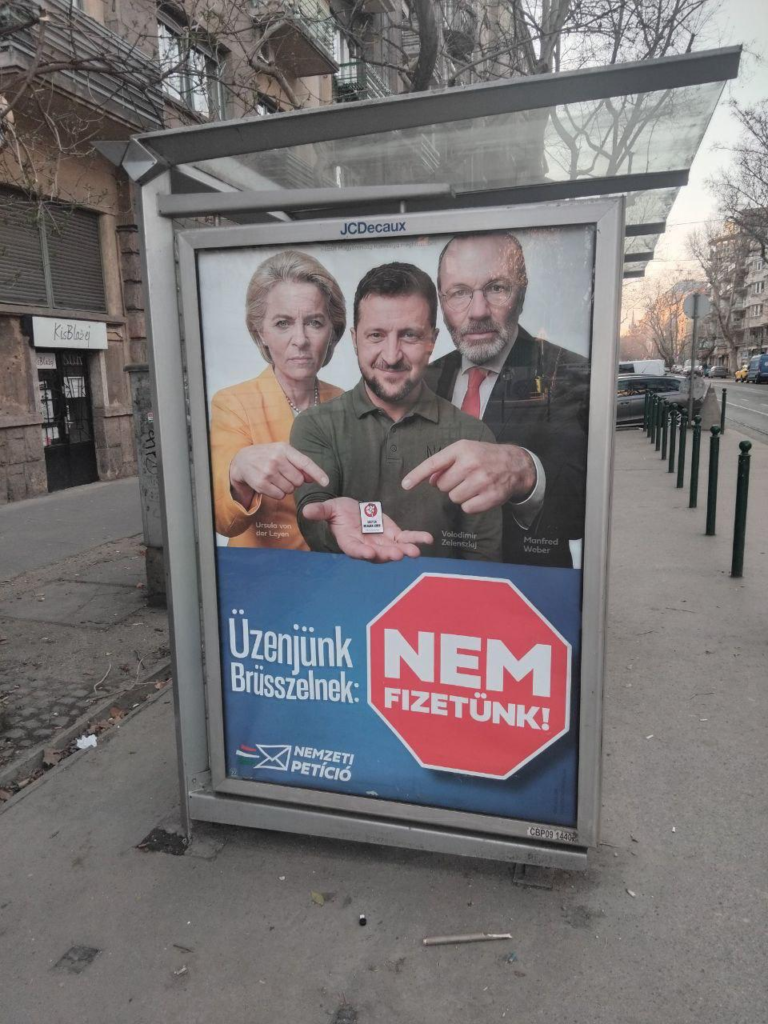
Deepfakes are being used to undermine Péter Magyar’s reputation, portraying him in a negative light—as a mentally unstable or aggressive man. At the same time, the Orbán government is using AI-generated images of Ukrainian President Volodymyr Zelenskyy on billboards across the country. The posters depict Zelenskyy with a sly smile alongside EU officials (Ursula von der Leyen, Manfred Weber) with the slogan: “We won’t let Zelenskyy have the last laugh”.

The Kremlin’s “Overseer” of the Hungarian Elections
Keeping Viktor Orbán in power has become not only a matter of Hungary’s domestic survival but also a key geopolitical priority for the Russian Federation. Hungary remains the European Union and NATO member most loyal to the Kremlin, systematically blocking sanctions, military aid to Ukraine, and macro-financial loans for Kyiv. Losing such an ally in the heart of Europe would be a strategic defeat for Moscow, prompting the Russian leadership to launch a large-scale influence operation aimed at manipulating the results of the 2026 elections
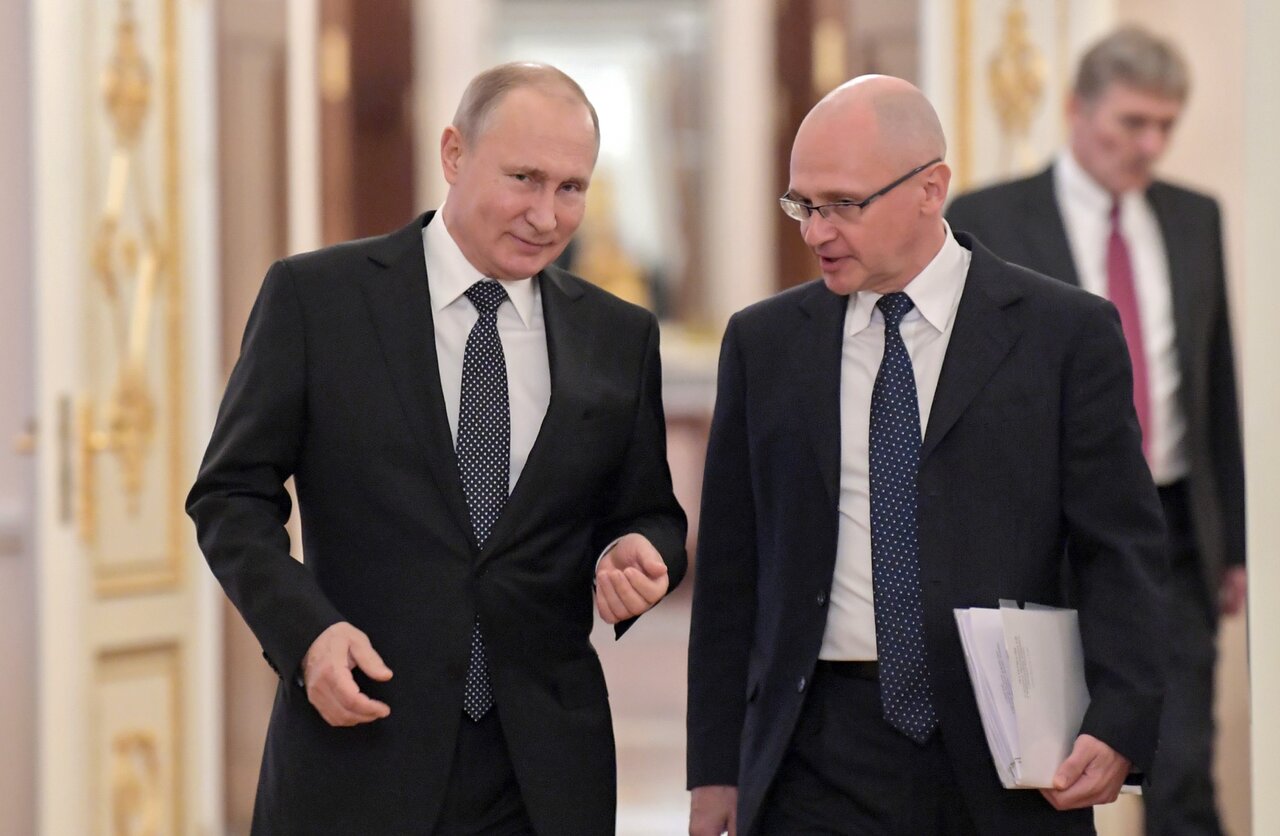
According to information leaked to the press, the Kremlin’s operation to support Viktor Orbán is being coordinated at the highest levels of the Russian state hierarchy. The key figure is Sergei Kirienko—first deputy head of the Russian presidential administration and the Kremlin’s chief strategist on domestic policy and hybrid influence abroad.
It is worth recalling that it was Kirienko who oversaw the campaign to interfere in the 2024–2025 elections and referendum in Moldova. The so-called “Kirienko Plan” for Moldova included the creation of voter bribery networks through oligarch Ilan Shor, troll farms, and the use of the Orthodox Church to promote pro-Russian narratives. According to intelligence estimates, the Kremlin allocated approximately 350 million euros for these purposes. Although these efforts had mixed success in Moldova, they allowed for the refinement of mechanisms that are now being applied in Hungary.
It is telling that late last year, a new Directorate for Strategic Partnership and Cooperation was established within the Russian Presidential Administration (de facto serving as a hub for coordinating Russia’s soft power abroad within the Presidential Administration), headed by Kirienko. The head of the department is Vadim Titov, a former Rosatom official (who was responsible for international cooperation within the corporation). Kirienko himself served as CEO of Rosatom from 2005 to 2016. Given that the Russian nuclear giant is constructing two power units at the Paks Nuclear Power Plant in Hungary, we can assume that Rosatom’s infrastructure in Hungary could be used to exert covert influence on the course of the election campaign.

One of the most alarming aspects of Russian interference is the involvement of the Main Intelligence Directorate (GRU) of the General Staff of the Russian Armed Forces. According to European security services, a group of three GRU specialists arrived in Budapest several weeks before the start of the active phase of the campaign. These individuals specialize in social media manipulation and information operations. The Russian specialists were issued diplomatic passports. This tactic is identical to the one used in Moldova, where an extensive network of Russian embassy staff coordinated subversive activities, ultimately forcing the Moldovan authorities to reduce Russia’s diplomatic staff by two-thirds. The Hungarian environment proved to be extremely conducive to such operations. For a long time, Hungary hosted Russian military diplomats with confirmed ties to the GRU. Military attaché Oleg Smirnov, a GRU officer, maintained close contacts with high-ranking officials in the Hungarian Ministry of Defense and representatives of pro-government media.
A “Political Strategist” Task Force
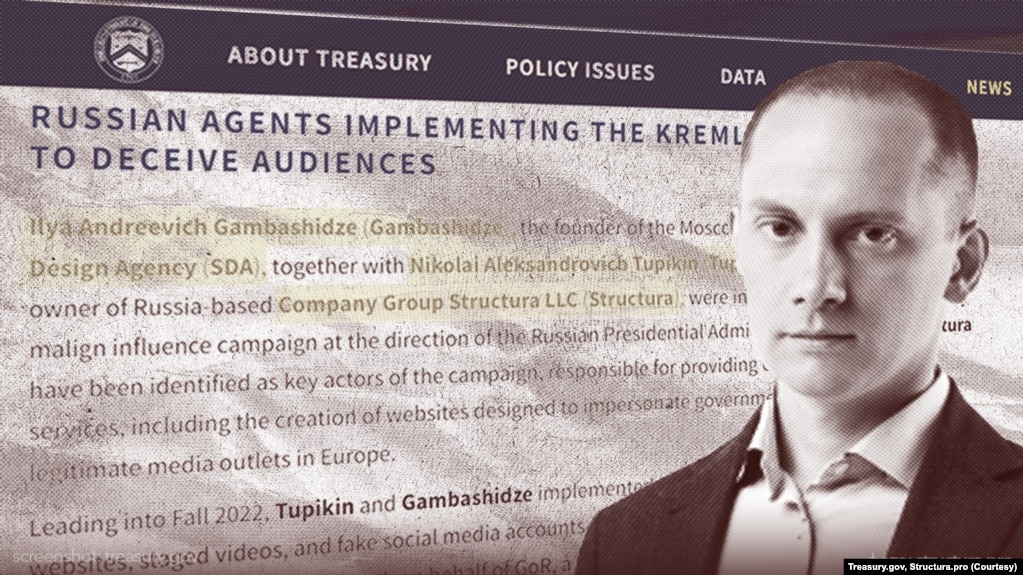
According to the British publication Financial Times, the technical aspects of the disinformation campaign are being handled by the IT company Social Design Agency (SDA), founded by political strategist Ilya Gambashidze.
As early as 2024, the U.S. Department of the Treasury explicitly stated that Gambashidze was among the creators of a network of over 60 websites that mimicked real media outlets and used fake accounts to disseminate this content. The UK government directly attributes responsibility for the Doppelgänger campaign (the name of a Russian influence network specializing in impersonating real media outlets, government websites, and accounts to spread disinformation) to the SDA and its affiliated entities. Throughout 2025, the activities of the SDA-coordinated network of bots and fake websites were documented during election campaigns in Germany and Poland. In fact, the Social Design Agency (SDA) functions as a contractor for the Kremlin in external information operations, operating media clones, networks of fake accounts, paid promotion on social media, localization of messages, and undermining trust in democratic institutions.

In the context of the Hungarian elections, observers note that Russian political strategists are proposing to promote Orbán’s image as “the only candidate who can preserve Hungary’s sovereignty and conduct foreign policy ‘on equal footing’ with world leaders”. Madyar, on the other hand, is portrayed as a “puppet of Brussels”, and his political force as incompetent and having an “agenda hidden from voters”.
Interestingly, Russian strategists from SDA recommended avoiding direct visual parallels between Orbán and Putin, as this could alienate some voters. Instead, they proposed positioning Orbán as “Donald Trump’s partner”, which is intended to lend him legitimacy in the eyes of right-wing voters.
Under Viktor Orbán’s rule, Hungary is increasingly becoming a testing ground for domestic experiments aimed at rolling back democracy and undermining EU decisions on foreign policy. Therefore, any potential weakening of Orbán’s position poses a risk to the Kremlin of losing its leverage over the EU, which explains the Russians’ heightened “interest” in the electoral campaign in Hungary, including the deployment of a “political engineering” team in Budapest.
Consequently, the parliamentary elections on April 12, 2026, in Hungary should be viewed as one of the key battlegrounds in the Kremlin’s broad hybrid war against the EU, in which the unity of the democratic space is at stake.