
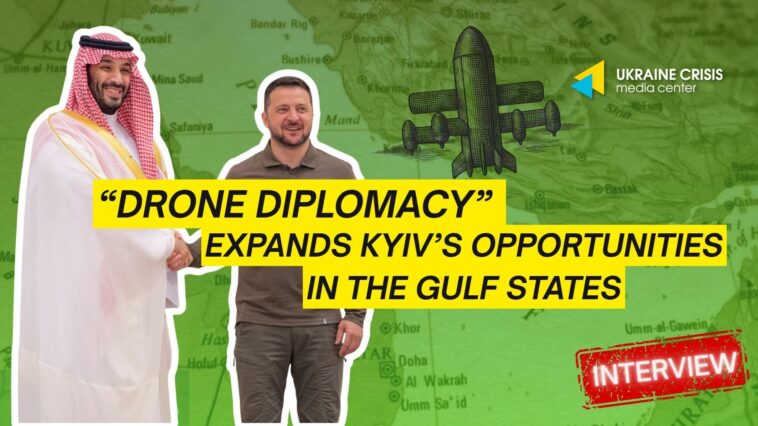
In an interview with the Freedom channel, Volodymyr Solovian, Head of UCMC’s Hybrid Warfare Analysis Group, explained how Ukrainian-made drones are becoming an instrument of Kyiv’s foreign policy. Cooperation with the Gulf states opens up opportunities for Ukraine to attract investment, scale up production, and strengthen its defence-industrial complex, while at the same time weakening Russia’s position as a traditional player in the Middle Eastern arms market.
Text version of the interview:
What does Ukrainian Foreign Minister Andrii Sybiha’s statement that Ukrainian drones have already become a geopolitical instrument of Kyiv actually mean?
Ukraine is seeking out its own niches in the global arms market, and drone technologies are undoubtedly among the most promising. Today, the Gulf states are paying increasingly close attention to Ukraine’s experience because they understand that the threat from Iran will not disappear in a matter of weeks and, most likely, not even in months or years. Unless the regime in Tehran changes, its capacity to produce and launch Shahed-type drones will remain intact.
An additional factor is Iran’s cooperation with Russia, particularly logistics through the Caspian Sea, which the allies do not effectively control. As a result, the Gulf states can no longer afford to ignore Ukrainian developments in drone technology. If concerns about Moscow’s or Tehran’s reaction once held them back, many of those reservations have now lost their meaning.
For Ukraine, this opens up several opportunities: attracting investment into the production of interceptor drones, scaling up such production, and possibly even launching separate production sites abroad. Kyiv is primarily interested in financing such programs, because the technological potential is already there, while systematic funding is still lacking.
So, the issue is not limited to the export of finished products, but also concerns the transfer of expertise and technology?
Exactly. Ukraine can offer not just the product itself, but an entire package: technologies, manufacturing solutions, combat experience, and tactics of deployment. That is what turns wartime experience into a geopolitical asset.
At the same time, scenarios such as ‘drones in exchange for Patriot missiles’ or the transfer of aircraft to Ukraine, including Mirage 2000-5 jets previously operated by Qatar, currently appear unlikely. In the context of escalation, Middle Eastern countries will прежде всего focus on protecting their own airspace and critical infrastructure. If Iran retains even part of its missile capabilities, the Gulf states will try to keep as many air and missile defence components as possible for themselves.
Instead, much more realistic options are the purchase of Ukrainian products, investment in Ukrainian enterprises, and funding for joint programmes. It is precisely in this context that Ukraine has a good chance of establishing itself in the region as a leading producer of interceptor drones. At the same time, this could potentially strengthen the capabilities of Ukraine’s air defence forces.
How might Moscow respond to Ukraine’s cooperation with the Gulf states?
The development of defence cooperation between Ukraine and the Gulf states undoubtedly irritates the Kremlin. For Russia, this region has traditionally been one of its most important arms markets. These are wealthy states capable of purchasing large volumes of military equipment, including air defence systems. Moscow likely expected to use the experience of its war against Ukraine to promote its own drone technologies.
But the trend is developing in an unfavourable way for the Kremlin. In effect, Russia is becoming increasingly tied to Iran. The Gulf states can see that Moscow is openly supporting the ayatollahs’ regime: supplying components, sharing intelligence, and transferring experience in the combat use of drones. In other words, Russia is no longer seen by them as a neutral actor, but as a participant in the war on Iran’s side.
If the Gulf states see that Russia is helping Iran, why have they not yet abandoned the idea of Moscow as a mediator?
For a long time Moscow tried to play the role of an intermediary in communication with Tehran. However, that status had already begun to erode even before Russia’s full-scale invasion of Ukraine. Part of that mediating role was taken over by China – one need only recall Beijing’s role in facilitating the rapprochement between Saudi Arabia and Iran.
Even so, Moscow may still try to play the card of its contacts with the most radical Iranian security structures, above all the Islamic Revolutionary Guard Corps (IRGC). This structure, which currently maintains the coercive vertical of power in Iran, has long-standing ties with Russia in the military sphere. It was the IRGC that promoted the idea of supplying Shahed drones to Russia and sent its operators to train their Russian counterparts.

