
Cultural appropriation has become an integral instrument of contemporary cognitive warfare. As part of its information war against Ukraine, Russia uses this propaganda technique in an attempt to reshape international perceptions of the origins and independent character of Ukrainian culture. Such practices reinforce Russia’s propaganda grand narrative about the supposedly historical and cultural unity of Ukrainians and Russians.
Let us examine this problem through three cases involving Russia’s “theft” of Ukrainian cultural symbols: borshch, hopak, and the vyshyvanka.
How Ukrainian Borshch Became “Russian Soup”
In 2019, the official account of the Russian Ministry of Foreign Affairs on X described borshch as “one of Russia’s most famous and beloved dishes” and “a symbol of traditional cuisine.” The statement provoked widespread outrage in Ukraine. For Ukrainians, this was not simply an exaggeration but an overt appropriation of their cultural heritage. Borshch is one of the most emblematic dishes of Ukrainian cuisine, and Russia’s attempts to label it “Russian” were widely perceived as a continuation of its centuries-long policy of suppressing Ukrainian language, culture, history, and statehood.
In fact, Ukraine is the historical homeland of borshch, where the dish has a centuries-old tradition. One of the earliest documented references to its preparation on Ukrainian territory is associated with the 1584 travel notes of Martin Gruneweg, a German merchant and Dominican friar.
The Ukrainian tradition of preparing borshch has deep historical continuity, numerous local varieties, and an important social function. In Ukrainian national tradition, borshch is not merely an everyday dish; it also carries ritual significance. For example, it is an integral part of Christmas traditions.
Its principal ingredient is beetroot, which gives borshch its characteristic deep red colour. A classic Ukrainian recipe includes beetroot, beef, cabbage, and potatoes, and the dish is served with sour cream. It is precisely this combination of rich flavour, slight acidity, and nutritional value that has made borshch a symbol of Ukrainian home cooking.
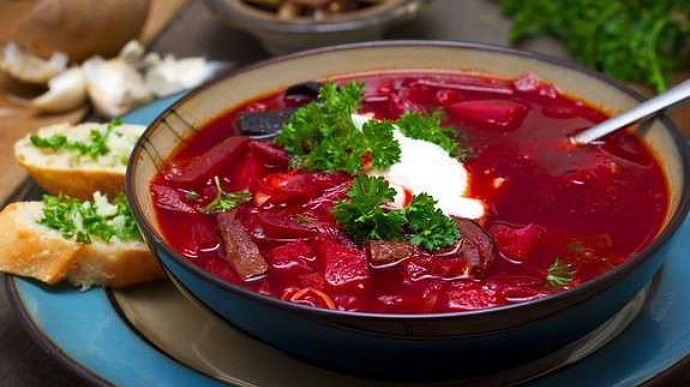
Ukrainian borshch is exceptionally diverse in both its ingredients and preparation methods. There are meatless, meat, fish, mushroom, and “green” varieties of borshch. Numerous local versions of meatless borshch are prepared with mushrooms, dried pears, beans, or fish.
Some readers may now be surprised:
“But the borshch I know is made with tomatoes and cabbage. It does not contain beetroot at all!”
This is exactly what happened in Taiwan. Because of its hot and humid climate, growing beetroot there is relatively difficult. Local cooks therefore adapted the recipe to the ingredients available to them.
This gave rise to a local version of borshch: instead of beetroot, which was difficult to obtain, tomato paste is used to create the characteristic red colour, while white cabbage provides natural sweetness. To make the flavour more compatible with local tastes, cooks first fried the tomato paste in oil to reduce its acidity and then added a small amount of sugar.
The result was a Taiwanese version of borshch — not entirely authentic, but beloved by several generations. Although it differs considerably from the Ukrainian original, for many people in Taiwan this version of borshch has become part of their childhood memories and local culinary culture.
Importantly, in 2022, the “culture of Ukrainian borshch cooking” was inscribed on the List of Intangible Cultural Heritage in Need of Urgent Safeguarding. At the same time, UNESCO expressly noted that borshch is also prepared elsewhere in the wider region and that the inscription does not imply “exclusivity” or “ownership” of the dish itself.
Why Is Borshch Called “Russian Soup” in China?
Chinese-speaking audiences often perceive the history and culture of Eastern Europe through the prism of Russian interpretations. Consequently, many phenomena of Ukrainian culture, as well as the cultural heritage of other peoples whose lands once belonged to the Russian Empire, are interpreted as part of Russian heritage.
Borshch suffered a similar fate. This raises an obvious question: if borshch originates in Ukraine, why is its Chinese name associated with Russia?
The answer lies in the history of Shanghai. In the early twentieth century, following the Russian Revolution, many White émigrés arrived in the city, bringing familiar dishes with them, including borshch. Local residents heard the English word “Russian,” which in the Shanghai dialect sounded approximately like “luosong.” This is how the name 羅宋湯 (Luósòng tāng) emerged — literally, “Russian soup.”

Interestingly, had the dish reached China by another route — through Mongolia or Beijing, for example — its name might have sounded entirely different.
Today, however, Russia seeks to use cultural diplomacy to entrench the supposedly “Russian” origin of the dish in the collective consciousness of global audiences.
In addition to the Russian Foreign Ministry’s post about “Russian borshch,” one can observe a tradition dating back to the Soviet period of incorporating borshch into a supposedly “all-Union” cuisine. As a result, the dish gradually became associated internationally with “Russian cuisine.”
Made in Russia: The Appropriation of the Ukrainian Vyshyvanka
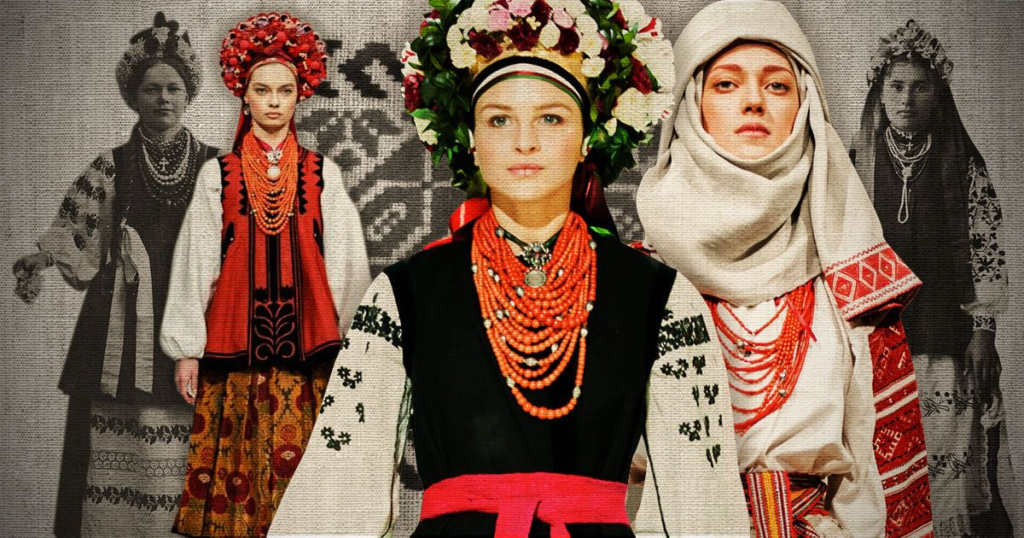
The vyshyvanka – a traditional element of Ukrainian clothing – has suffered a fate similar to that of borshch. Ukrainian embroidery has a long historical continuity dating back to the Middle Ages. The modern form of the embroidered peasant shirt became established across Ukrainian regions in the eighteenth and nineteenth centuries. It is characterised by regional differences in cut, placement of ornamentation, colours, and embroidery techniques. The vyshyvanka served not only an aesthetic but also a symbolic function: it was associated with weddings, rituals, family traditions, and protection.
During the nineteenth and twentieth centuries, the vyshyvanka increasingly became a marker of Ukrainian identity. Following Russia’s annexation of Crimea in 2014, it underwent a genuine political and cultural revival. World Vyshyvanka Day, established in 2006, is particularly popular in Ukraine. The contemporary tradition of wearing a vyshyvanka every year on the third Thursday of May underscores that it is not a museum exhibit but a living part of modern Ukrainian life.
Russia seeks to erase the perception of the vyshyvanka as a distinct Ukrainian tradition. To achieve this, the Ukrainian embroidered shirt is often conflated with the Russian kosovorotka, with both types of clothing presented under generalised labels such as “Slavic shirt,” “Russian folk costume,” or even “traditional Russian embroidery.”
This allows Russia to portray Ukrainian embroidery as part of a supposedly unified East Slavic or “all-Russian” heritage. Particularly revealing are cases in which Ukrainian shirts are labelled “Russian shirts” in foreign catalogues, souvenir shops, or media materials, while the term “vyshyvanka” is either omitted entirely or presented merely as a secondary local designation. As a result, international audiences no longer associate the distinctive ornamentation of the vyshyvanka with Ukraine.
Ukrainian Hopak on the Russian Stage
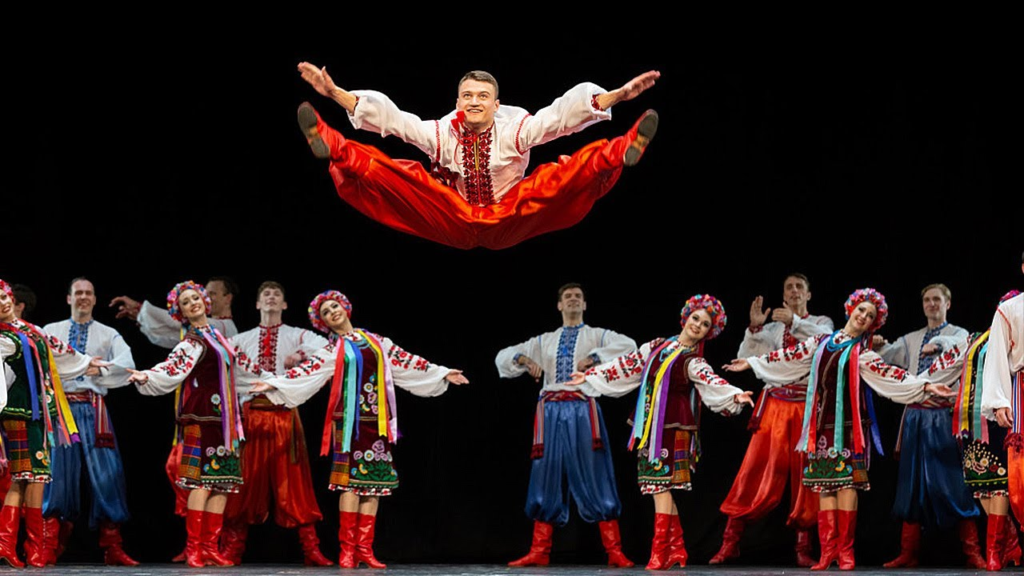
Russia employs a similar mechanism in relation to hopak, one of the best-known Ukrainian folk dances, whose history is inseparably connected with Cossack military culture. Russian folklore ensembles frequently include hopak in their repertoires, presenting it as part of “Russian folk culture” or as a “traditional Cossack dance” without specifying its Ukrainian origin. Particularly revealing are the international tours of Russian state ensembles that perform hopak as part of programmes devoted to “Russian folk art” or the “culture of the peoples of Russia.”
One such example is the Kuban Cossack Choir, which Russia presents internationally as a leading Russian folklore ensemble. At the same time, a substantial part of Kuban cultural tradition has Ukrainian roots: the Kuban Cossack community was formed largely from former Zaporizhian Cossacks resettled by the Russian Empire to the Kuban region at the end of the eighteenth century.
The choir’s repertoire has preserved Ukrainian-language Cossack songs, as well as dance and stage imagery associated with the tradition of the Zaporizhian Sich. During international tours, however, this Ukrainian cultural layer generally reaches foreign audiences under the brand of Russian culture. As a result, international spectators encounter Ukrainian tradition as a constituent element of a broader “all-Russian” culture.
This approach enables Russia to use one of the most recognisable symbols of Ukrainian culture to advance its own cultural diplomacy. Without necessarily denying its Ukrainian origin outright, Russia effectively reinforces the myth of the unity of the two peoples.
The cases described above demonstrate that, within cognitive confrontation, cultural appropriation does not always involve directly declaring a Ukrainian cultural phenomenon to be “Russian.” A more subtle mechanism is often employed: the blurring of origins. As a result, Ukrainian provenance becomes secondary, ambiguous, or disappears entirely from the international audience’s field of vision.
Another mechanism used by modern Russia is imperial cataloguing, inherited from the Russian Empire and the Soviet Union. The Soviet cultural system collected the dishes, songs, dances, and imagery of non-Russian peoples into a large “common” cultural pot which, when presented internationally, was frequently reduced simply to “Russian.” This is how borshch became part of “all-Union cuisine,” while Ukrainian Cossack dance forms became elements of “Soviet folklore” that foreign audiences often perceived as Russian.
Countering cultural appropriation therefore requires more than refuting individual false claims. It also requires the systematic restoration of the precise origins, names, and historical context of Ukrainian cultural symbols.

